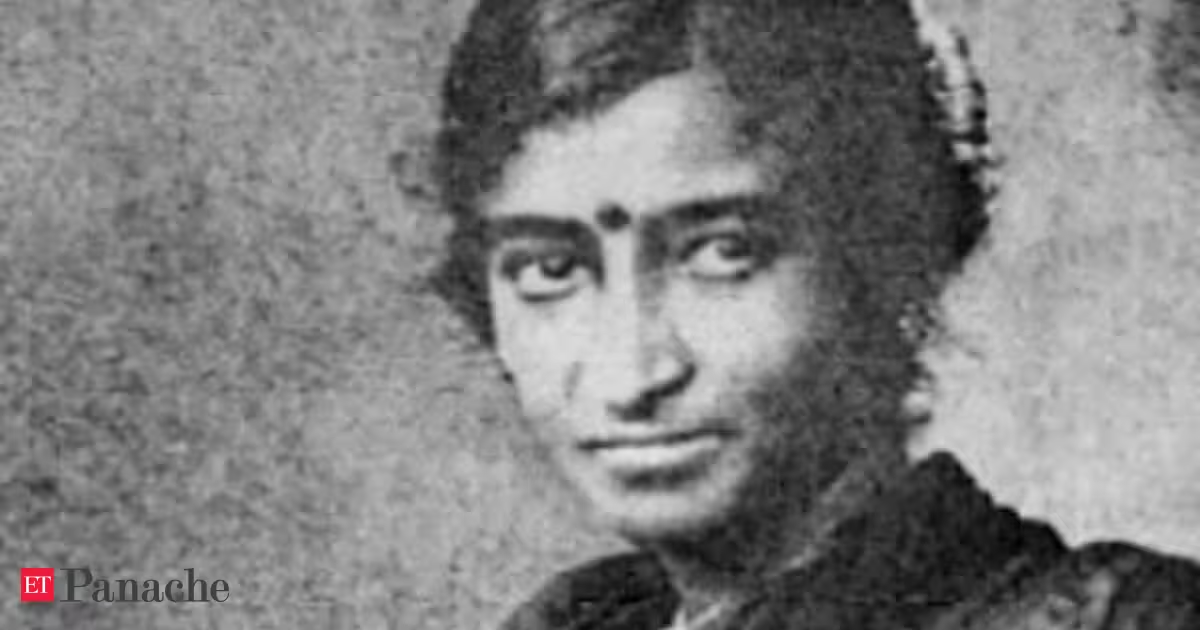
Long before Bollywood transformed into a star-driven industry, with formal auditions, talent agents, casting processes and box-office figures determining an actor’s standing, the very decision to step in front of the camera was fraught with challenges. For women in particular, entering cinema was not merely a career choice but a bold challenge to the social conventions of the time. The woman who broke this stereotype and bagged a role in a Dadasaheb Phalke film was Durgabai Kamat. Her journey is a story of resilience, freedom, and identity.How Durgabai Kamat entered theatreMuch of Durgabai Kamat’s personal life has been brought to the public by her daughter, Kamlabai Gokhale. In an interview filmed by Reena Mohan for her documentary Kamlabai (1992), Kamlabai called her mother a ‘gifted artiste’, as reported by The Indian Express. She was skilled in Kathak and in playing the veena, sitar and tabla.Kamlabai, however, revealed that her father was not a good man and used to physically assault her mother. No longer able to tolerate the violence, Durgabai left for Mumbai with her daughter and chose performing in the theatres as a means of survival. Durgabai was a part of the theatre company Chittakarshak Natak Company, owned by Raghunathrao Gokhale.How Durgabai Kamat featured in Dadasaheb Phalke’s filmAs per Kamlabai, Durgabai performed in a variety of prose plays, taking on roles in translations and adaptations of Shakespeare, including King Lear and Macbeth. She even played Othello’s wife and the nurse in Romeo and Juliet. Additionally, Durgabai also portrayed Sudeshna, the wife of King Virata, in Keechak Vadh. Around 1913, the theatre company arrived in Nashik, and Durgabai’s fate changed for the better.Legendary director and screenwriter Dadasaheb Phalke, an ardent music and theatre lover, approached Raghunathrao Gokhale, requesting Durgabai to act in his film. Previously, Dadasaheb used male actors, disguised as women, for his iconic first feature film Raja Harishchandra. But he wanted to change the trajectory by including women in his second film, Mohini Bhasmasur. Raghunathrao agreed.Soon after, Durgabai was cast as Parvati, while her daughter Kamlabai played Mohini in Mohini Bhasmasur. According to Kamlabai, they completed shooting the film in approximately 6 months, and in doing so, the mother and daughter changed Indian cinema forever. Kamlabai continued her mother’s legacy for 6 decades, followed by her grandson Chandrakant Gokhale and then the next generation: actors Vikram Gokhale and Mohan Gokhale
She escaped an abusive marriage and performed in theatres to survive in Mumbai. How India’s first film actress broke stereotypes and landed a role in a Dadasaheb Phalke movie
Durgabai Kamat, India's first female actor, shattered societal norms by pioneering her presence in early Indian cinema. With a strong foundation in prose performances and adaptations of Shakespeare, she captured the attention of Dadasaheb Phalke, who cast her as Parvati in his groundbreaking film, Mohini Bhasmasur. Her daughter, Kamlabai, took on the role of Mohini, creating a remarkable legacy as a mother-daughter pairing that would forever alter the landscape of Indian film.
392 words~2 min read