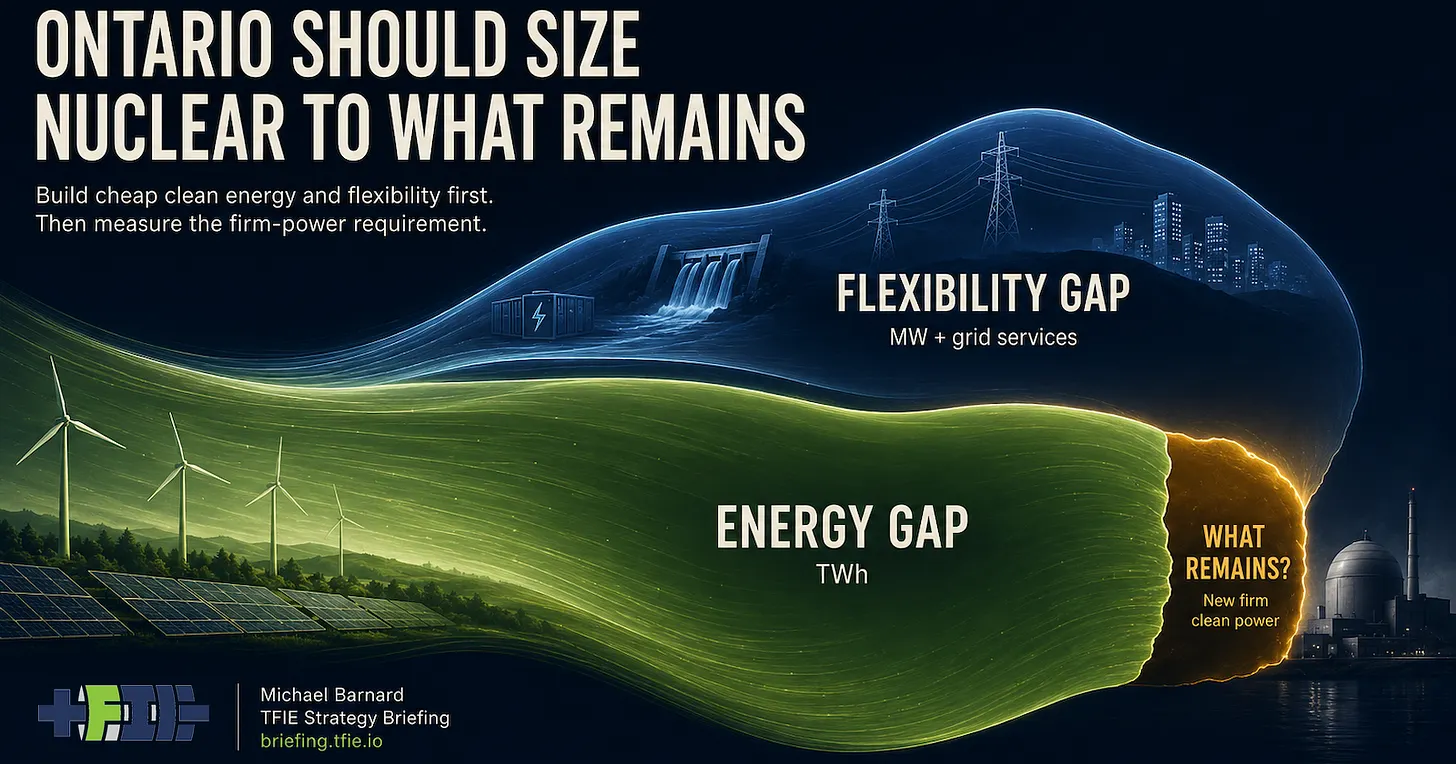
Ontario should build clean energy and flexibility first, then size new nuclear to the durable gap that remains.
Support CleanTechnica's work through a Substack subscription, on Patreon, or on Stripe. Help us produce all of the high-quality, original content we publish week after week despite the challenges of content-scraping AI, antisocial media, inflation, and other hurdles.
Ontario needs a lot more electricity. Demand hit 145.6 TWh in 2025, up 4.4% in a year, and IESO’s reference case gets to 250 TWh by 2050. But its own range runs from 207 to 297 TWh. That’s not a rounding error. It’s a completely different buildout depending on which end of the range Ontario actually lands near.
That’s why the most interesting part of IESO’s latest outlook isn’t the 2050 headline. It’s what happens first. After projects already under way are counted, Ontario is short more than 8 TWh of annual energy in 2032 and more than 12 TWh by 2035. The remaining incremental summer capacity gap doesn’t show up until 2035, and it starts at only about 950 MW. Ontario’s first problem is getting enough clean electricity over the year, not finding some enormous block of new peak capacity.
The problem is that “power” isn’t one thing. A wind farm makes a lot of electricity when the wind blows. A battery makes essentially no net annual electricity but can move it into more useful hours. Hydro can provide both energy and flexibility. Transmission can make electricity generated somewhere else useful in Ontario. Demand response can make a peak disappear without generating anything at all. And nuclear can produce enormous amounts of low-carbon electricity and dependable capacity for decades. Pretending they are all selling the same product is a good way to buy the wrong mix.