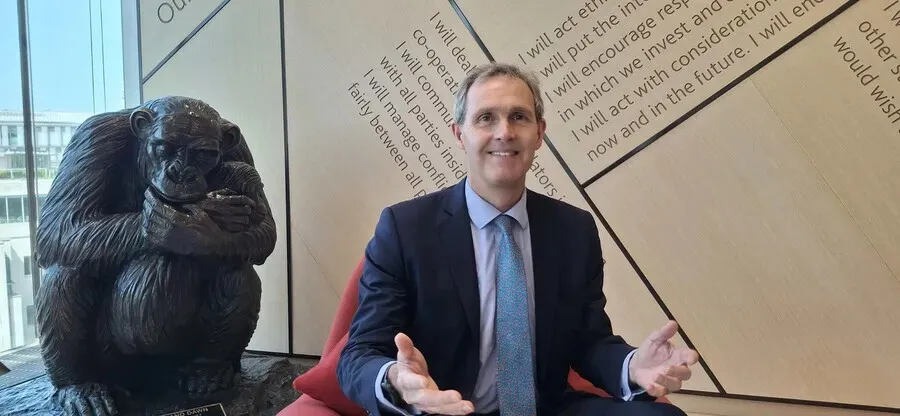
Bruce Duguid, the head of stewardship at EOS at Federated Hermes, speaks to the Hankyoreh at the organization’s offices in London on June 22, 2026. (Lee Bong-hyun/Hankyoreh)
A decade after its adoption, the Korea Stewardship Code will soon get its first revamp. The code calls on institutional investors to act as “stewards” of the companies they own, monitoring performance and pushing for change. Yet by most accounts, it has remained largely dormant for the past 10 years.But much remains to be debated about the revision to the code. For instance, should the National Pension Service (NPS) hand over voting rights along with the assets it entrusts to external asset managers? How should conflicts of interest be resolved at asset managers affiliated with chaebol or financial groups? And when individual institutions lack the clout to act alone, is there a way to speak with one voice? With these questions in mind, the Hankyoreh sat down with Bruce Duguid, the head of stewardship at EOS, at the organization’s London offices on June 22. EOS is the specialist stewardship arm of the global asset manager Federated Hermes. On behalf of asset owners — pension funds, insurers and foundations — it monitors companies, conducts dialogue with them, and implements voting. One might call it the original model for outsourcing shareholder rights. Within an organization of about 45 people total, a team of 30 professionals covers 450 to 500 companies a year. In 2025 alone, EOS engaged 859 companies on 3,849 issues and objectives, and implemented its clients’ voting at 13,516 shareholder meetings. The institutions it advises hold US$2.4 trillion in assets. After our interview, Duguid provided additional written answers on Korea-specific issues. Three takeaways stood out.First, culture over code. Asked to name the single most important change needed for Korean institutional investors, Duguid pointed not to rules but to people. “Regulatory reform and updated stewardship codes can provide the necessary framework, but it is the behavioral change among institutional investors, supported by leading domestic funds, that will determine whether stewardship becomes meaningful in practice,” he said. In short, however sophisticated the code, if institutional investors do not move of their own accord, it remains a norm on paper — an apt description of Korea, where the code has effectively sat dormant for a decade.Second, even companies with controlling shareholders, such as founding families, can be engaged — if you know how. Duguid said engagement with Korean conglomerates, where control is concentrated in founding families, “requires a fundamentally different approach.” Because boards and management in such structures tend to reflect the interests of the controlling shareholder, he advises focusing engagement on independent directors and framing the agenda in “terms that resonate with minority shareholders” — board effectiveness, valuation impact, cost-of-capital issues such as treasury share cancellation. Don’t just say “improve your governance”; speak in numbers and share prices. He also noted that Korean regulation limiting directors’ board seats has narrowed the pool of director candidates, and welcomed recent efforts by large Korean companies to recruit non-Korean directors despite language barriers.Third, if you’re struggling alone, band together, and if you lack the strength to band together, borrow it. Duguid believes a collective engagement model “would work in Korea.” Aggregating investor influence can overcome the structural limits of individual engagement, and Japan’s explicit encouragement of collaborative engagement in its latest stewardship updates offers a relevant precedent for Korea. Notably, he said that “participation from institutions such as NPS strengthens legitimacy and influence.”Our conversation with Duguid follows. Hankyoreh: Korea adopted its stewardship code in 2016, but it has never since been revised and has, in effect, become largely a dead letter. The government and political circles are now working to overhaul the code and encourage more active implementation by institutional investors. In your view, what is the single most important change needed for Korean institutional investors to engage effectively?Duguid: While reforms to the stewardship code are important, the single most critical change required for effective engagement in Korea is the development of a genuine culture of stewardship among domestic institutional investors. Regulatory reform and updated stewardship codes can provide the necessary framework, but it is the behavioral change among institutional investors, supported by leading domestic funds, that will determine whether stewardship becomes meaningful in practice.Hankyoreh: Korea has the distinctive governance issue of the “chaebol” structure, in which a founding family acts as controlling shareholder across multiple affiliated companies. Minority shareholder rights are often inadequately protected, and institutional investor engagement frequently fails to have much effect. What engagement strategy is appropriate for such companies?Duguid: Engagement with Korean conglomerates requires a fundamentally different approach from standard governance engagement, because control is highly concentrated in founding families, often through complex circular shareholding structures. In practice, boards and management teams tend to reflect the interests of the controlling shareholder rather than acting as independent stewards of all shareholders. As a result, we focus our engagement on the independent directors of the board and frame engagement in terms that resonate with minority shareholders — board effectiveness, valuation impact, cost of capital (treasury share cancellation), and minority shareholder perception.In addition to the distinctive chaebol ownership structure, another common governance issue in Korea stems from board composition. Since local regulation does not permit one director to serve on more than two boards, companies have a limited pool of board candidates. Historically, most companies have not been open to bringing in non-Korean nationals — for reasons such as language barriers and in-person board attendance — but we have seen some companies, especially large ones, starting to actively look for global talent and expand their pool beyond Korea despite these constraints.”Hankyoreh: Do you believe a collective, collaborative engagement model could work in Korea?Duguid: A collective engagement model would work in Korea, but it requires adaptation to a market dominated by controlling shareholders. By aggregating investor influence, collaborative engagement can enhance credibility and help overcome the structural limits of individual engagement. Recent developments in Asia support this approach: Japan has explicitly encouraged collaborative engagement models in its latest stewardship updates, recognising their effectiveness in addressing governance and market-wide issues. This is a relevant precedent for Korea, where similar structural challenges exist. In practice, collaboration is most effective when focused on specific, high-impact issues such as capital allocation, related-party transactions, or governance reforms and effectiveness. Importantly, it should involve both global and domestic investors, with participation from institutions such as NPS strengthening legitimacy and influence.Hankyoreh: Korea’s National Pension Service retains voting rights directly even when it entrusts assets to external managers. In the EOS structure, who ultimately holds the voting rights?Duguid: Our clients retain their shareholder rights and give us a mandate to implement their policies. Even where assets are entrusted to asset managers, this means the voting authority is transferred away from the asset manager to EOS. But the delegation concerns implementation only — the final decision always rests with the asset owner, our client.Hankyoreh: Why do asset owners outsource engagement to EOS rather than conducting it in-house?Duguid: EOS is the stewardship team for Federated Hermes, and at the same time a stewardship service provider to third-party clients. Most of those clients are asset owners — pension funds, insurers, foundations — rather than asset managers. Asset owners have a much longer time horizon, and they need to manage systemic risks that cannot be diversified away through active management alone. If asset owners built their own teams, resourcing constraints would allow them to cover only a small number of companies. Our team of 30 professionals covers about 450 to 500 companies each year — often around 50% of the value of a large asset owner’s portfolio — and we can maintain a good-quality relationship and dialogue with companies, meeting senior representatives. It is really more efficient for one team to represent many different asset owners. It’s a matter of efficiency and effectiveness.Hankyoreh: How does EOS handle situations where a client’s preferred voting position differs from its own recommendation?Duguid: We determine voting implementation reflecting our clients’ policies, but clients can change our recommendation at any time. It is an important principle of our service that clients own their decisions. Changes are more frequent on sensitive or contentious issues. Two clients may take different views on the same company, and we aim to respond flexibly to those varied needs.”Hankyoreh: How does EOS measure and report the outcomes of its engagement? What defines a successful engagement?Duguid: We always focus our engagement on objectives. There are four milestones on the journey to each objective. Milestone one is raising the concern with the company; two is the company acknowledging and understanding the challenge; three is the company indicating a commitment to change; and four is the company actually making the change. When an engagement is completed, we write a case study, and we also calculate the future effect of the change. A typical engagement takes about three years, though some conclude in one or two years and others run for six or seven. We also run a momentum indicator to track the pace of progress, and if it is too slow, we may decide to discontinue the engagement.”Hankyoreh: On what criteria does EOS select companies for engagement?Duguid: There are three main criteria. First, the size of our clients’ holdings — the scale of the financial interest. Second, the materiality of the issues at the company: what sector it is in, and how large the systemic challenges are. Third, feasibility — whether change can actually be achieved: whether shareholder rights are well protected, whether there is a controlling shareholder that makes dialogue difficult, or whether it is a state-owned enterprise. We combine these three factors and then use our patented Financial Connectivity platform to analyse the financial materiality of each issue at each company. AI is used in part, but judgments about each company’s specific context are made directly by our team.Hankyoreh: When engagement stalls, how does EOS escalate?Duguid: Our starting point is a good and constructive relationship with the company — we are really on the same side and want the same things. When progress stalls, we escalate in stages. First, we intensify meetings: increasing frequency and contacting board members directly, especially independent directors, rather than the IR team. Second, voting: signalling concern through votes against director re-election, for example. Third, shareholder resolutions — in practice, filed by our clients with our support. Fourth, and rarely, using the media to bring an issue into the open. If access is fundamentally impossible, the company may simply not be engageable; where feasibility is low, we deprioritise or discontinue the engagement.Hankyoreh: In the US, the backlash to ESG has intensified. In Korea, some argue that over-emphasising E and S can obscure the more urgent G issues. Is there a hierarchy among the three?Duguid: We see governance as a horizontal foundation underpinning everything else. Only with the right governance in place can a company properly handle long-term strategy and capital allocation, as well as the identification of environmental and social risks. New issues such as nature and biodiversity and responsible AI are rising, but governance remains central to managing all of them well.By Lee Bong-hyun, research fellow at the Hankyoreh Economy & Society Research Institute ESG CenterPlease direct questions or comments to [english@hani.co.kr]