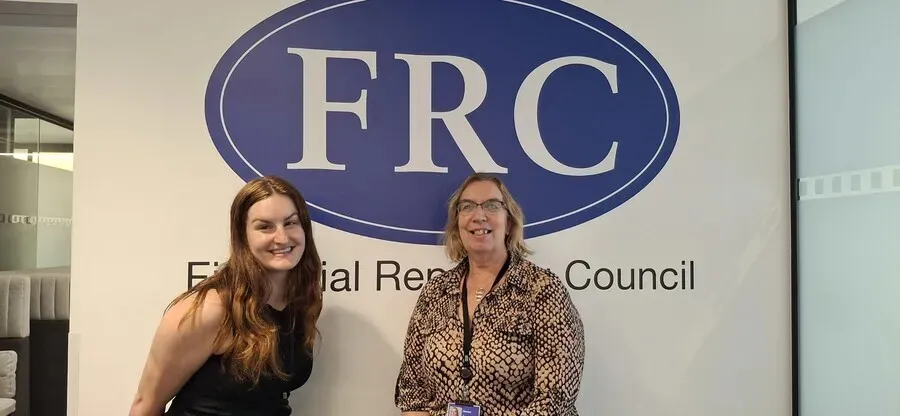
Bridget Fraser and Maureen Beresford of the Financial Reporting Council in the UK stand for a photo at their offices in London on June 22, 2026. (Lee Bong-hyun/Hankyoreh)
With the KOSPI recently surging to record highs, corporate governance reform has moved to the forefront of Korea’s capital market agenda. But changing the law does not necessarily change the market. Hard law must be accompanied by soft regulation — above all, a stewardship code, which asks institutional investors to act as faithful stewards of other people’s money by monitoring investee companies, engaging with them, and exercising shareholder rights responsibly. Korea established its own stewardship code in 2016 and is now working on its first revision in a decade. Several key questions are coming to the fore: Should signatory status be subject to periodic renewal? Who should oversee implementation? And how far should ESG (environmental, social and governance) requirements go?The United Kingdom, which pioneered the world’s first stewardship code in 2010 and helped spread the model globally, has spent the past 15 years grappling with precisely these questions.In order to learn more, the Hankyoreh caught up with Maureen Beresford, the director of corporate governance and stewardship at the Financial Reporting Council (FRC), the body that sets the UK Stewardship Code and oversees its implementation. The Hankyoreh first spoke to Beresford in April, when she was in Seoul for the International Corporate Governance Network conference (see box below). This follow-up conversation allowed us to explore issues that our previous interview was unable to address. She was joined by Bridget Fraser, a senior policy adviser for corporate governance and stewardship at the FRC, who answered questions on the areas of work she oversees.The FRC is an independent regulator that operates under a framework agreement with the UK government and is responsible for setting and overseeing accounting and audit standards as well as the corporate governance and stewardship codes. The UK Stewardship Code, first published in 2010, was revised in 2012 and 2019, and again in 2025; assessments under the new code begin this year.The interview underscored three key points.First, requiring one-time-only registration is a sure way to have people sign up and then forget about their obligations. Beresford suggests that if annual reassessment is too heavy a burden for the market, requiring updates every two or three years is a workable compromise. The real value of regular reporting is that it forces institutions to disclose up-to-date, relevant examples of what they actually did over the past year. It is a direct answer to the biggest open question in Korea’s revision debate — the renewal cycle, which has yet to be decided.Second, ESG is not the purpose of the code but a means to long-term value. In its 2025 revision, the UK redefined stewardship away from explicit “ESG outcomes” language towards “long-term sustainable value.” The aim was to stop the regulator from appearing to dictate particular types of investment, and instead give institutions the freedom to state their own objectives. Even after the wording changed, signatories’ ESG reporting did not diminish.Third, a code can work without sanctions, because the market supplies the discipline. The FRC relies on soft power; it neither publishes reasons for removal from the register nor imposes penalties. Instead, the revised code introduced a dedicated principle on how asset owners like pension funds select, appoint and monitor their external managers, with stewardship performance scrutinised from the tendering stage through to contract renewal. The prospect of losing mandates if one falls off the register acts, in effect, as the sanction.Our conversation is presented in full below. Hankyoreh: The FRC requires signatories to renew their status every year. Korea has not yet decided on a renewal cycle. Why does the UK insist on annual renewal?Beresford: If you only require registration once, people tend to sign up and then forget about it. If renewing every single year places too heavy a burden on the market, requiring updates at least every two or three years is a reasonable compromise that keeps the commitment alive.Fraser: The beauty of asking for regular reports is that it forces organizations to provide contemporary, relevant examples of their stewardship from the previous year. It proves that stewardship is a living story, not just words on paper. When the regulator assesses those reports, rather than reviewing every phrase mechanically, what builds real trust in the market is applying reasonable, qualitative judgement — asking whether the organization is implementing stewardship genuinely and substantively, given its size and maturity. Stewardship is not a reflexive act of voting; it is a long journey of creating value over time.Hankyoreh: In the latest revision of the code, the definition of stewardship moved away from language emphasising ESG “outcomes” towards “long-term sustainable value.” What was the reasoning?Beresford: After several years of operating the code, we consulted the market. Some feedback suggested the tone of the previous code was being read as implying that managers had to deliver a specific ESG outcome every single time, with every single investment — which felt like excessive pressure. In reality, while many investments do pursue environmental or social objectives, many do not. So we changed the wording and refined the underlying definitions, so that the regulator would not appear to be dictating particular types of investment, and institutional investors would have the freedom to make their own objectives clear. The underlying motivation was a pragmatic demand from the market for a concise, practical framework that keeps reporting focused on the issues that matter.Fraser: If you look at the actual reports, many still deal extensively with ESG issues. We do not prescribe a reporting format. Some organizations submit their sustainability or ESG reports written against the UK Stewardship Code. What matters is that the code is not a set of instructions telling signatories what they must do; it is a framework for showing how they implement stewardship across different asset classes, geographies and investment approaches.Hankyoreh: What was the market’s reaction after the wording changed?Beresford: Initially there were genuine concerns that ESG was being deprioritized. But once signatories read the full text of the code and the guidance underneath it, they understood that we still treat ESG factors as very important, and the concerns subsided. Signatories today continue to report actively on their specific ESG objectives and activities.Hankyoreh: In Korea, there is a worry that an excessive focus on the environment (E) and social issues (S) could obscure the urgent task of governance (G) reform — that some companies may showcase strong E and S credentials precisely to mask poor governance.Beresford: That is a very interesting point. We are also responsible for the UK Corporate Governance Code, and when we analyse disclosures, we do sometimes find a gap: a company’s narrative reporting expresses tremendous passion for the environment, yet its financial statements show no money actually going there. The Financial Conduct Authority (FCA) monitors disclosures very strictly to close that gap and to detect greenwashing.Hankyoreh: In Korea, opinion is divided over whether the power to review stewardship implementation should sit with a public body such as the Financial Services Commission, or be entrusted to a private organization. Which is better?Beresford: We use soft power. We read every stewardship code application. If an organization does not meet the standard, they are removed from our signatory list, but we do not publish reasons for removal, and we impose no sanctions. It is a voluntary code, and the pressure is generated by the market. Because many asset owners require their managers to be code signatories, the system works without any formal enforcement powers.Hankyoreh: Has it become standard practice for UK pension funds to reflect a manager’s stewardship performance when selecting managers or renewing mandates?Fraser: In the revised code, we introduced a dedicated principle on how asset owners, such as pension funds, select, appoint and monitor their external asset managers. As a result, a culture has spread widely in which pension funds scrutinize managers’ stewardship performance from the request-for-proposal stage right through to contract renewal. Being a signatory now functions as a badge of reporting transparency. Beyond that, the reporting format for pension funds asks for real, contemporary case studies of how their managers implemented stewardship over the previous year — turning stewardship from a paper pledge into a substantive factor that shapes actual business contracts.Hankyoreh: When assessing proxy advisers as code signatories, do you apply different criteria from those used for asset managers?Fraser: There is a difference. The UK Stewardship Code contains two tracks within a single code: one set of principles for asset owners and asset managers, and a separate set for service providers. Proxy advisers report under the service-provider track. In the recent revision, we substantially streamlined and tailored those principles to the nature of service providers’ work. For proxy advisers in particular, we apply dedicated principles focused on how they assure the quality of the research and recommendations they provide, and how they secure the accuracy of their information — for example, how they make corrections when a company points out an error.Hankyoreh: In Korea, there is frustration that global proxy advisers, covering Korean companies through overseas offices in Tokyo and elsewhere, issue mechanical, box-ticking “against” recommendations without understanding the particularities of Korean governance or the government’s reform efforts. Does the UK see the same tension?Beresford: The UK has a very similar conflict. Companies are sometimes unhappy with the recommendations proxy advisers provide to investors, and they ask for time to respond before general meetings. The FRC’s official recommendation in such cases is for companies and investors to communicate directly, without going through intermediaries. Realistically, though, given the sheer number of investors and companies, the market cannot avoid relying on advisers.Hankyoreh: Do you apply different assessment criteria to smaller or less-resourced institutions?Beresford: Formally, the criteria are the same for everyone. But because we read every application ourselves, we exercise judgment proportionate to the organization’s size and maturity. We do not expect a small manager founded five years ago to perform at the level of BlackRock. There is no formal tiering — it is all internal judgment against our overriding criteria.Fraser: One thing we are proud of is that signatories now come not only from listed equities but from other asset classes, such as fixed-income managers. A bond manager has no voting rights — so how does it exercise its rights and responsibilities? It is enough to explain other mechanisms, such as dialogue before an issuance. We look at the organization as a whole, holistically. Hankyoreh: Is the FRC a government body?Beresford: We are an arm’s-length body, maintaining an independent relationship with the government. We report to the Department for Business, but we operate independently, and we are funded by fees paid by the organizations we regulate.Hankyoreh: What advice would you give Korea’s financial authorities and stakeholders as they revise the stewardship code?Beresford: Listen very carefully to what asset managers and asset owners are saying during the consultation process. And take a balanced, proportionate view before making final decisions. Stewardship is not instantaneous — an engagement case that spans 10 years is what truly means something. I would sum it up in three words: examples, listen, proportionate.Our first interview with BeresfordThe Hankyoreh first spoke to Beresford on April 13 in Seoul, ahead of her attendance at the ICGN Seoul Conference at the Korea Exchange the following day. At the heart of that conversation was a fundamental question: how does the UK Stewardship Code remain effective and relevant year after year?UK signatories submit implementation reports and have their status reassessed annually. The assessment is not a checklist but a qualitative evaluation demanding concrete examples and outcomes, encouraging institutions to report around their own objectives and their own narrative. A team of around 15 reviews some 300 applications a year, with each report double-checked principle by principle, and feedback given not only to those removed but to those who pass. The list of unsuccessful applicants is never published — but falling off the register can cost a manager its mandates from pension funds, so the market itself performs the role of sanction. The 2025 revision repositioned ESG as a means to long-term value creation rather than the code’s purpose, and emphasised a proportionate implementation framework calibrated to each organisation’s size and role.By Lee Bong-hyun, research fellow at the Hankyoreh Economy & Society Research Institute ESG CenterPlease direct questions or comments to [english@hani.co.kr]