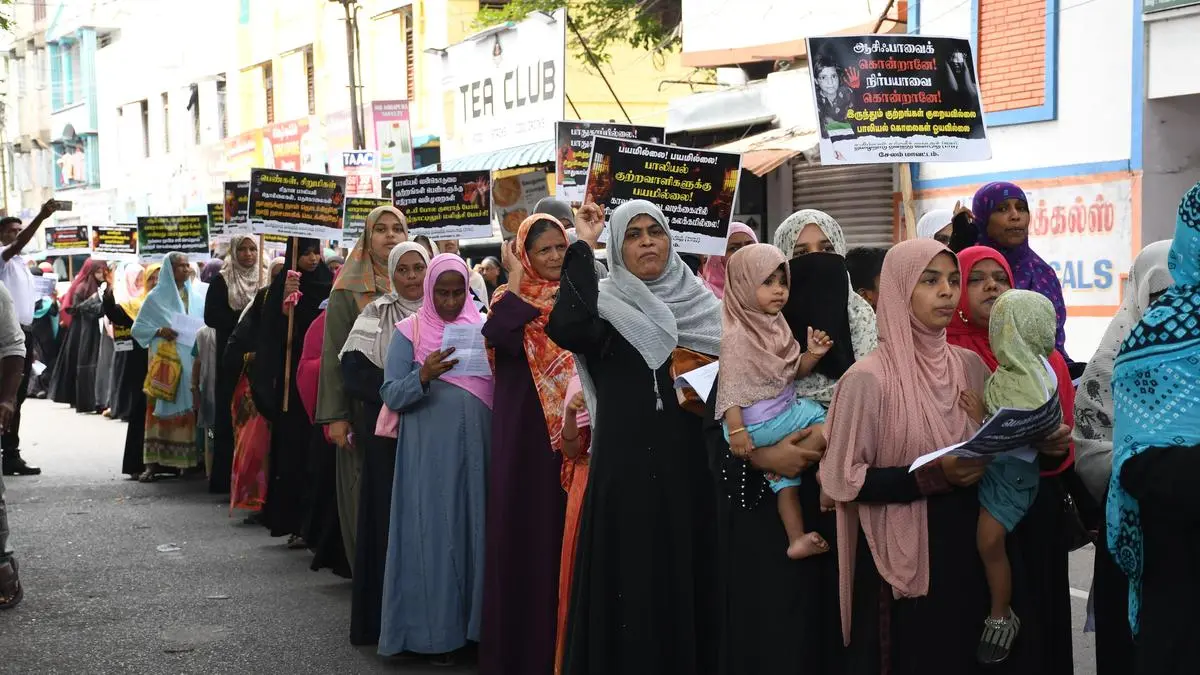
In a country divided by caste, region, language and sect as much as by religion, the assurance of citizenship should not depend on who happens to be the majority
| Photo Credit:
S Guru prasath
On August 16, 1946, India woke to the Great Calcutta Killings. Four days of communal slaughter followed the Muslim League’s call for “Direct Action” in support of Pakistan, a dark preview of what Partition would bring — hundreds of thousands dead, fifteen million uprooted.Independent India could have taken that carnage as proof that Hindus and Muslims could never share a nation. Instead, it chose a remarkably different path. At considerable political cost, its leaders reassured the Muslims who stayed that they were full and equal citizens of the new India, and in 1952 the electorate strongly validated that constitutional settlement at the ballot box. No country of India’s scale, with its dozens of languages, innumerable communities and every major world faith, had attempted anything quite like it. Young India was betting that its extraordinary diversity could be held together without requiring people to give up the identities into which they had been born.Selective retellingThat choice is now under strain. A selective retelling of history casts Muslims as lingering representatives of a foreign rule, alongside a persistent, unspoken expectation that they prove loyalty to a country already theirs. Vigilante violence around cattle protection has repeatedly targeted Muslims on suspicion. Minority presence in national governance has thinned, and Jammu and Kashmir’s restructuring was read by many as confirming that a Muslim-majority region could not be trusted with the autonomy it had enjoyed for decades.These developments represent a drift from the understanding of citizenship India began with. A government with a secure mandate and nearly three years left in its term now has the room to correct it. Restoring minority confidence would be an achievement more enduring than most legislative or infrastructure initiatives, since it goes to the nature of the state itself. Strip away secularism and India loses much of what holds it together. No single language, religion or ethnicity ties a Kashmiri to a Keralite, a Tamil to a Punjabi or a Naga to a Gujarati.In a country divided by caste, region, language and sect as much as by religion, the assurance of citizenship should not depend on who happens to be the majority. Indian secularism was never merely about protecting minorities; it was also about protecting the majority from the consequences of turning majority status into ownership of the state.Reaffirming this understanding also requires some care in how India speaks about Pakistan. There is no reason for the state to go soft on Pakistan. However, national security demands India distinguish clearly between a hostile foreign government and its own citizens. Ordinary Pakistanis cannot be treated as synonymous with their government’s policies. When that distinction fades from public discourse, it begins to suggest that India’s Muslims, sharing a faith with people across the border, somehow belong on the other side of the divide. They should not have to carry the burden of a conflict between states. Partition is settled history and need not remain a wound repeatedly reopened for domestic political ends.There is also a simple historical answer to the suggestion that minorities cannot be trusted with the defence or advancement of the nation. When Field Marshal Sam Manekshaw led India’s armed forces to victory in 1971, the achievement belonged to the country, not to the small Parsi community to which he belonged.Public serviceThe same holds across Indian public life. Abdul Kalam became one of the most admired Indians of his generation. Muslims have represented India with distinction in public service, science, sport and the arts, and fellow citizens have generally celebrated those achievements without asking which community they came from. That instinct exists but badly needs to show up more consistently.This matters to India’s place in the region too. Any eventual accommodation with Pakistan will be easier if India can demonstrate, without qualification, that its Muslim citizens are secure and equal. Pakistan will use failures within India to reinforce its own narrative. The best answer to that is not rhetoric but the evident reality of Indian Muslims living, working and succeeding as Indians.The necessary course correction is not complicated: more minority representation in public institutions, swift and impartial action against vigilante violence, the law applied without regard to victim or accused, and an end to symbolic provocations that offer fleeting political gain while doing lasting damage to national cohesion. None of this requires the government to apologise for holding a political mandate. It requires something more useful — confidence in the country it governs. The secular promise made in the aftermath of Partition remains unfinished. The present government has something few of its predecessors had: political security and considerable time before it must face the electorate again, presenting it with an unusual opportunity to settle this question in the country’s interest rather than the next election’s. It should use it.But this is not a responsibility that can be left to government alone. Countries rarely fracture because a majority wakes up one morning and decides that it wants them to. More often the damage comes gradually, as citizens grow accustomed to principles being chipped away and decide objecting is inconvenient. The India that took shape in 1947 rested on the idea that its people could belong to different faiths and communities while remaining Indian. Seventy-nine years on, that is what needs to be reaffirmed.The writer explores the intersections of state, society, and history as a columnist and has taught at IISc and other institutionsPublished on August 14, 2026