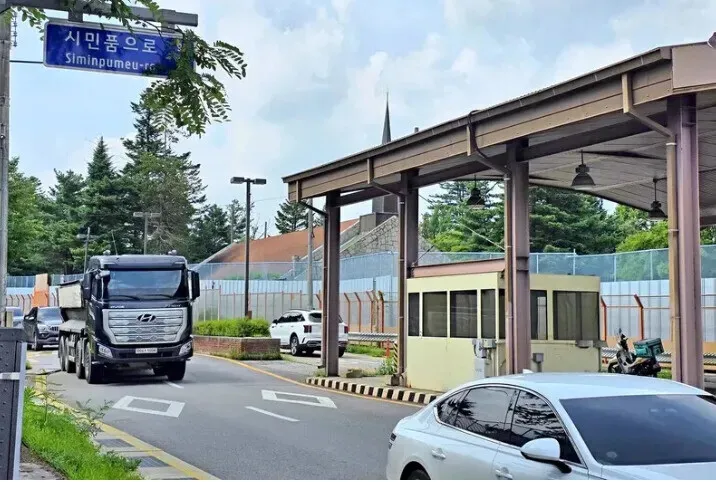
Lee Byung-jong Imagine the vast Central Park in New York or Hyde Park in London being occupied by foreign troops. It would be a tremendous humiliation for New Yorkers or Londoners, as well as for Americans or Britons more generally. Unfortunately, such an unthinkable and unpleasant situation has actually been taking place in Seoul. Much of the military base in Yongsan, located at the heart of the city, is still occupied by the US military, despite a decades-old agreement to return it to South Korea. Of the approximately 2.4 million square meters of land promised to Seoul, only about 30 percent has been returned so far, following a series of delays caused mainly by disagreements over how to clean up the polluted site.The remaining area, which is larger than 200 soccer fields, was originally supposed to be handed over as early as next year. However, given the deadlocked talks between Seoul and Washington, several more years are likely to be needed. The main stumbling block is soil pollution at the base. After more than 80 years of military use, the site reportedly contains dioxin and other toxic heavy metals that have contaminated the soil and groundwater. The key issue is who should bear the high costs of cleaning it up. The Korean side, particularly vocal civic groups, demands that the US shoulder the bulk of the expense, while Washington argues that the contamination is not serious enough to warrant such action under the Status of Forces Agreement, which governs various matters concerning the 28,000 US troops stationed in Korea.The issue has persisted for years, but it flared up again early this month when President Lee Jae Myung openly criticized the US military for delaying the return of its bases across South Korea. President Lee was not referring specifically to the Yongsan base. Rather, he was talking about dozens of bases north of Seoul that have been relocated to a gigantic new US base in Pyeongtaek, south of the capital. Camp Humphreys, the largest overseas US military base, was built by the Korean government, which paid more than 90 percent of its total cost of $10 billion. Most US troops stationed in Yongsan and other northern bases have been relocated southward to Camp Humphreys, but many of those bases have not yet been fully vacated because of soil pollution and other issues. "Logically, it simply doesn't make sense," President Lee lamented, arguing that the US was making "excuses" to delay the return.To be sure, the Korean side is also partly responsible for the delay, particularly in the case of the Yongsan base. Some believe that the government has been rather lukewarm in pressing for a solution amid fervent opposition from vocal environmental and other civic groups. These groups demand that the US military completely clean up the site before returning it, while the US side has refused to do so. As the two sides remain far apart on the issue, the Korean government is caught between them, unable to make much progress. Amid the stalemate, the US has neither the motive nor the incentive to accelerate the return. It continues to occupy the Yongsan base, even though no significant military presence remains there.In the meantime, this prime piece of land in a crowded city of 10 million people remains idle. As Seoul's housing shortage worsens and real estate prices soar, the government is scrambling to find more space for residential and other purposes. The Yongsan base is scheduled to become a grand park, much like New York's Central Park, once it is fully returned. But amid the acute housing crisis, some have suggested that part of the site should be used to build apartments.Whether the base eventually becomes a park or a residential area, most Seoulites simply want it returned more quickly. For many of them, the site is a source of national indignation and humiliation. For hundreds of years, it was occupied by a succession of foreign troops, symbolizing the nation's painful and humiliating history. Mongolian, Chinese and Japanese militaries deployed troops there after invading Korea. The Japanese, in particular, used it as their military headquarters in Korea during their 35 years of colonial rule. After Japan withdrew in 1945 at the end of the Second World War, the US military took over the site.The Yongsan base has been a scar for Koreans not only psychologically but also physically. Because it is located at the very center of Seoul, it has seriously constrained the city's natural development. It has served as a practical divider between the northern and southern parts of Seoul, disconnecting the two areas and contributing to the city's unnatural growth. Traffic has had to be rerouted because roads cannot pass through the base.Once the site is completely returned, however, it could become a new landmark in Seoul. Namsan lies to its north, while the Han River flows to its south. The area could naturally connect the two parts of the city, transforming it into a vast ecological treasure and providing residents with a much-needed breathing space. After centuries of humiliating history, the site could finally become a source of pride for Seoul as well as for Korea.- - -Lee Byung-jongLee Byung-jong is a former Seoul correspondent for Newsweek, The Associated Press and Bloomberg News. He is a professor at the School of Global Service at Sookmyung Women’s University in Seoul. The views expressed here are the writer’s own. — Ed.
[Lee Byung-jong] Return Yongsan base to Korea
Imagine the vast Central Park in New York or Hyde Park in London being occupied by foreign troops. It would be a tremendous humiliation for New Yorkers or Londo
904 words~4 min read