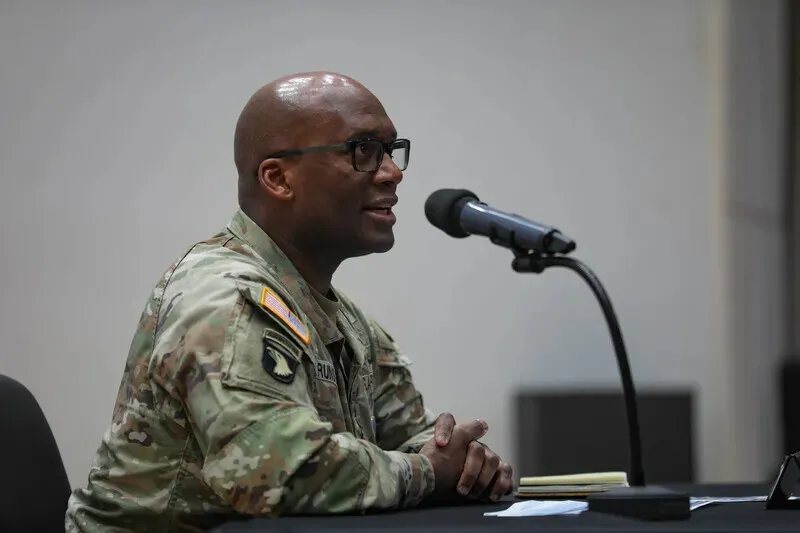
Gen. Xavier Brunson, the commander of US Forces Korea, speaks to reporters during a press conference at Camp Humphreys in Pyeongtaek on Aug. 8, 2025. (courtesy of USFK)
By Jung E-gil, senior international affairs writerThe superiority of US military power lies in the transoceanic projection of force. That’s the unique capability that gives pause to potential rivals like China and Russia. Indeed, it’s the linchpin of American hegemony.That military power is grounded in over 750 US military bases and facilities in some 80 countries around the world, as well as the US’ blue-water navy, including its supercarriers with their precision-guided weaponry.Notably, the US’ constellation of global military bases and access to those bases is essential for the operations of a blue-water navy. Without the presence of friendly harbors in the vicinity, US aircraft carriers cannot be resupplied and consequently cannot take part in operations.After World War II, most countries permitted the US to make use of their bases and territory when a war broke out in the area. Those countries could count on being compensated in the form of American aid and didn’t have to worry about retaliation by whoever the adversary was. Such retaliation was inconceivable given the US military’s insurmountable technological lead.During the Gulf War in 1991, the US stationed advanced fighters at Incirlik Air Base in Turkey, on the border with Iraq, which served to neutralize the Iraqi threat. When the US invaded Afghanistan after the 9/11 terror attacks, troops arrived from bases in nearby Uzbekistan and Tajikistan.But since the Iraq War of 2003, the US has faced logistical roadblocks. American policymakers were shocked when Turkey rejected a US plan to open a northern front in Iraq through Turkish territory. Then during the war in Afghanistan in 2011, Pakistan cut off a supply line running from Karachi into Afghanistan.The US war against Iran today represents an inflection point in its access to its network of overseas bases. The US has bases and facilities at 19 or more sites across the Middle East, eight of those being permanent bases in Bahrain, Kuwait, Qatar, Saudi Arabia and the United Arab Emirates.American bases in six countries (those five plus Jordan) have been rendered basically inoperable by Iranian attacks, and those countries have sustained major damage because of additional attacks on civilian facilities. Within two weeks of the onset of hostilities, these US military facilities were basically closed, with US troops forced to relocate to hotels or offices.In effect, US military bases turned out to be not a security guarantee, but a security liability for countries in the Middle East.Since hostilities began, NATO allies have been blocking the US from using their territory or bases. Spain, for example, has blocked access to Naval Station Rota and Morón Air Base, which it jointly operates with the US, while France and Italy have taken similar measures.There has even been friction with the UK, regarded as the US’ closest ally, over use of the Diego Garcia base.Turkey has only allowed the US to operate the anti-aircraft network that defends its own territory.A barrage of Iranian drones and ballistic missiles has broken through American air defenses, exhausting 30%-80% of the US’ entire stockpile of high-priced precision munitions, while Middle Eastern hosts of American bases face the brunt of the damage.In short, Iran has demonstrated its anti-access/area denial (A2/AD) capability, preventing American forces from being deployed across the ocean.Now all eyes are focused on East Asia.If a conflict were to break out between the US and China over Taiwan, the US would need to use bases and territory in Japan, Korea, the Philippines and Australia.Since China’s military is at a near-peer level with the US, one shrinks from contemplating the devastation that China’s A2/AD assets could wreak on regional countries that host US military bases. But US officials continue to publicly describe Korea and the US bases located there as assets in an attack against China.Gen. Xavier T. Brunson, commander of US Forces Korea, recently said that China views Korea as a “dagger in the heart of Asia.” That’s the same official who compared Korea to a “fixed aircraft carrier floating in the water between Japan and mainland China” during the LANPAC Symposium in May 2025.Last November, Brunson suggested turning the map of East Asia on its side so that east faces up. From that angle, he said, the Korean Peninsula and other US assets should be viewed not as “vulnerable forward positions” but as “advantageously positioned assets already inside the defensive perimeter.” He also argued that “Korea provides strategic depth” within “a strategic triangle connecting Korea, Japan and the Philippines.”In a defense forum held in Honolulu on Jan. 3, Brunson underlined that US Forces Korea are the only US forces stationed on the Asian continent inside the first island chain.This past April, Brunson told the US House Armed Services Committee that “the Korean Peninsula is key strategic terrain vital to defending the American homeland and advancing American interests in the region.” He also said that the US forces based on the Korean Peninsula could strengthen deterrence across the Indo-Pacific region even after Korea recovers wartime operational control (OPCON) of its forces.Following the war against Iran, the US can no longer take for granted its military bases in other countries or access to those bases.Furthermore, those bases are no longer necessarily a security asset. While Koreans’ attention is directed elsewhere, those bases could become a threat to our security.If countries in the Middle East had withheld access to their bases from the US, would the US have gone ahead with the war against Iran that ended up being so destructive?That’s something Koreans should consider. It’s also all the more reason Korea should recover OPCON as quickly as possible.Please direct questions or comments to [english@hani.co.kr]