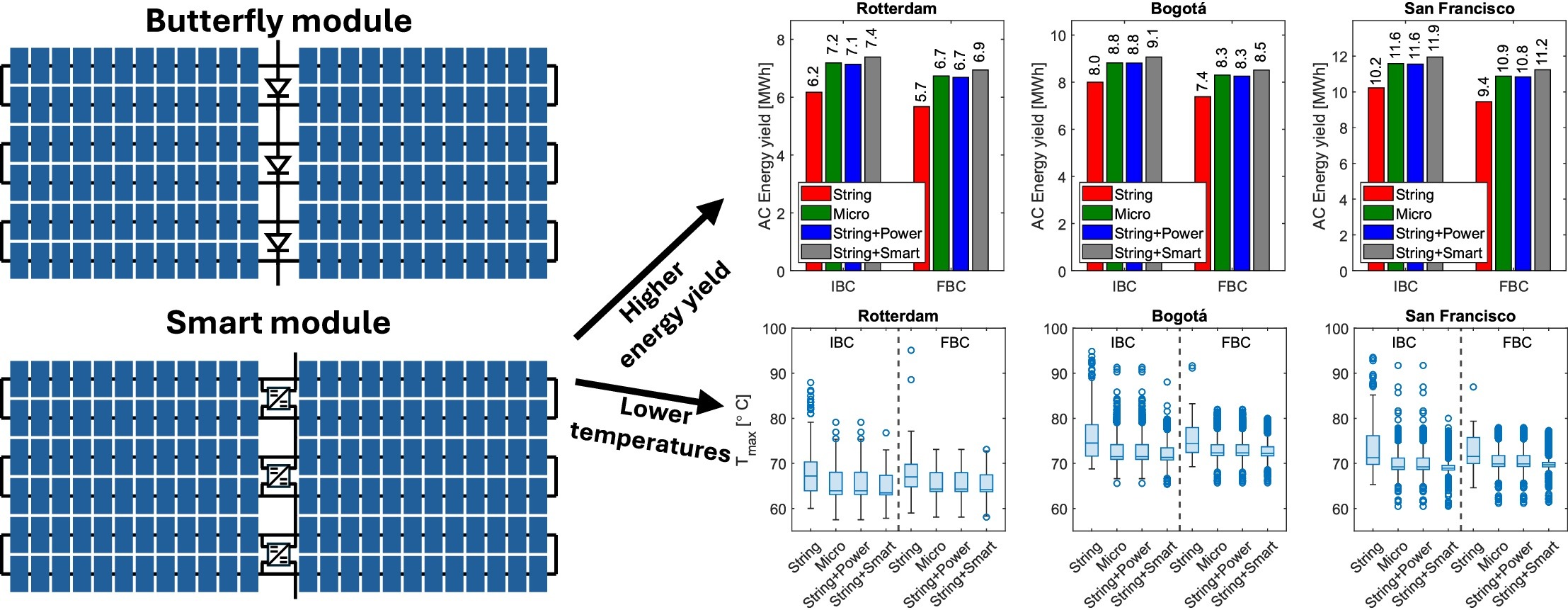
TU Delft researchers found that smart PV modules with integrated buck converters can significantly improve energy yields under partial shading by allowing individual substrings to operate independently. The systems delivered 15%-20% more energy than string-inverter systems and 2%-3% more than systems using microinverters or power optimizers, while potentially supporting up to 50% higher module costs at the same LCOE.
A research team from Delft University of Technology (TU Delft) in the Netherlands has investigated the potential of smart PV modules in urban environments. As simulated in the study, smart PV modules feature built-in buck converters that allow substrings within a module to operate independently, improving energy yield under shaded conditions.
“Although this concept has already been introduced in other studies, the novelty of our work is that we calculate the energy yield of systems with these smart modules under realistic conditions and compare them with conventional systems,” corresponding author Youri Blom told pv magazine. “The results show that the smart modules have the highest performance across all considered system topologies.”
Blom said his group plans to further investigate how power electronics can improve the performance of solar panels.