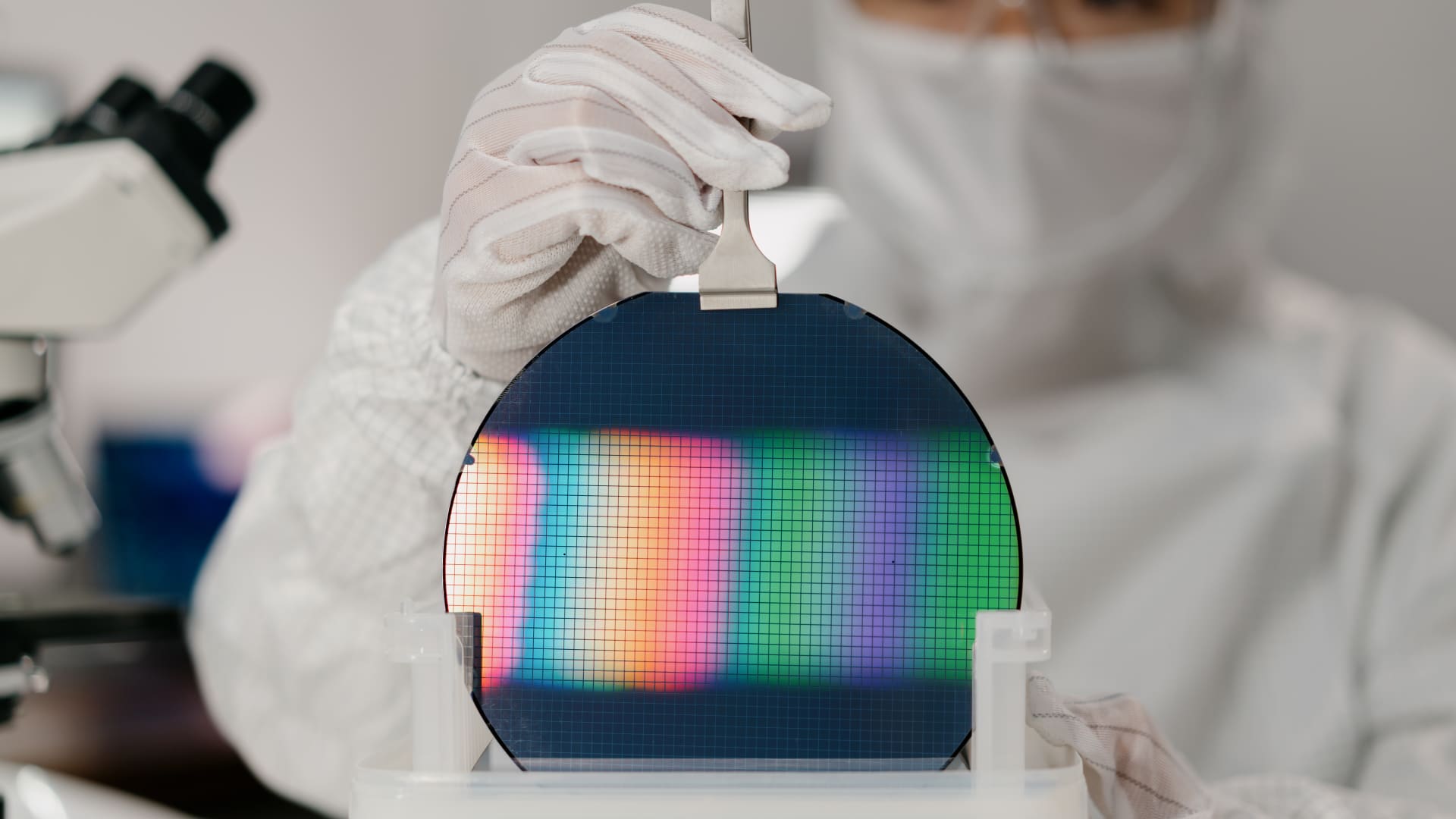
China’s semiconductor industry, once considered an underachiever in the global market, has advanced by leaps and bounds at an almost scary pace. Rather than slowing it down, US sanctions and checks on China have hastened the country’s technological self-reliance, yielding tangible advances in artificial intelligence chips and memory semiconductors. An unsettling shift is underway in the market, with Apple, a major semiconductor buyer, moving to adopt Chinese-made chips and other global PC makers, including HP, Asus and Acer, following suit. Significant changes are already being observed in China, which used to be the world’s largest net importer of semiconductors. Trade statistics recently released by the General Administration of Customs of the People’s Republic of China show that its exports of integrated circuits reached US$216.02 billion in the first seven months of 2026, surging 99.5% year-on-year. Export volumes during this period also rose 6.2% year-on-year. Semiconductor exports stood at 8.6% of China’s total export value from January through July, increasing 3.5 percentage points from 2025. Chinese companies that have cultivated their production skills domestically are expanding their influence by targeting niche markets centered on general-purpose products as the chip shortage driven by AI intensifies. As export profits surge due to soaring memory prices, China is also securing the financial resources needed to reinvest in achieving semiconductor self-sufficiency. Even when considering that China’s semiconductor exports include shipments from Samsung Electronics and SK Hynix’s Chinese factories, it is evident that the country has made significant progress toward its goal of creating a self-sustaining chip ecosystem. Even in the memory sector, where Korean companies reign supreme, the production capabilities of Chinese companies are swiftly advancing and expanding. An analysis by Omdia indicates that CXMT, China’s biggest memory company, saw a 47.5% increase in its monthly DRAM wafer production capacity, soaring from 200,000 in the first quarter of 2025 to 295,000 in the first quarter of 2026. Annual production capacity is also projected to expand from 3 million wafers in 2025 to 3.6 million wafers in 2026. China’s advances in semiconductor processing technology are also accelerating rapidly. The share of CXMT’s older 20-nanometer-class (2z㎚) process is expected to plummet from 38% in 2025 to around 2% in 2027. A nanometer is a unit of measurement for the width of circuits etched onto semiconductors, with 1 nanometer equaling one-billionth of a meter. The smaller the number, the more sophisticated the processing, resulting in improved performance and power efficiency. While reducing the share of older and general-purpose processes, CXMT aims to increase the share of its first-generation 10-nanometer-class (1x㎚) process from 62% to 93%. Mass production of its second-generation 10-nanometer-class (1y㎚) process is also expected to begin in part starting this year.YMTC, a Chinese semiconductor manufacturer specializing in NAND flash memory, is also hot on the tail of the industry frontrunners. The company’s yearly wafer production in 2025 was 1.77 million units, which rose to 2.01 million units this year, and is projected to increase to 2.5 million units in 2027. It is expected to effectively scrap its 128-layer NAND flash, which was its main product, by 2027 to focus on producing NAND flash with more than 200 layers, such as 232-layer and 270-layer NAND. Here, “layers” refers to the number of vertically stacked memory cell layers; generally, the more stacked layers, the more data can be stored in the same chip area. Of course, there is still a considerable gap between Chinese companies and their Korean rivals. Samsung Electronics and SK Hynix have already provided key customers with seventh-generation HBM4E samples, which use a sixth-generation 10-nanometer-class 1c DRAM process. When it comes to NAND flash, SK Hynix expects to expand production of 321-layer NAND products to 50% of its domestic production capacity. However, what stands out is how quickly Chinese companies are closing the gap with their Korean counterparts, supported by a strengthening domestic industry ecosystem that is helping drive their progress. Not only is China showing remarkable growth in finished chip products, but also in the supply chain in general, including materials, parts and equipment. This growth is evinced by China’s accelerated efforts to independently develop immersion-type deep ultraviolet (DUV) lithography equipment to counter recent US export controls. In a recent interview with The Economist, SpaceX CEO Elon Musk warned that China is “closer than most people realize to solving the lithography problem,” which is key to the production of ultra-fine semiconductors. This growth trend also goes hand in hand with the overarching support from the Chinese government. The Chinese central government has, since 2014, provided large funds to the semiconductor industry through the China Integrated Circuit Industry Investment Fund, also known as the Big Fund. Including its third phase, which was set up in 2024, the fund has raised about 680 billion yuan. The government is also eagerly providing tax incentives, granting corporate income tax exemptions for up to 10 years to production facilities based on semiconductor processes of 28 nanometers or smaller. The government is simultaneously strengthening the self-sufficiency of the industry in general with additional deductions for research and development expenses, policies to foster domestically produced equipment and materials, and human resources support. According to analyses of UN Comtrade data by the Korea Institute for International Economic Policy, a government-funded research institute, China had the highest world export market share for components and semiconductor-related items by export amount. While it had a mere 4.0% share in 2000, by 2022, it had soared to 18.4%, surpassing the shares of the US (9.4%), Japan (5.8%), and Korea (3.9%). While American and Japanese companies possess advanced technological skills and market dominance in core materials and high-value-added components for high-tech manufacturing processes, China is rapidly gaining market shares in general-purpose materials and components. “In the past, growth in China’s semiconductor imports tended to go hand in hand with increased exports of Korean intermediate goods to China, but now, this link has weakened significantly as China has established a domestic production ecosystem. Now, as the biggest semiconductor demand market, China has an industrial ecosystem that allows for domestic manufacturing and exports,” said Jeong Hyung-gon, a senior research fellow with the Korea Institute for International Economic Policy. China’s push for semiconductor independence is doing more than building a domestic supply chain for a high-tech industry. It is also reinforcing the country’s advances in AI, a technology expected to play a central role in future competition for technological dominance. The country’s tech giant Huawei is leading the way for China to become independent in the semiconductor field with its Ascend AI chip by reducing its reliance on America’s Nvidia. DeepSeek, Moonshot AI and other Chinese AI companies are continuously launching AI models that maximize the use of limited semiconductor resources by focusing on cost-effectiveness and efficiency. “China has consistently invested in its goal of becoming independent in the semiconductor sector, and the development of immersion extreme ultraviolet lithography equipment is a result of those efforts,” said Kim Yang-peng, a researcher at the Korea Institute for Industrial Economics and Trade.“China is already producing general-purpose DRAM, and has reached 300 layers with its NAND flash technology. Given that the gap in technology is not significant, the landscape of the general-purpose memory market could change rapidly if China gains price competitiveness and other advantages,” the analyst said. By Bae Ji-hyun, staff reporter; Park Jong-o, staff reporter
From isolation to independence: How China took its chip sector to the next level
Chinese firms are quickly catching up with industry leaders, giving the country a leg up in the AI race as well
1,214 words~6 min read