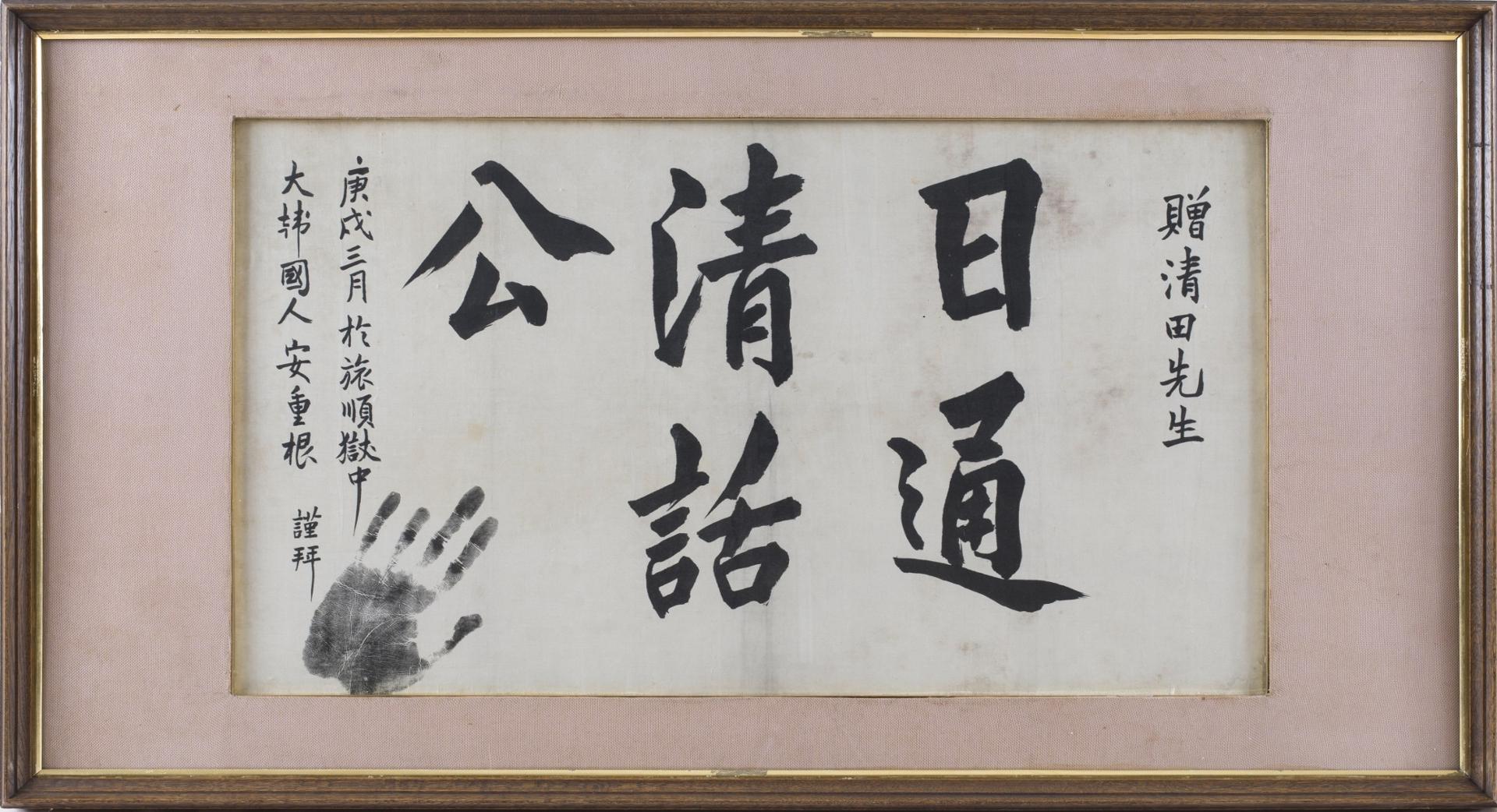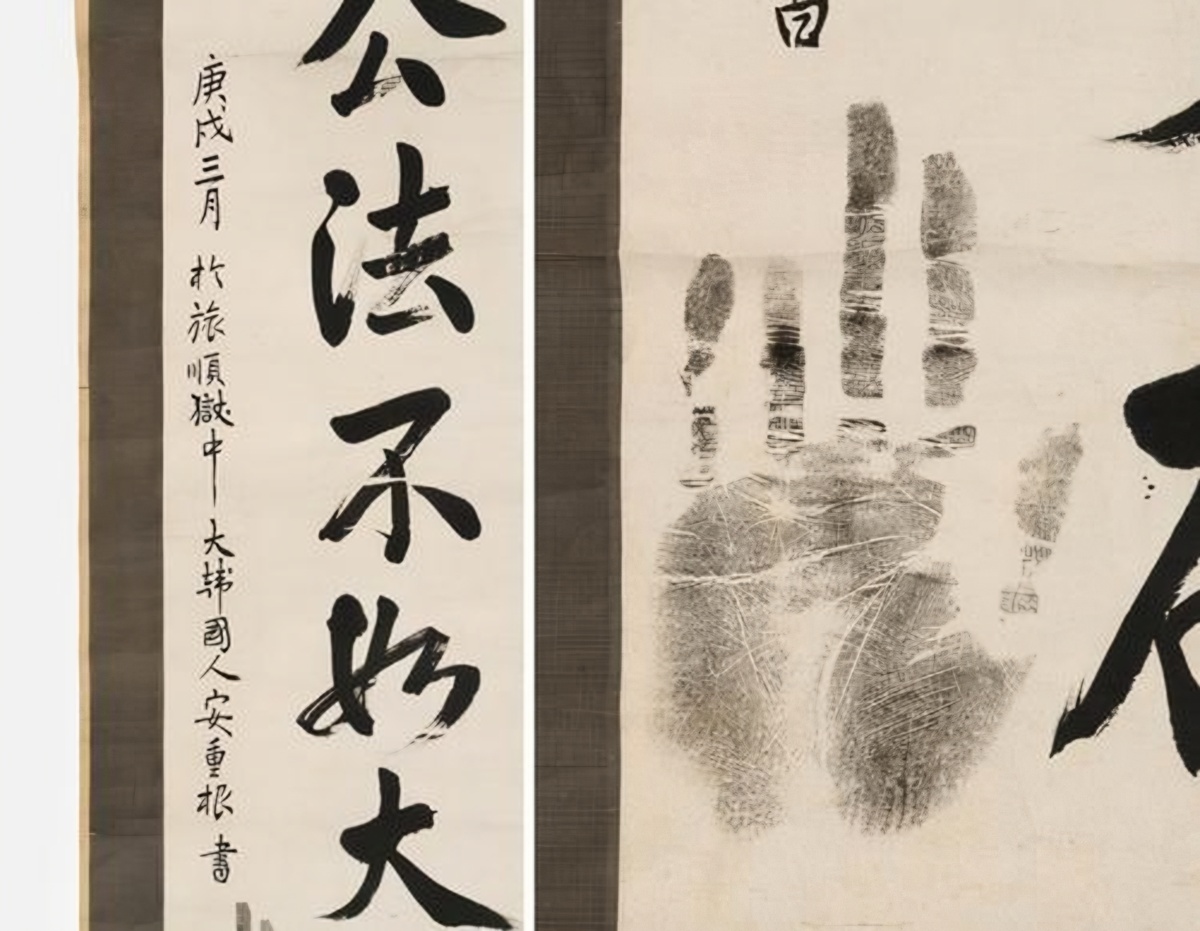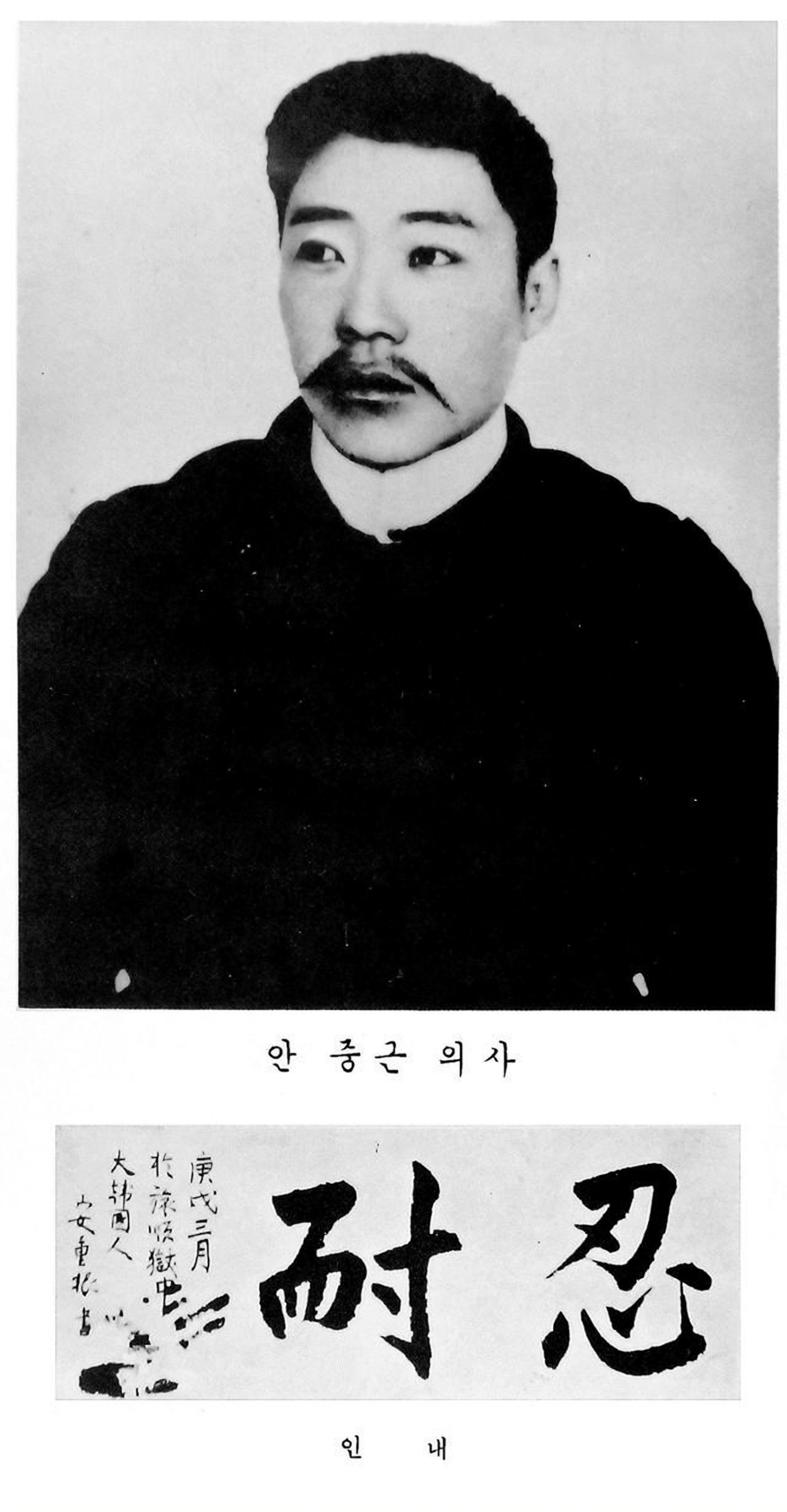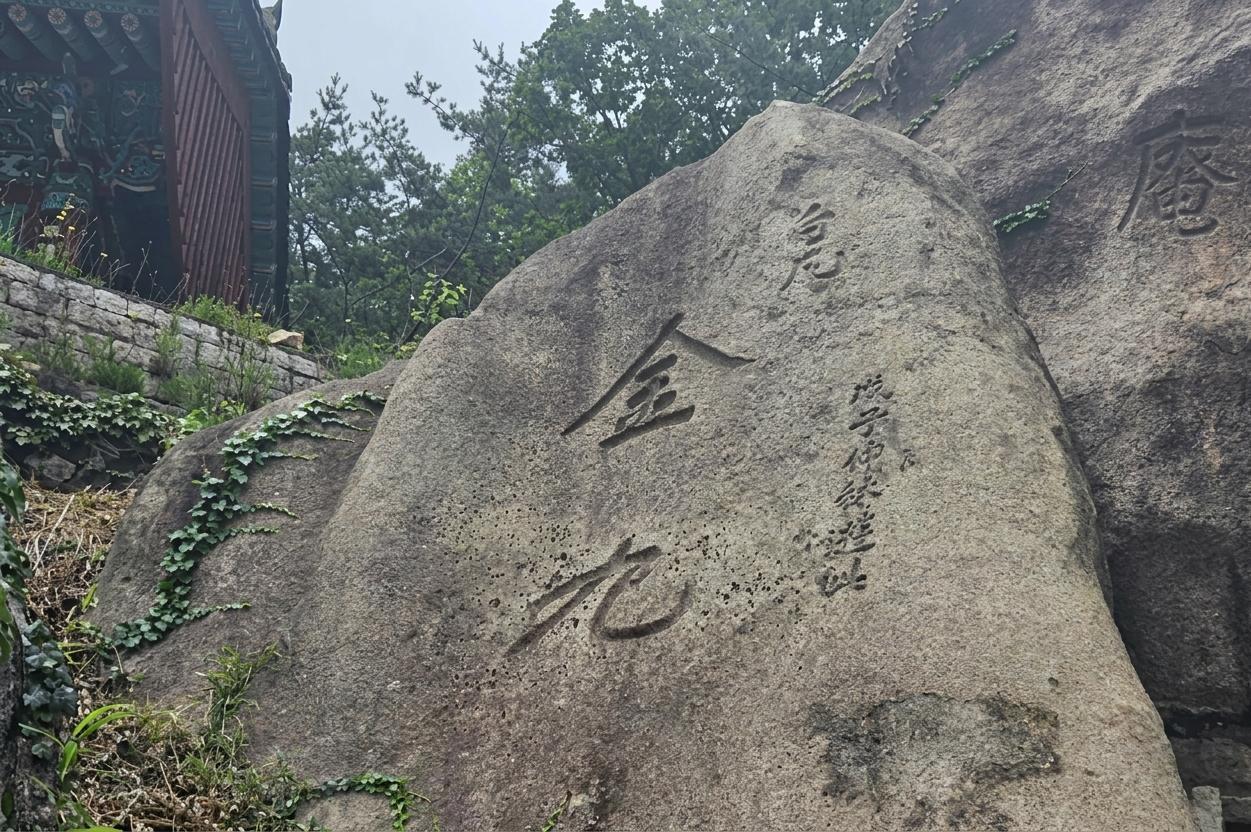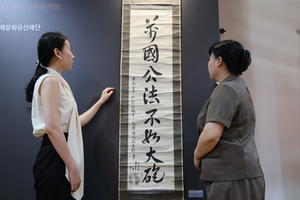
A calligraphic work by Korean independence activist Ahn Jung-geun is unveiled during a media preview at Deoksugung , Seoul, Thursday. (Yonhap) A calligraphic work by Korean independence activist Ahn Jung-geun, written after Japanese authorities rejected his plea for a trial under international law, has been returned to Korea from Japan, the Korea Heritage Service said Thursday.The eight-character hanja inscription, "Manguk Gongbeop Buryeo Daepo," or "International Law Is No Match for Cannons," was unveiled at Deoksugung in Seoul ahead of National Liberation Day on Saturday. The work was recovered through a joint effort by the Korea Heritage Service and the Overseas Korean Cultural Heritage Foundation.A Korea Heritage Service official described the eight characters as "boldly brushed across a sheet of paper measuring more than 1 meter in length, preserving a powerful testament to Ahn's unwavering resolve despite his disillusionment with the limits of international law."The calligraphy is believed to have been written by Ahn in Lushun Prison in China in March 1910, just days before he was executed on March 26.Ahn was sentenced to death in February 1910 after assassinating Ito Hirobumi, a former Japanese prime minister and key figure in Japan's colonization of Korea, at Harbin Railway Station in northeastern China on Oct. 26, 1909.Ahn argued that he had committed a justified act of war as a lieutenant general of the Korean Independence Righteous Army and should therefore be tried under international law. Japanese authorities rejected his demand and prosecuted him for murder.The phrase is derived from an expression attributed to Japanese philosopher Fukuzawa Yukichi (1835-1901), which criticized imperial powers for professing adherence to international law, yet acting according to the logic of force and shaping the international order to serve their own interests.The calligraphy bears Ahn's handprint in its lower-left corner. An inscription above it says that "the Korean Ahn Jung-geun wrote this in March of the Gyeongsul year (1910) in Lushun Prison."Experts authenticated the work by comparing it with Ahn's other calligraphy. They found similarities in his brushstrokes, the composition of character forms, and brushwork speed, as well as a matching handprint.The work's provenance was also traced through writing on its reverse. It was originally owned by Kurihara Sadakichi, then warden of Lushun Prison, who showed concern for Ahn during his imprisonment, according to accounts of their interactions.It was later passed to an individual who referred to himself as "Pyeongmun-Gwangsaeng Noehyeop-Ilin," who mounted and preserved the work.The existence of the calligraphy was first confirmed in May 2025, when the Overseas Korean Cultural Heritage Foundation learned of it through a local network. After an investigation and negotiations led by the foundation, with administrative support from the Korea Heritage Service, the work was returned to Korea in November.Ahn left numerous calligraphic works during the roughly 40 days between his death sentence and execution. Thirty-one of his calligraphic works are currently designated as Korean treasures, according to the Korea Heritage Service.The newly recovered calligraphy will go on public display later this month. Calligraphy by independence activist Ahn Jung-geun reads, “International Law Is No Match for Cannons.” (Korea Heritage Service) The ink inscription on the back of Ahn Jung-geun's recently returned calligraphy (Korea Heritage Service)
'International Law Is No Match for Cannons': Independence activist's calligraphy returns to Korea
A calligraphic work by Korean independence activist Ahn Jung-geun, written after Japanese authorities rejected his plea for a trial under international law, has
524 words~2 min read