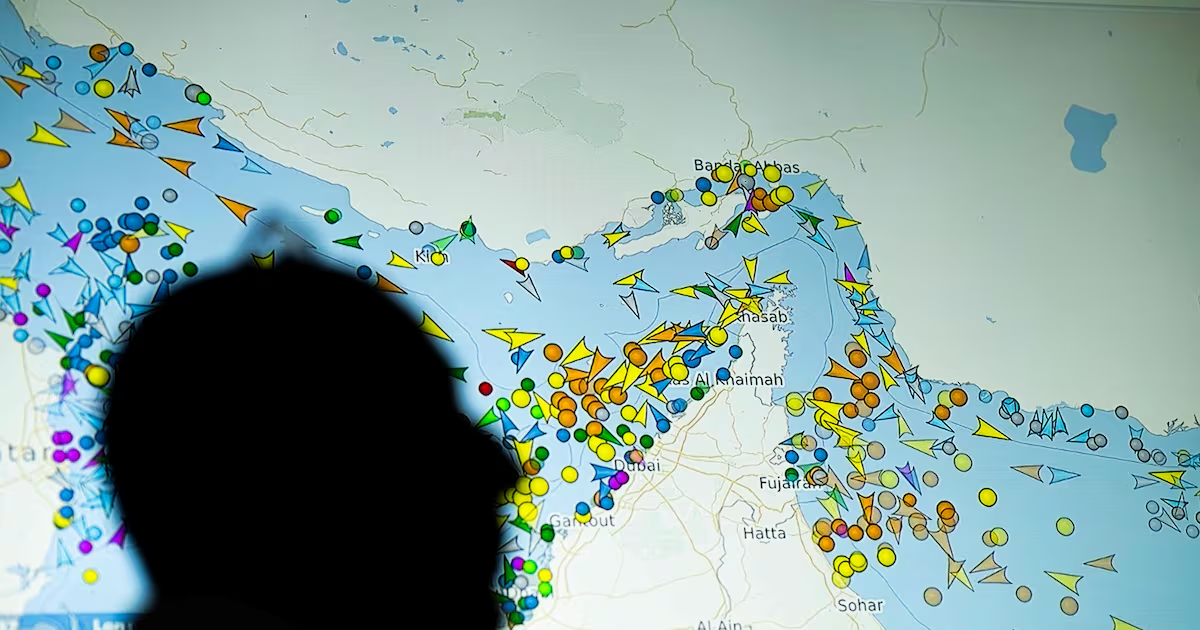
The longer-than-expected closure of the Strait of Hormuz means that some part of the oil production in the Middle East will remain shut in through the end of next year, the U.S. Energy Information Administration (EIA) said in its latest Short-Term Energy Outlook (STEO) this week.The renewed tensions in the Middle East that began in late July and have been simmering so far in August will keep traffic at Hormuz severely constrained through this month, which has prompted the EIA to hike its third-quarter oil price forecasts as lower supply would further deplete global inventories.Currently, the administration sees oil flows through the Strait of Hormuz to begin slowly increasing in September, and production shut-ins in the region to further ease.Most of the crude oil production in the Middle East is expected to return to near pre-conflict averages in early 2027. However, some output of about 600,000 barrels per day (bpd) will continue to be offline through the end of 2026, the EIA reckons.This forecast is based on the assumption that oil shipments through the Strait of Hormuz will remain severely constrained through August, with flows slowly increasing in September.The EIA, however, does not expect that the Houthi threats to ships transporting Saudi crude oil through the Bab el-Mandeb Strait have resulted in any additional shut-ins of crude oil production. “If these assumptions hold, we expect it will take until early 2027 for production and trade patterns to generally return to pre-conflict status,” the EIA said in its monthly outlook published on Tuesday.“We anticipate nonetheless that some producers around the Persian Gulf will not be able to bring oil output back to pre-conflict averages during the STEO forecast period.”The EIA estimates that shut-ins among the Middle East producers averaged 5.5 million bpd in July, nearly halved from the 10.1 million bpd shut-ins on average during the March-May period.Shut-ins in the third quarter are now seen at an average of 6.72 million bpd, higher than in the July STEO, as traffic at the Strait of Hormuz has plunged in recent weeks to more than a two-month low.Of note is that the United Arab Emirates (UAE), which quit OPEC on May 1, had fully restored its crude oil production as early as June, while all other Gulf oil producers still had some part of their supply curtailed as of July, including 2.3 million bpd in Saudi Arabia, 1.96 million bpd in Iraq, and 1.05 million bpd in Kuwait.The UAE has managed to boost its oil exports to pre-crisis levels, as it has kept pushing crude through the Strait of Hormuz and outside it. Abu Dhabi National Oil Company (ADNOC) has offered nearly 100 million barrels of crude in spot tenders since June and is increasing its production to record highs, thanks to the workarounds to shuttle crude through Hormuz to load it on larger vessels outside the Strait, maximize the use of its onshore pipeline to ship crude from the west to the east of the country, bypassing Hormuz, and ship tankers through the Strait in dark mode.The EIA sees shut-ins in the Middle East easing to just 1.68 million bpd in the first quarter of 2027. These are set to gradually decline, but about 600,000 bpd could still be off the market by the end of 2027.Due to the continued constraints at Hormuz, the EIA hiked its forecast for the Brent crude oil spot price by $11 per barrel from the July outlook and now sees Brent Crude averaging around $85 per barrel in the third quarter.Early on Wednesday in Asian trade, Brent traded at about $89 per barrel, rising this week amid fading hopes of U.S.-Iran talks on a deal to reopen the Strait of Hormuz.Of course, all these assumptions by the EIA and other analysts could quickly become irrelevant if re-escalation or de-escalation in the Middle East region changes the oil flows picture again, as it has been doing for five and a half months now.By Tsvetana Paraskova for Oilprice.comMore Top Reads From Oilprice.comRussia Rebuilds Nuclear Workforce at Iran’s Bushehr PlantEgypt and Libya Near $1 Billion Oil Pipeline DealThe Hormuz Shock Is Far From Over
EIA Sees 600,000 Bpd of Middle East Oil Still Offline by End-2027 | OilPrice.com
The longer-than-expected closure of the Strait of Hormuz means that some part of the oil production in the Middle East will remain shut in through the end of next year
685 words~3 min read