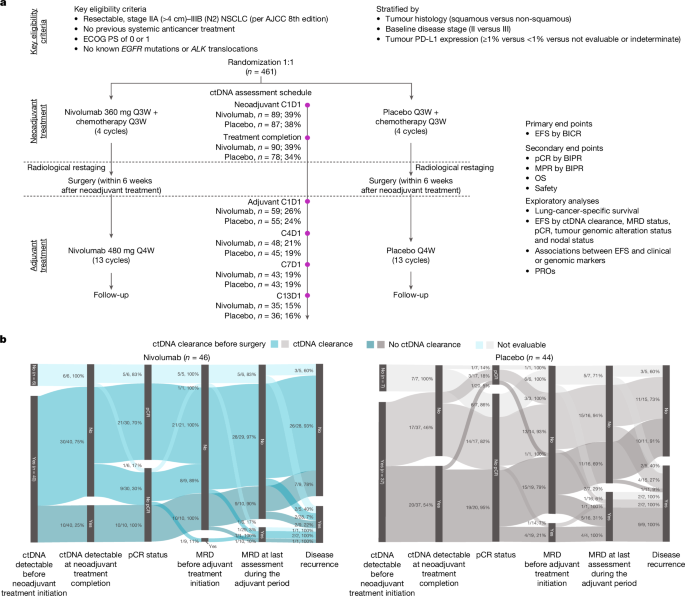
MainNeoadjuvant nivolumab plus platinum-doublet chemotherapy is an established standard-of-care treatment for eligible patients with resectable NSCLC based on the results of the phase III CheckMate 816 study. Data from this trial demonstrated significant and clinically meaningful improvements in pCR, EFS and overall survival (OS) versus chemotherapy alone2,3. The phase III CheckMate 77T study (NCT04025879) built on these findings and demonstrated significant and clinically meaningful EFS benefit with nivolumab administered in combination with platinum-doublet chemotherapy before surgery and as a single agent after surgery (that is, perioperative nivolumab) versus placebo (hazard ratio (HR), 0.58; 97.36% confidence interval (CI), 0.42–0.81; P < 0.001) among patients with stage IIA–IIIB resectable NSCLC1. Improved pCR rates were also observed in the nivolumab arm (25.3%) versus the placebo arm (4.7%)1. On the basis of these results, perioperative nivolumab was approved in the USA, the European Union and other countries for eligible patients with resectable NSCLC4,5,6,7. Clinical benefit with perioperative immunotherapy has also been demonstrated in other phase III studies, such as KEYNOTE-671, AEGEAN and RATIONALE-315, which found that perioperative pembrolizumab, durvalumab and tislelizumab, respectively, significantly improved EFS and pCR rates compared with placebo8,9,10,11,12,13. Perioperative pembrolizumab and tislelizumab were also shown to significantly improve OS11,13.Immunotherapy-based treatments have demonstrated clinical benefit in patients with resectable NSCLC with clinical and/or genomic markers associated with poor prognoses. Patients with detectable ctDNA, molecular residual disease (MRD) and absence of pCR seem to have worse survival outcomes owing to persistent disease. By contrast, neoadjuvant2,3 and perioperative14,15,16,17,18 immunotherapy-based treatments have demonstrated improved clinical outcomes versus control treatments in these populations. Patients with stage III N2 NSCLC also typically have poor outcomes owing to high risk of recurrence19. Notably, perioperative nivolumab20, pembrolizumab11 and durvalumab21 each demonstrated clinical benefit versus placebo in this subgroup. Furthermore, previous evidence has shown that patients with metastatic NSCLC and tumours with distinct driver-gene alterations, including KRAS, KEAP1, STK11, TP53, CDKN2A or SMARCA4, may not derive robust benefit from standard therapies22,23,24,25,26,27,28,29,30,31. These include certain patients with tumour KEAP1 mutations treated with perioperative durvalumab in the AEGEAN study18. However, adjuvant atezolizumab seemed to improve survival outcomes relative to best supportive care in select subgroups defined by tumour genomic alteration status among patients with resected NSCLC32. Notably, the phase II NADIM study showed that perioperative nivolumab has promising clinical activity in select subgroups of patients with resectable NSCLC with historically poor prognoses16. Here we aimed to identify potential markers of therapeutic benefit with perioperative treatment in key patient subgroups. We report findings of various exploratory analyses of clinical outcomes with perioperative nivolumab versus placebo on the basis of ctDNA dynamics and genomic alteration status in participants of CheckMate 77T at a median follow-up of 41.0 months. We also report the results of machine-learning modelling analyses to explore clinicogenomic markers possibly predictive of EFS outcomes. Moreover, we provide updated EFS outcomes in all randomized patients and key subgroups, and the first prespecified interim analysis of OS and patient-reported outcomes (PROs).Patients and treatment summaryAs previously reported1, 735 patients were enrolled between November 2019 and April 2022 at 95 academic hospitals and specialized cancer centres in 19 countries worldwide. Overall, 229 patients were randomly assigned to the nivolumab arm, of which 228 received neoadjuvant treatment, 178 underwent definitive surgery and 142 received adjuvant treatment. Of the 232 patients assigned to the placebo group, 230 received neoadjuvant treatment, 178 underwent definitive surgery and 152 received adjuvant treatment. (Fig. 1a and Extended Data Fig. 1a). Baseline characteristics were generally similar between treatment arms (Extended Data Table 1).Fig. 1: Study design and outcomes during the neoadjuvant and adjuvant treatment periods of CheckMate 77T.a, Study design and ctDNA assessment schedule. b, ctDNA dynamics, pCR and disease recurrence in evaluable patients. Regarding eligibility criteria in a, EGFR mutation testing was mandatory for patients with non-squamous disease, and ALK alteration testing was mandatory for patients with a history of ALK alterations; EGFR and ALK tests were performed using assays approved by the US Food and Drug Administration or the local health authority. Tumour PD-L1 expression was determined using the PD-L1 immunohistochemistry 28-8 pharmDx assay (Methods). Regarding neoadjuvant chemotherapy treatment in a, patients with squamous tumour histology received either cisplatin plus docetaxel or carboplatin plus paclitaxel, whereas patients with non-squamous tumour histology received either cisplatin plus pemetrexed, carboplatin plus pemetrexed, or carboplatin plus paclitaxel. Regarding end points in a, pCR and major pathologic response (MPR) were assessed according to pan-tumour immune-related pathologic response criteria50. Regarding ctDNA assessments in a, ctDNA was measured using the Invitae Personalized Cancer Monitoring (tumour-informed) assay in patients with ctDNA-evaluable samples from ≥1 time point. Percentages were calculated using patients randomized to the perioperative nivolumab arm (n = 229) or placebo arm (n = 232) as the denominator. In b, the analysis only included biomarker-evaluable patients with evaluable ctDNA before neoadjuvant treatment initiation and at neoadjuvant treatment completion, pCR status, MRD status before adjuvant treatment initiation and at ≥1 other time point during the adjuvant treatment period and disease recurrence. ctDNA clearance-status subgroups were defined by ctDNA clearance at neoadjuvant treatment completion. AJCC, American Joint Committee on Cancer; BICR, blinded independent central review; BIPR, blinded independent pathologic review; C, cycle, D, day (for example, C1D1 indicates cycle 1 day 1); Q3W, every 3 weeks; Q4W, every 4 weeks.Biomarker analysesExploratory biomarker analyses were performed in 190 patients (nivolumab, 98 out of 229 (43%); placebo, 92 out of 232 (40%)) with evaluable paired tumour samples from screening and blood samples from ≥1 time point during the study for whole-exome sequencing (WES). These individuals constituted the biomarker-evaluable population. The most common reasons for exclusion were samples not passing pathology evaluation, assays not being available and samples failing WES (Extended Data Fig. 1b). Baseline characteristics in the biomarker-evaluable population were generally balanced between treatment groups and similar to those in the all-randomized patient population (Extended Data Table 1).ctDNA dynamics and pCR statusIn an exploratory analysis, ctDNA was used to assess ctDNA clearance during the neoadjuvant treatment period and the MRD status during the adjuvant treatment period. All 190 patients in the biomarker-evaluable population had ctDNA-evaluable samples from ≥1 time point during the study (Fig. 1a). Baseline characteristics in patients with detectable ctDNA (nivolumab, 83 out of 98 (85%); placebo, 75 out of 92 (82%)) or no detectable ctDNA (nivolumab, 6 out of 98 (6%); placebo, 12 out of 92 (13%)) before neoadjuvant treatment initiation are reported in Supplementary Table 1. In total, 90 out of 98 (92%) patients in the nivolumab arm and 78 out of 92 (85%) patients in the placebo arm had evaluable ctDNA at neoadjuvant treatment completion. The most substantial decrease in ctDNA levels occurred between neoadjuvant treatment initiation and completion across both treatment groups (Fig. 2a,b). Overall, 140 patients had detectable and evaluable ctDNA before initiation and at completion of neoadjuvant treatment: 76 out of 98 (78%) for the nivolumab group; 64 out of 92 (70%) for the placebo group. Moreover, 63 out of 76 (83%) patients in the nivolumab arm and 60 out of 64 (94%) patients in the placebo arm completed all 4 neoadjuvant treatment cycles (Supplementary Table 2). In the nivolumab group, 50 out of 76 (66%) patients had ctDNA clearance at neoadjuvant treatment completion compared with 24 out of 64 (38%) patients in the placebo group (Fig. 2c). Furthermore, 42 out of 50 (84%) patients in the nivolumab arm and 22 out of 24 (92%) in the placebo arm completed all neoadjuvant treatment cycles (Supplementary Table 2). Baseline characteristics were generally similar regardless of ctDNA clearance status across both treatment groups (Supplementary Table 3). Overall, higher ctDNA levels before neoadjuvant treatment initiation seemed to correlate with higher baseline disease stage and tumour burden (Supplementary Fig. 1a).Fig. 2: Outcomes by ctDNA clearance during the neoadjuvant treatment period and MRD status during the adjuvant treatment period.a, Patient-level distribution of ctDNA levels during the neoadjuvant and adjuvant treatment periods in biomarker-evaluable patients. b, ctDNA clearance and MRD status per ctDNA levels in biomarker-evaluable patients. c, Associations between ctDNA clearance and pCR status. d, Landmark EFS from definitive surgery in patients with MRD-negative status before adjuvant C1D1 treatment initiation. e, Baseline characteristics, treatment, clinical outcomes and disease recurrence in patients who became MRD-positive during the adjuvant treatment period (n = 13). In a, each dot represents 1 patient, centre lines of boxes represent medians, upper and lower borders of boxes represent 75th and 25th percentiles, respectively, and upper and lower whiskers span 1.5 times the interpercentile (75th and 25th) ranges from upper and lower bounds of the boxes, respectively; dots not captured in boxes or whiskers (including minima and maxima) represent outliers. In a and b, 10−6 represents ctDNA levels equal to 0. In b and c, ctDNA clearance-status subgroups were defined by ctDNA clearance at neoadjuvant treatment completion. In b, MRD status subgroups were defined by MRD during the last available assessment during the adjuvant treatment period; dashed lines separate neoadjuvant and adjuvant treatment periods. Patients with unevaluable change in MRD status were MRD-negative before adjuvant treatment initiation or did not have evaluable MRD status at ≥1 other time point during the adjuvant treatment period. In c, purple font indicates patients in the nivolumab group who had ctDNA clearance at the neoadjuvant treatment completion and pCR. In b and e, patients with unevaluable ctDNA clearance had no detectable ctDNA before neoadjuvant treatment initiation and/or did not have evaluable ctDNA at neoadjuvant treatment completion. In d, the HR and corresponding two-sided 95% CI were estimated using an unstratified Cox proportional-hazards model with treatment arm as a single covariate. In e, each bar represents one patient. CL, clearance; R0, no residual tumour; R1, microscopic residual tumour; R2, macroscopic residual tumour.Among patients with ctDNA clearance at neoadjuvant treatment completion, 25 out of 50 (50%) patients in the nivolumab arm had pCR compared with 3 out of 24 (12%) patients in the placebo arm. This finding represents 50% and 12% positive predictive values of ctDNA clearance, respectively (positive likelihood ratios of 2.04 and 2.14, respectively; Supplementary Table 4). In patients without ctDNA clearance, 0 out of 25 (0%) patients in the nivolumab arm had pCR compared with 1 out of 40 (2%) patients in the placebo arm, which represents 100% and 98% negative predictive values of ctDNA clearance, respectively (negative likelihood ratios of 0 and 0.38, respectively). Among patients with evaluable ctDNA clearance and percent residual viable tumour (%RVT), median %RVT was 0% in the nivolumab arm (n = 42) versus 33% in the placebo arm (n = 19) for patients with ctDNA clearance at neoadjuvant treatment completion. By contrast, median %RVT was 50% in the nivolumab group (n = 17) compared with 70% in the placebo group (n = 25) for patients without ctDNA clearance (Supplementary Fig. 1b). Of the patients with ctDNA clearance in the nivolumab arm, 29 (69%) had 0–5% RVT in primary tumour (RVT-PT), 9 (21%) had >5–80% RVT-PT and 4 (10%) had >80% RVT-PT (Supplementary Table 5). For the patients with ctDNA clearance in the placebo arm, these values were 6 (32%) for 0–5% RVT-PT, 9 (47%) for >5–80% RVT-PT and 4 (21%) for >80% RVT-PT. Of the patients without ctDNA clearance in the nivolumab arm, 1 (6%) had 0–5% RVT-PT, 13 (76%) had >5–80% RVT-PT and 3 (18%) had >80% RVT-PT (Supplementary Table 5). These values for the placebo group were 1 (4%) for 0–5% RVT-PT, 15 (60%) for >5–80% RVT-PT and 9 (36%) for >80% RVT-PT.In the biomarker-evaluable population, 98 patients (nivolumab, 49 out of 98 (50%); placebo, 49 out of 92 (53%)) had evaluable MRD status after surgery and before adjuvant treatment initiation and ≥1 other time point during the adjuvant treatment period. Of these patients, 48 out of 49 (98%) patients in the nivolumab arm and 44 out of 49 (90%) patients in the placebo arm were MRD-negative before adjuvant treatment initiation. By contrast, 1 out of 49 (2%) patients in the nivolumab group and 5 out of 49 (10%) in the placebo group were MRD-positive, none of whom became MRD-negative during the adjuvant treatment period. Among patients who were MRD-negative before adjuvant treatment initiation, 4 out of 48 (8%) patients in the nivolumab arm and 9 out of 44 (20%) patients in the placebo arm became MRD-positive during the adjuvant treatment period. Baseline characteristics by MRD status during the adjuvant treatment period are reported in Supplementary Table 3. Of the four patients in the nivolumab group who became MRD-positive during the adjuvant treatment period, one patient had ctDNA clearance (at neoadjuvant treatment completion), one patient did not have ctDNA clearance and two patients did not have evaluable ctDNA clearance status at neoadjuvant treatment completion. Of the nine patients in the placebo arm who became MRD-positive during the adjuvant treatment period, one patient had ctDNA clearance (at neoadjuvant treatment completion), five patients did not have ctDNA clearance and three patients did not have evaluable ctDNA clearance status at neoadjuvant treatment completion. Of the 4 patients in the nivolumab arm and 8 patients in the placebo arm who were MRD-positive before adjuvant treatment initiation (regardless of whether they had surgery), none became MRD-negative during the adjuvant treatment period, and 3 (75%) and 8 (100%), respectively, had disease recurrence. Figure 1b shows Sankey plots for patients with all evaluable factors for ctDNA dynamics, pCR status and disease recurrence (nivolumab, n = 46; placebo, n = 44). In this subgroup, 1 patient in the nivolumab arm and 5 patients in the placebo arm were MRD-positive after surgery and before adjuvant treatment initiation, and disease recurrence rates were 22% and 45% in the respective treatment groups.EFS by ctDNA dynamics and pCR statusIn patients with definitive surgery, the HR for landmark EFS from definitive surgery for nivolumab versus placebo was 0.87 (95% CI, 0.51–1.47) in patients without pCR. The HR was not calculated in patients with pCR owing to the limited sample size (nivolumab, n = 32; placebo, n = 5; Extended Data Fig. 2a). Similar to analyses in all randomized patients, EFS was longer with nivolumab than with placebo (median, 40.1 months (95% CI, 28.4 to not reached (NR)) versus 15.8 months (95% CI, 10.0–35.1); HR, 0.65 (95% CI, 0.43–0.98)) in biomarker-evaluable patients (Extended Data Fig. 3). Among these patients, the EFS HR for nivolumab versus placebo in patients with detectable ctDNA before neoadjuvant treatment initiation was 0.58 (95% CI, 0.37–0.92; Extended Data Fig. 2b). The HR was not calculated among patients without detectable ctDNA before neoadjuvant treatment initiation owing to the limited sample size (nivolumab, n = 12; placebo, n = 6). The EFS HRs for nivolumab versus placebo were 0.48 (95% CI, 0.22–1.02) in patients with ctDNA clearance before surgery and 0.76 (95% CI, 0.40–1.46) in patients without ctDNA clearance (Extended Data Fig. 2c).In a composite biomarker analysis of EFS by ctDNA clearance before surgery and pCR status, patients with ctDNA clearance and pCR in the nivolumab group (n = 25) had prolonged EFS compared with patients with ctDNA clearance and no pCR (n = 25; HR, 0.29; 95% CI, 0.10–0.85) and compared with patients with no ctDNA clearance and no pCR (n = 26; HR, 0.23; 95% CI, 0.08–0.65). Among patients with no pCR, the EFS HR for patients with ctDNA clearance versus patients without was 0.70 (95% CI, 0.31–1.59; Extended Data Fig. 4a). For the placebo arm, EFS HRs for comparisons involving patients with ctDNA clearance and pCR were not calculated owing to the limited sample size (n = 3). The EFS HR for patients with ctDNA clearance and no pCR (n = 21) versus patients with no ctDNA clearance and no pCR (n = 39) was 0.77 (95% CI, 0.39–1.54; Extended Data Fig. 4b).Among patients who were MRD-negative after surgery and before adjuvant treatment initiation, the HR for landmark EFS from definitive surgery with nivolumab versus placebo was 0.75 (95% CI, 0.40–1.42; Fig. 2d). The HR was not calculated among patients who were MRD-positive after surgery and before adjuvant treatment initiation owing to the limited sample size (nivolumab, n = 3; placebo, n = 7). All 13 patients who were MRD-negative after surgery and before adjuvant treatment initiation and became MRD-positive during the adjuvant treatment period had disease recurrence (Fig. 2e).Tumour genomic alteration analysesIn an additional exploratory analysis, EFS was assessed by KRAS, KEAP1, STK11, SMARCA4, TP53 and CDKN2A tumour alteration status. Among the biomarker-evaluable patients, the frequency of selected tumour alterations was generally similar across both treatment groups. However, KRAS and TP53 mutations were numerically lower and more frequent, respectively, in the nivolumab group than in the placebo group (Supplementary Table 6). KRAS, KEAP1 and STK11 tumour mutations were generally observed in patients with non-squamous NSCLC, whereas TP53 tumour mutations were observed frequently regardless of tumour histology. CDKN2A tumour mutations were generally observed in patients with squamous NSCLC, whereas CDKN2A copy number loss was observed in similar proportions of patients regardless of tumour histology. Across all 190 biomarker-evaluable patients from both treatment groups, the most common single alteration was TP53 mutation (48 patients; 25%), and the most common co-alterations were TP53 mutation with CDKN2A alteration in both groups (38 patients; 20%). The following proportions were observed for other types of alterations: 67 (35%) had KRAS, KEAP1 and/or STK11 tumour mutations, including 3 (2%) with KRAS and KEAP1 co-mutations, 7 (4%) with KRAS and STK11 co-mutations and 3 (2%) with KRAS, KEAP1 and STK11 triple co-mutations; 22 (12%) had KRAS and TP53 co-mutations; and 31 (16%) had TP53 mutations with KEAP1 and/or STK11 co-mutations (Fig. 3a). Surgical outcomes by tumour genomic alteration status are reported in Supplementary Table 7.Fig. 3: Prevalence and efficacy of tumour mutational subgroups.a, Prevalence of KRAS, KEAP1, STK11, TP53 and SMARCA4 tumour mutations and CDKN2A tumour alterations in biomarker-evaluable patients. Tumour genomic alteration status was assessed by WES of pretreatment tumour samples from screening. CDKN2A alteration included CDKN2A mutation and/or homozygous copy number loss. b–i, EFS in patients with the following tumour type: KRAS mutation (b); KRAS wild type (c); KEAP1 mutation (d); KEAP1 wild type (e); STK11 mutation (f); STK11 wild type (g); TP53 mutation (h) or TP53 wild type (i). The line charts follow the same colour code as the bar charts. HRs and corresponding two-sided 95% CIs were estimated using an unstratified Cox proportional-hazards model with treatment arm as a single covariate. The 95% CIs for 30-month EFS rates were as follows: 10–57 (nivolumab) and 18–60 (placebo) (b); 51–73 (nivolumab) and 30–54 (placebo) (c); 23–75 (nivolumab) and 8–59 (placebo) (d); 47–70 (nivolumab) and 31–55 (placebo) (e); 10–73 (nivolumab) and 9–67 (placebo) (f); 48–70 (nivolumab) and 31–53 (placebo) (g); 46–70 (nivolumab) and 28–54 (placebo) (h); and 29–74 (nivolumab) and 26–62 (placebo) (i).EFS by KRAS, KEAP1, STK11 or TP53 tumour mutational status is shown in Fig. 3b–i. Among patients in the nivolumab arm, pCR was observed in 7 (47%) patients with KRAS tumour mutations, 4 (29%) with KEAP1 tumour mutations, 4 (40%) with STK11 tumour mutations and 27 (34%) with TP53 mutations. Among patients in the placebo group, pCR was observed in 1 (5%) patient with KRAS tumour mutations, no patients with KEAP1 tumour mutations, no patients with STK11 tumour mutations and 2 (3%) patients with TP53 mutations. EFS by CDKN2A (mutation and/or copy number loss) or SMARCA4 tumour alteration status is shown in Supplementary Fig. 2.EFS seemed longer with nivolumab than with placebo in patients with single or co-alterations in of KEAP1, STK11, CDKN2A and/or SMARCA4 in the tumour (HR, 0.48; 95% CI, 0.28–0.83). The EFS HR in patients with no alterations in these 4 genes was 0.90 (95% CI, 0.48–1.69; Extended Data Fig. 5a,b). The univariate HRs for patients with single or co-alterations in ≥1 of these 4 genes versus patients without alterations in any of these 4 genes were 0.91 (95% CI, 0.50–1.69) with nivolumab and 1.77 (95% CI, 1.01–3.11) with placebo. Multivariate HRs, accounting for smoking status, disease stage, tumour histology, tumour PD-L1 expression and tumour mutational burden (TMB), were 0.99 (95% CI, 0.53–1.86) with nivolumab and 1.82 (95% CI, 1.01–3.30) with placebo. EFS seemed longer with nivolumab than with placebo in patients with TP53 tumour mutations and without KEAP1 or STK11 co-mutations (HR, 0.55; 95% CI, 0.32–0.95; Extended Data Fig. 5c,d). The EFS HR in patients with TP53 tumour mutations and KEAP1 and/or STK11 co-mutations was 0.44 (95% CI, 0.16–1.24; Extended Data Fig. 5e). Patient characteristics, tumour genomic alterations, treatment status and clinical outcomes in all biomarker-evaluable patients are reported in Supplementary Fig. 3.Of the 190 biomarker-evaluable patients, 98 (nivolumab, 51 out of 98 (52%); placebo, 47 out of 92 (51%)) had baseline TMB < 10 mutations per Mb and 92 (nivolumab, 47 out of 98 (48%); placebo, 45 out of 92 (49%)) had baseline TMB ≥ 10 mutations per Mb. EFS HRs for nivolumab versus placebo were 0.65 (95% CI, 0.39–1.11) among patients with baseline TMB < 10 mutations per Mb and 0.62 (95% CI, 0.32–1.20) among patients with baseline TMB ≥ 10 mutations per Mb (Supplementary Fig. 4).Predictive modellingTo identify potential predictive markers of EFS outcomes, a random survival forest machine-learning model was trained using data from 80% of biomarker-evaluable patients in the nivolumab arm and placebo arm and tested using data from the remaining 20% of biomarker-evaluable patients to evaluate associations between key clinical and genomic markers (for example, baseline demographic and disease characteristics, pCR, ctDNA clearance and tumour genomic alterations) and EFS. The model that used training data from all biomarker-evaluable patients had a Harrell’s concordance index of 0.79, which indicated that risk scores assigned by the model correlated well with the likelihood of an EFS event. By contrast, the model that used test data had a Harrell’s concordance index of 0.65. The most predictive factors for reduced risk of EFS events included ctDNA clearance before surgery, non-N2 NSCLC, pCR, squamous tumour histology and treatment with nivolumab (Supplementary Fig. 5a). SMARCA4 mutation, CDKN2A alteration and KEAP1 mutation had relatively less value on predicting EFS outcomes in this model using biomarker-evaluable patients from both treatment groups. In a model using only patients who received nivolumab, the most useful predictors for reduced risk of EFS events in order of decreasing magnitude included pCR, high TMB, high tumour PD-L1 expression, non-N2 NSCLC and ctDNA clearance before surgery (Supplementary Fig. 5b). EFS risk-score tertiles were calculated in the training population and applied to the test population. Clear separations were observed between the Kaplan–Meier curves for the predicted high-risk, medium-risk and low-risk groups among all biomarker-evaluable patients but not among biomarker-evaluable patients in the nivolumab arm only (Supplementary Fig. 5c,d).Clinical outcomesAt the 16 December 2024 database lock (median follow-up, 41.0 months; range, 31.3–59.8 months), nivolumab continued to demonstrate EFS benefit versus placebo in all randomized patients (HR, 0.61; 95% CI, 0.46–0.80). The 30-month EFS rates were 61% for the nivolumab group and 43% for the placebo group (Fig. 4a). Consistent EFS benefit continued to be observed with nivolumab versus placebo across several subgroups, although 95% CIs for HRs crossed 1 in certain subgroups defined by disease stage, tumour histology, tumour PD-L1 expression, nodal status, sex, geographical region, smoking history and platinum therapy type (Fig. 4b). EFS by baseline disease stage, tumour histology, tumour PD-L1 expression and nodal status (N2 or non-N2) are reported in Extended Data Figs. 6–8b. Across both treatment groups, patients with ctDNA clearance before surgery generally had prolonged EFS compared with patients without, and patients with pCR had prolonged landmark EFS from definitive surgery versus patients without, regardless of whether patients had N2 or non-N2 NSCLC (Extended Data Fig. 8c–f).Fig. 4: Survival outcomes.a,b, EFS per BICR in all randomized patients (a) and key patient subgroups (b). c, OS in all randomized patients. In a and c, HRs and corresponding two-sided 95% CIs were estimated using a Cox proportional-hazards model stratified by tumour histology (squamous versus non-squamous), baseline disease stage (II versus III) and tumour PD-L1 expression (≥1% versus <1% versus not evaluable or indeterminate) with treatment arm as a single covariate. In a, 95% CIs for 30-month EFS rates were 54–68 for the nivolumab arm and 36–50 for the placebo arm. In b, HRs and corresponding two-sided 95% CIs were estimated using an unstratified Cox proportional-hazards model with treatment arm as a single covariate. HRs were not calculated for subgroups with <10 patients in either treatment arm. Nodal status was N3 in four patients, and N2 subcategory was not reported in one patient. In c, 95% CI for the HR was 0.61–1.18; 95% CIs for 30-month OS rates were 72–83 in the nivolumab arm and 66–78 in the placebo arm.At the first prespecified interim OS analysis, median OS was NR in either treatment arm, 30-month OS rates were 78% with nivolumab compared with 72% with placebo and the boundary for significance was not crossed (HR, 0.85; 97.63% CI, 0.58–1.25; Fig. 4c). In a post hoc exploratory analysis of lung-cancer-specific survival, which only included deaths due to disease per investigator assessment, 38 patients died due to NSCLC in the nivolumab group compared with 64 patients in the placebo group. The 30-month lung-cancer-specific survival rates were 87% for the nivolumab arm compared with 75% in the placebo arm (HR, 0.60; 95% CI, 0.40–0.89; Extended Data Fig. 9). Subsequent anticancer therapy of any type was received by 29% of patients in the nivolumab arm and 44% of patients in the placebo arm, and subsequent systemic therapy was received by 22% and 38%, respectively (Supplementary Table 8).PROsIn general, completion rates for all PRO assessments were >90% in both treatment arms, except at the pre-surgical and post-surgical visits. Patients in both treatment arms generally had good health-related quality of life (HRQoL) per baseline PRO assessment scores, similar to population norms33,34,35. Changes from baseline PRO assessment scores were generally not clinically meaningful in either treatment arm according to assessment-specific minimally important differences36,37,38 (Supplementary Fig. 6). Exceptions included clinically meaningful worsening in EQ-5D-3L utility index (UI) scores in both treatment arms at the post-surgical visit. In analyses of time to definitive deterioration (TTDD), nivolumab reduced the risk of definitive deterioration of NSCLC Symptom Assessment Questionnaire (NSCLC-SAQ) scores by 32% versus placebo (HR, 0.68; 95% CI, 0.46–0.99; Supplementary Fig. 6a). TTDD values with nivolumab versus placebo for the Functional Assessment of Cancer Therapy-Lung Cancer Subscale (FACT-LCS), EQ-5D-3L visual analogue scale (VAS) and EQ-5D-3L UI are shown in Supplementary Fig. 6b–d. TTDD values in patients with N2 or non-N2 NSCLC is shown in Supplementary Fig. 7.SafetySafety outcomes at the current database lock were consistent with previously reported ones1,39. Any-grade treatment-related adverse events occurred in 89% of patients treated with nivolumab and in 87% of patients treated with placebo. Grade 3–4 treatment-related adverse events occurred in 32% of patients in the nivolumab group and 25%, in the placebo group (Supplementary Table 9). No new surgery-related adverse events occurred. As previously reported1, treatment-related deaths were reported in two patients (both from pneumonitis) in the nivolumab arm (occurred after neoadjuvant treatment completion) and no patients in the placebo arm. Additional information regarding causes of death is reported in Supplementary Table 10.DiscussionThis update from CheckMate 77T presents a comprehensive report of ctDNA dynamics and genomic markers from a phase III study evaluating perioperative immunotherapy in patients with resectable NSCLC. Of the patients with detectable and evaluable ctDNA both before and at the end of neoadjuvant treatment, nearly two times as many patients with resectable NSCLC in the nivolumab arm had ctDNA clearance before surgery compared with the placebo arm (66% versus 38%). Half of the patients with ctDNA clearance in the nivolumab arm had pCR, whereas none of the patients without ctDNA clearance had pCR. Moreover, fewer patients became MRD-positive after surgery during adjuvant treatment in the nivolumab arm (4 out of 48) than in the placebo arm (9 out of 44). No patients who were MRD-positive before adjuvant treatment (regardless of whether they had surgery) in the nivolumab arm (0 out of 4) or the placebo arm (0 out of 8) became MRD-negative during the adjuvant treatment period, and most (3 out of 4 and 8 out of 8, respectively) had disease recurrence. In general, EFS seemed to be prolonged with nivolumab versus placebo regardless of tumour KRAS, KEAP1, STK11, TP53, CDKN2A or SMARCA4 alteration status. Perioperative nivolumab also continued to demonstrate durable, long-term EFS benefit versus placebo in all randomized patients. OS data were immature, although lung-cancer-specific survival seemed longer with nivolumab versus placebo. No new safety signals were observed at this follow-up.Patients with detectable ctDNA before treatment initiation, no ctDNA clearance before surgery, no pCR after neoadjuvant treatment and/or with MRD after surgery typically have an increased risk of disease recurrence, aggressive tumour biology and worse survival outcomes40,41,42,43,44,45. EFS seemed to be prolonged with nivolumab versus placebo in patients with detectable ctDNA before neoadjuvant treatment initiation in the CheckMate 77T study. This result suggests that nivolumab may provide clinical benefit in patients with initially high tumour burden. Consistent with previous reports evaluating neoadjuvant and perioperative immunotherapy-based treatment2,3,14,15,16,17,18, ctDNA clearance before surgery seemed to be associated with prolonged EFS and increased pCR rates with nivolumab in CheckMate 77T. However, these exploratory findings should be interpreted with caution given that differences in baseline characteristics between patients with versus without ctDNA clearance (for example, Eastern Cooperative Oncology Group performance status (ECOG PS) and tumour PD-L1 expression) may have affected results. Furthermore, post hoc exploratory analyses using predictive modelling suggested that ctDNA clearance before surgery and pCR were among the most useful factors associated with prolonged EFS with nivolumab, whereas the absence of these characteristics was associated with worse outcomes. These results are consistent with analyses of neoadjuvant nivolumab plus chemotherapy in the CheckMate 816 study3 and perioperative nivolumab in the NADIM16 and NADIM II trials46, as well as studies evaluating other perioperative immunotherapy-based regimens in resectable NSCLC (for example, NeoCOAST, NeoCOAST-2 and AEGEAN). All of these studies reported increased rates of pathologic response and/or prolonged survival outcomes in patients with pre-surgical ctDNA clearance status or reductions in ctDNA levels versus patients without, and in patients who were MRD-negative after surgery versus patients who were MRD-positive14,15,17,18. The findings from CheckMate 77T indicate that a combined evaluation of ctDNA dynamics and pCR may offer a more nuanced framework for risk stratification in patients with resectable NSCLC. It is important to note that the subset of patients who did not achieve pCR but exhibited ctDNA clearance following neoadjuvant therapy may represent a distinct group that derives meaningful benefit from perioperative treatment based on numerically higher 30-month EFS rates with nivolumab versus placebo in CheckMate 77T (57% versus 51%, respectively). This finding is consistent with results reported for perioperative durvalumab versus placebo in AEGEAN17. Conversely, persistent MRD after surgery, although observed in a limited number of biomarker-evaluable patients, was associated with high rates of disease recurrence, regardless of immunotherapy administration. This result highlights a population at elevated risk of early relapse despite standard intervention, for which intensification of therapy post-surgery should be considered. Although exploratory, these biomarker-driven observations underscore the potential for future prospective studies to incorporate dynamic, molecularly informed end points to validate these findings and to guide treatment decisions in a personalized manner.As reported in previous studies22,23,24,25,26,27,28,29,30,31, patients with KRAS, KEAP1, STK11, TP53, CDKN2A or SMARCA4 tumour genomic alterations typically have worse clinical outcomes compared with patients with wild-type tumours. Mutations of these genes may promote immune evasion and reduce T cell activity through various mechanisms, which results in increased tumour growth25,26,27,28,29,30,31. In an exploratory analysis from CheckMate 77T, EFS seemed longer with nivolumab versus placebo across several subgroups, including patients with genomic alterations in KRAS, KEAP1, STK11, TP53, CDKN2A (mutation and/or copy number loss) or SMARCA4 in the tumour and in patients with wild-type tumours, although sample sizes for certain subgroups were small. Similar findings were observed with adjuvant atezolizumab versus best supportive care in genomic analyses of patients with resected NSCLC from IMpower010, although atezolizumab did not seem to affect survival outcomes in patients with KEAP1 or STK11 tumour mutations32. EFS with nivolumab was similar regardless of tumour KEAP1, STK11, CDKN2A and/or SMARCA4 alteration status (univariate HR, 0.91; multivariate HR, 0.99). By contrast, the univariate and multivariate HRs for EFS with placebo among patients with versus without single or co-alterations in tumour KEAP1, STK11, CDKN2A and/or SMARCA4 alterations were 1.77 and 1.82, respectively. These findings indicate that EFS may be prolonged with nivolumab in patients with tumour genomic alterations historically associated with poor prognoses and have limited clinical benefit with chemotherapy alone. However, although analyses should be interpreted with caution owing to small sample sizes, the clinical activity of perioperative nivolumab in patients with tumour KEAP1, STK11, EGFR and/or RB alterations from NADIM (n = 9) and perioperative durvalumab in patients with tumour KEAP1 alterations from AEGEAN (n = 16) was limited16,18. These results suggest that further prospective investigation of the effect of tumour genomic alterations on perioperative immunotherapy is needed. Similarities in the magnitude of EFS benefit with nivolumab versus placebo in patients with KEAP1 or STK11 tumour mutations compared with patients with wild-type tumours in CheckMate 77T may have been due to most of these patients not having KRAS tumour co-mutations, which are generally associated with worse clinical outcomes compared with tumours with only KEAP1 or STK11 mutations47. Alternatively, the possible combination of tumour-related and host-related factors such as oxidative stress, inflammation, antigen release and micrometastatic vulnerability that potentially enhance immune priming in early-stage NSCLC could have accounted for the results. The magnitude of EFS benefit with nivolumab versus placebo among all patients with CDKN2A tumour alterations was also similar to that observed in patients with CDKN2A tumour mutations or CDKN2A copy number loss only. This result suggests that the type of CDKN2A alteration may not be a barrier to perioperative treatment. Furthermore, tumour genomic alterations did not preclude patients from having ctDNA clearance, definitive surgery and/or pCR, and were not associated with increased rates of MRD after surgery or disease recurrence.Our results of predictive modelling in CheckMate 77T should be interpreted with caution owing to potential biases introduced by the inclusion of markers assessed after randomization (for example, pCR and ctDNA clearance) and the relatively small sample sizes. However, a key message is the inherent difficulty of identifying clinically meaningful predictive biomarkers of outcomes, even in one of the largest randomized datasets available with a clinically annotated biospecimen collection. Indeed, the variables that demonstrated the most consistent and robust associations with EFS outcomes were established clinical and pathologic factors, including nodal status, tumour PD-L1 expression, pathologic response, ctDNA clearance, tumour histology and treatment arm, rather than relatively less common and exploratory genomic biomarkers. These results suggest that despite increasing interest in the discovery of new biomarkers, currently available evidence remains insufficient to support the use of exploratory genomic biomarkers in routine clinical decision-making in the perioperative setting for early-stage NSCLC, particularly given their low prevalence, incomplete ascertainment and the modest correlations observed in predictive modelling.Taken together, our results reinforce the importance of relying on validated factors predictive of outcome while highlighting the need for larger pooled analyses to more definitively determine the clinical relevance of emerging biomarkers. Our results also support a context-dependent model of immunotherapy sensitivity and suggest that a combination of specific biology and potential distinct immunometabolic features may affect clinical outcomes in early-stage NSCLC, as observed in analyses by Tumour-Immune Prognostic Scores (an additive score derived from tumour PD-L1 expression, TMB, tumour genomic alteration status and T cell receptor clonality) for perioperative nivolumab in NADIM15. More comprehensive models that integrate multiple factors are needed to better predict treatment outcomes in this treatment setting.Limitations of biomarker analyses in CheckMate 77T included the use of core needle biopsy to collect pretreatment tumour samples. This method may have resulted in an insufficient amount of tumour tissue to be collected and analysed using WES, thereby limiting the number of evaluable patients. Absence of paired plasma samples for ctDNA analysis may have further reduced the analysis population and limited the interpretation of ctDNA dynamics and correlations with clinical outcomes owing to missing data. Although plasma-only assays for ctDNA and tumour genomic alterations are available and may have increased the number of patients eligible for biomarker analyses in CheckMate 77T, which required both plasma and tumour samples, potential concerns regarding sensitivity, specificity and cost limited the use of these assays. Moreover, 41% of all randomized patients met criteria for inclusion in the biomarker analyses, thereby limiting subgroup analyses owing to small sample sizes. Given the post hoc exploratory nature of several biomarker analyses in CheckMate 77T, caution should be exercised when interpreting results.In CheckMate 77T, the addition of perioperative nivolumab to neoadjuvant chemotherapy did not meaningfully worsen HRQoL per exploratory analyses. Baseline PRO assessment scores were generally maintained with perioperative nivolumab over the course of the study. Moreover, perioperative nivolumab reduced the risk of deterioration of HRQoL across all PRO assessments. Similar findings were observed in KEYNOTE-671 and AEGEAN, which found that HRQoL was maintained with perioperative pembrolizumab and durvalumab, respectively48,49. These PRO analyses suggest that perioperative immunotherapy does not negatively affect HRQoL in patients with resectable NSCLC.In conclusion, CheckMate 77T continues to demonstrate clinical benefit with perioperative nivolumab versus placebo in patients with resectable NSCLC, including in subgroups defined by ctDNA dynamics and tumour genomic alteration status. Exploratory analyses suggested that ctDNA clearance and pCR status separately or in combination are associated with prolonged EFS for nivolumab versus placebo. Moreover, EFS seemed to be prolonged and pCR rates seemed to be improved in the nivolumab arm versus the placebo arm regardless of the presence of key tumour genomic alterations. OS data continue to mature, and nivolumab seemed to have a favourable effect on HRQoL. These results constitute a comprehensive report on clinical and biomarker analyses and reinforce perioperative nivolumab as an efficacious treatment option for patients with resectable NSCLC.MethodsPatientsAdults with resectable stage IIA (>4 cm) to stage IIIB (N2 node stage, single-station or multistation) NSCLC (according to the AJCC, Cancer Staging Manual, 8th edition) and ECOG PS 0 or 1, no EGFR mutations or known ALK translocations, and no previous systemic anticancer treatment were eligible for enrolment. Additional details regarding patient eligibility criteria have been previously reported1.Study design and treatmentsIn the global, phase III, double-blind CheckMate 77T study (NCT04025879), patients were randomized 1:1 (via an interactive response technology system; stratified by tumour histology (squamous versus non-squamous), baseline disease stage (II versus III) and tumour PD-L1 expression (≥1% versus <1% versus not evaluable or indeterminate)) to receive perioperative nivolumab or placebo (Supplementary Fig. 1). Patients received nivolumab 360 mg plus platinum-doublet chemotherapy or placebo plus platinum-doublet chemotherapy every 3 weeks for up to 4 cycles during the neoadjuvant period. Patients then underwent definitive surgery within 6 weeks of the last neoadjuvant treatment dose. Within 90 days after surgery, patients received nivolumab 480 mg or placebo every 4 weeks for up to 13 cycles during the adjuvant period.CheckMate 77T was performed in accordance with the provisions of the Declaration of Helsinki and the International Council for Harmonisation Good Clinical Practice guidelines. The protocol was approved by the independent ethics committee or institutional review board at each trial site. A full list of the independent ethics committees and institutional review boards is reported in Supplementary Note 1. All patients provided written informed consent.End points and assessmentsThe primary end point (EFS per BICR, defined as the time from randomization to disease progression (according to RECIST v.1.1) precluding or preventing completion of surgery, abandoned surgery due to unresectability, disease progression or recurrence (according to RECIST v.1.1) after surgery, disease progression (according to RECIST v.1.1) in patients without surgery or death from any cause) and key secondary end points (pCR (defined as 0% RVT after surgery in the primary tumour and sampled lymph nodes) and MPR (defined as ≤10% RVT after surgery in the primary tumour and sampled lymph nodes)) per BIPR according to pan-tumour immune-related pathologic response criteria50, and safety (adverse events categorized according to the Medical Dictionary for Regulatory Activities v.26.0 and graded according to National Cancer Institute Common Terminology Criteria for Adverse Events v.4.0) for CheckMate 77T have been reported at a previous interim analysis1. In addition to analyses of these primary and secondary end points performed at this follow-up, exploratory analyses included EFS by ctDNA clearance during the neoadjuvant treatment period, landmark EFS from definitive surgery by MRD status during the adjuvant treatment period and by pCR status, and PROs (NSCLC-SAQ, FACT-LCS and EQ-5D-3L) in all evaluable patients (prespecified analyses) and by nodal status (stage III N2 or non-N2; post hoc analyses) and lung cancer–specific survival (defined as the time from randomization to death with noted reason of ‘disease’ per investigator assessment) in all randomized patients (post hoc analysis). Furthermore, a post hoc exploratory analysis of associations between EFS with perioperative nivolumab or placebo and potential clinical and genomic markers (for example, age, disease stage, geographical region, ECOG PS, node stage, race, sex, smoking status, TMB, tumour histology, tumour PD-L1 expression, tumour genomic (KRAS, KEAP1, STK11, SMARCA4, TP53 and CDKN2A) alteration status, ctDNA clearance before surgery, definitive surgery and pCR) was performed.Archival or fresh formalin-fixed paraffin-embedded tumour tissue blocks or 5–10 unstained tumour tissue sections (with an associated pathology report) for tumour PD-L1 expression and tumour genomic status analyses were collected at screening within 3 months before enrolment. Dako’s PD-L1 immunohistochemistry 28-8 pharmDx assay was used to evaluate tumour PD-L1 expression, with scoring and interpretation performed using Dako’s interpretation manual. The threshold for positive tumour PD-L1 expression was ≥1% of viable tumour cells in a sample exhibiting partial or complete linear circumferential staining of the plasma membrane at any intensity. Evaluated genes included KRAS, KEAP1, STK11, SMARCA4, TP53 and CDKN2A.Invitae’s Personalized Cancer Monitoring assay, a tumour-informed (bespoke) personalized ctDNA panel that incorporated WES (using paired tumour specimens and blood samples) was used to identify up to 50 variants from a patient’s pretreatment tumour specimen and subsequently assessed for the presence or absence of these tumour-specific variants in blood samples. As previously reported51, specificity was >99.9% and sensitivity was 96.3% for a combination of 10 ng of cell-free DNA input, 0.008% allele frequency, 50 variants on the patient-specific panels and a baseline threshold (number of deep reads covering somatic target variants, ≥10,000). ctDNA clearance status during the neoadjuvant treatment period and MRD status during the adjuvant treatment period were based on ctDNA detection or lack thereof. ctDNA clearance was defined as the change from detectable ctDNA before neoadjuvant treatment initiation (cycle 1 day 1) to no detectable ctDNA at neoadjuvant treatment completion (end of neoadjuvant treatment or before definitive surgery). MRD-positive status was defined as detectable ctDNA after surgery. For the reported analysis, only ctDNA samples collected prospectively before neoadjuvant treatment cycle 1 day 1, after neoadjuvant treatment (before surgery), and day 1 of adjuvant treatment cycles 1, 4, 7 and 13 were evaluated per the study protocol. All samples were tested retrospectively using one pipeline version (RUO Panel Designer v.1; RUO MRD v.1).PRO assessments were completed before dosing on day 1 of each treatment cycle during the neoadjuvant treatment period (every 3 weeks), at the pre-surgical visit (14 days before surgery), at the post-surgical and pre-adjuvant visit (30–90 days after surgery), before dosing on day 1 of each treatment cycle during the adjuvant treatment period (every 4 weeks) at follow-up visits 1 (30 days after the last adjuvant dose) and 2 (100 days after the last adjuvant dose) and then every 3 months thereafter. The NSCLC-SAQ is a 7-item scale that captures core symptoms of NSCLC (appetite, cough, dyspnoea, fatigue and pain). Scores range from 0 to 20, with higher scores indicating greater symptom burden. The FACT-LCS is a 7-item scale that assesses lung-cancer-specific symptom severity (appetite, breathing, cognition, coughing and weight). Scores range from 0 to 28, with lower scores indicating greater symptom burden. The EQ-5D-3L VAS is a single-item scale assessing overall health status, and scores range from 0 to 100, with lower scores indicating worse health status. The EQ-5D-3L UI is derived from the 5-item descriptive system that assesses specific aspects of health (anxiety or depression, mobility, pain or discomfort, self-care and usual activities). Scores range from −0.59 to 1, with lower scores indicating worse health status.Genomic analysesPaired-end FASTQ reads were aligned to the human reference genome (GRCh38) using Sentieon Burrows–Wheeler Aligner (v.0.7.17) with parameters enabling soft clipping and generating coordinate-sorted binary alignment map (BAM) files52. Duplicate reads were identified and marked using Sentieon mark duplicates to ensure that only unique reads were retained for downstream analyses. Local realignment around known indels was then performed to correct misalignments and to improve variant calling accuracy, followed by base quality score recalibration to adjust base quality scores and to produce recalibrated BAM files for subsequent analyses52. Alignment and recalibration quality metrics were collected using Picard (v.2.26.5) and consolidated into project-level summary reports53. Somatic variants were called using the Sentieon TNhaplotyper2 algorithm (v.202010.01), which performs parallelized variant calling from BAM files52. A customized panel of normals built from 400 white blood cell samples was provided as input, with gnomAD (r3.0) used to filter known germline variants54. Tumour or normal contamination fractions estimated using Genome Analysis Toolkit (GATK) CalculateContamination (v.4.2.0)55 and the default allelic frequency threshold (3.125 × 10⁻⁵) were incorporated into the variant calling process. The resulting variant call formats (VCFs) were filtered using the Sentieon TNfilter algorithm (v.202010.01) to remove technical artefacts, non-somatic variants and sequencing errors. Filtered VCFs were merged with GATK MergeVcfs (v.4.2.0) and corrected for multinucleotide variants (MNVs) to produce MNV-corrected files. MNV-corrected VCFs were used to generate a variant-calling summary report with Sentieon CollectVCMetrics (v.202010.01) and subsequently underwent ploidy correction to generate the final ploidy-corrected VCF for downstream analyses. The filtered VCF files from the GATK MergeVcfs step were processed and annotated through a multistep procedure using various bioinformatics tools. Initially, COSMIC data (v.71 and v.87)56 were added using bcftools annotate (v.1.11)57 followed by annotation of the panel of normals. Additional annotation was performed using snpEff (v.4.3t), incorporating features such as loss of function and motif annotations58. The VCF file was then split into smaller files for parallel processing. Sentieon VCFConvert (v.202010.01) was used for file conversion, and SnpSift (v4.3t)58 was used for further annotations with dbSNP (v.153)59, COSMIC coding and noncoding variants (v.87), ClinVar (release 20170104)60, variant-type dbNSFP (v.3.5c)61 and gnomAD54. Each annotation step was followed by compression and indexing. The individual VCF files were concatenated using bcftools concat (v.1.10.1) to remove duplicates and to handle overlapping variants, and were finally sorted using vcf-sort to ensure proper variant order. This comprehensive process integrated multiple data sources to produce the final annotated VCF files. The filtered VCF files generated from the GATK MergeVcfs step were annotated using Ensembl Variant Effect Predictor (v.104)62 and converted to mutation annotation format files using vcf2maf (v.1.6.21)63.Copy number variants (CNVs) were identified using the CNV pipeline implemented in GATK (v.4.1)55,64,65. Aligned BAM files were processed to generate read-depth coverage profiles across targeted genomic intervals and normalized to correct for systematic technical biases, including guanine–cytosine content, capture efficiency and sequencing depth variation. For tumour samples without matched normal controls, sex-specific panels of normals were constructed by stratifying all available normal samples by sex and ranking them by sequencing depth. For each sex, normal samples with the largest (top 20) and smallest (bottom 20) sequencing depth were selected to capture coverage variability and used to construct a cohort-level panel of normals, which were applied to denoise tumour-only samples. For datasets with matched tumour–normal pairs, CNV calling was performed using paired analysis. In both tumour-only and tumour-paired analyses, denoised copy ratios were segmented using an approach based on the hidden Markov model, and segment-level copy ratios were reported as log2 values relative to the estimated baseline ploidy. Segment files generated by the GATK CNV workflow were aggregated across all tumour samples and analysed using GISTIC2 (v2.0.23) to identify recurrent somatic copy number alterations66. GISTIC2 was used with the default parameters to facilitate a broad analysis that enabled the identification of chromosome arm-level events. Gene-level amplification and deletion calls were obtained from the all-thresholded gene result table, which provided discrete copy number states for each gene across all samples.Statistics and reproducibilityThe methodology regarding sample size calculations has been previously reported1. As a statistically powered, prespecified secondary end point, OS was tested hierarchically given that the between-group difference in EFS was significant1. The first prespecified interim analysis was triggered once 140 deaths had occurred (information fraction, 80%). Type I error for OS was controlled using a Lan–DeMets alpha-spending function with O’Brien–Fleming-type boundaries across the interim and final analyses. Based on the observed number of deaths at the interim analysis, the corresponding nominal significance boundary was 0.0237. Accounting for the alpha spent at this interim analysis, the nominal significance level for the prespecified final OS analysis at 174 deaths is expected to be approximately 0.043. For OS analyses, patients who were alive or lost to follow-up were censored on the last known date alive. If the date of death was missing but the reason for death was present, the date of death was imputed as the last known date alive.Change from baseline PRO assessment scores was assessed using mixed model for repeated measures in patients with evaluable scores at baseline and ≥1 other time point during on-treatment and post-treatment follow-up. The primary dependent variable was change from baseline. Fixed effects were treatment, visit week, stratification factors and interactions between treatment and visit week interaction. Baseline score was a covariate, and visit week was a repeated measure. TTDD was defined as the time from randomization to the date of the first worsening from baseline that exceeded the prespecified threshold (≥3-point worsening for NSCLC-SAQ and FACT-LCS; ≥7-point worsening for EQ-5D-3L VAS; ≥0.08-point worsening for EQ-5D-3L UI) with no subsequent improvement that exceeded the threshold relative to baseline score.Survival and TTDD curves and rates were estimated using the Kaplan–Meier method. HRs and two-sided CIs were estimated with a Cox proportional-hazards model (stratified for EFS and OS analyses in the all-randomized population and unstratified in patient subgroups, lung-cancer-specific survival and TTDD analyses) using treatment arm as a single covariate. Medians and corresponding CIs were computed using a log-log-transformed model.In addition to binary pre-surgical ctDNA clearance (with or without) and post-surgical MRD status (positive or negative), quantitative ctDNA levels were calculated and defined as the number of tumour-specific variants present in a blood sample divided by the total sequencing depth or coverage across multiple genomic positions. To enable log-scale visualization of quantitative ctDNA levels, a value of 10−6 was added to measurements at time points with ctDNA levels equal to 0. The longitudinal dynamics of quantitative ctDNA levels by treatment arm were visualized as medians with 95% CI estimated by a bootstrap resampling approach (10,000 bootstrap replicates per sample).To identify potential clinical and genomic markers predictive of EFS with perioperative nivolumab or placebo, a multivariate analysis was performed using a random survival forest machine-learning model with hyperparameters optimized in a cross-validated fashion using training data from 80% of patients in the biomarker-evaluable population and tested in the remaining 20% of patients in the biomarker-evaluable population. Harrell’s concordance index was used to evaluate the performance of the random survival machine-learning model using training data and testing data. Shapley additive explanations were used to evaluate the predictive value of each marker in this multivariate analysis.Given that CheckMate 77T was a clinical trial, no attempts at replication or reproduction were conducted.Reporting summaryFurther information on research design is available in the Nature Portfolio Reporting Summary linked to this article.
Biomarkers of nivolumab benefit in resectable non-small cell lung cancer - Nature
Potential predictive biomarkers of perioperative nivolumab therapy benefit in non-small cell lung cancer are identified from evaluable participants in the CheckMate 77T trial.
13,519 words~61 min read