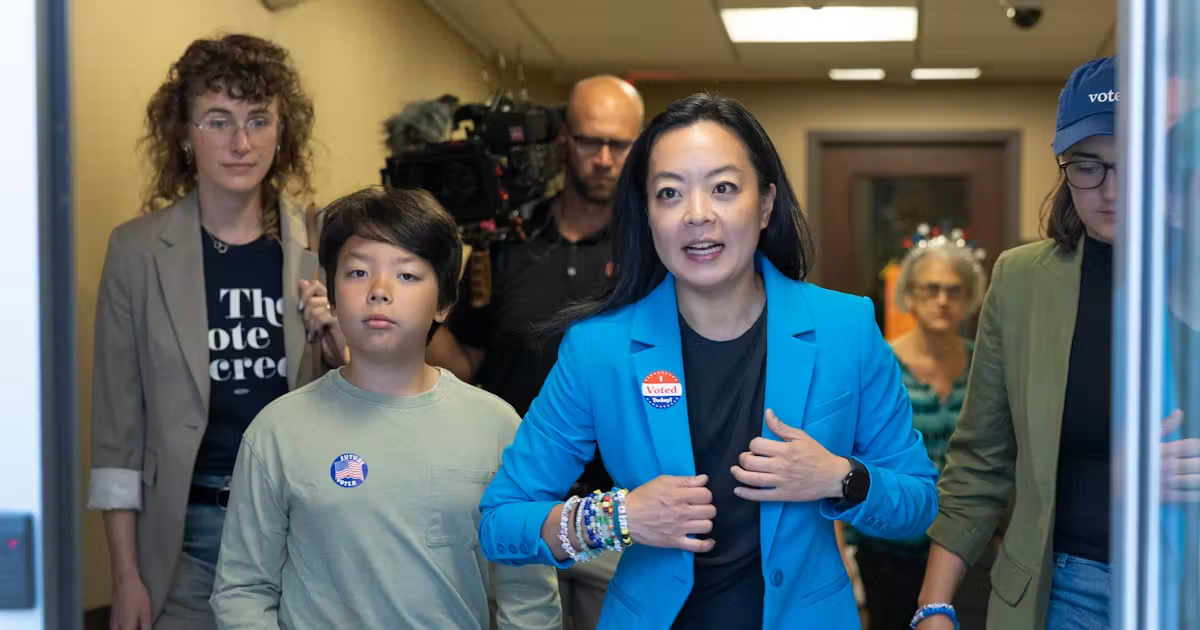
The progressive momentum of the summer has stalled. Francesca Hong’s surprising loss in Wisconsin’s gubernatorial primary on Tuesday, following the unexpectedly narrow victory of Michigan’s Abdul El-Sayed last week, calls for a reassessment of the state of Democratic voters. They might be frustrated with the party establishment, but they still appear to be cautious about fully embracing progressives, particularly in swing states. The primaries in New York and Colorado, where three House incumbents were unseated and other more establishment and center-left candidates were defeated, suggested that Democratic voters were moving both ideologically leftward and away from heeding the guidance of party leaders. In those states and others, candidates backed by Alexandria Ocasio-Cortez, Bernie Sanders, Elizabeth Warren, and the Democratic Socialists of America were winning and beating opponents supported by House Minority Leader Hakeem Jeffries and others from the party’s center-left wing. But shifting to the Midwest introduced two other elements to these contests: more conservative electorates and electability considerations. While I don’t have data to prove this, I would assume that the average Democrat in Michigan and Wisconsin is less progressive than in the New York districts where DSA-backed candidates won. And in the Michigan and Wisconsin primaries, prominent figures in those states, mostly notably governors Gretchen Whitmer and Tony Evers, emphatically endorsed Hong and El-Sayed’s opponents, arguing that they were more likely to win the general election. Democratic voters are likely to be particularly receptive to these arguments in Michigan and Wisconsin, both of which are must-win presidential states and flipped from Donald Trump to Joe Biden back to Trump over the last decade. Hong’s defeat was almost a mirror image of El-Sayed’s victory a week earlier. Pre-primary polls, as with El-Sayed, suggested Hong had a comfortable double-digit lead. But instead, Milwaukee County Executive David Crowley and Hong ended up effectively tied, as Representative Haley Stevens and El-Sayed were last week. (El-Sayed won by about 1 percent; Crowley by even less.) Like El-Sayed, Hong won in areas near the state’s colleges but trailed her more centrist opponent in small counties and the state’s heavily Black urban county (Wayne County in Michigan, Milwaukee County in Wisconsin.) While it’s too early to have such full analysis of the results in Wisconsin, I assume that Hong, like El-Sayed, Zohran Mamdani, and other progressives, defeated her more centrist opponent among younger and college-educated voters but trailed with African Americans, non-college voters, and those over age 50. We don’t know if the polls were wrong, Crowley gained ground, or Hong lost it in the final days of the campaign. But two factors probably shaped the stunning outcome a lot: Evers’s rejection of Hong and strong backing of Crowley; and Hong’s own comments reinforcing doubts about her, most notably when she at first refused to fully backtrack from her 2020 tweet calling for ending the celebration of Thanksgiving. It was notable that prominent progressives such as Warren, Ocasio-Cortez, and Sanders, who had campaigned aggressively for El-Sayed, refused to endorse Hong in the final days of the campaign. I suspect they, like center-left Democrats, were skeptical she could win the general election and didn’t want her defeat to tar the broader progressive movement. There was some good news for progressives on Tuesday in the Midwest. Peggy Flanagan, the lieutenant governor of Minnesota who was backed by Warren and other prominent progressives, easily defeated Representative Angie Craig in a Senate primary. Craig, like Representative Stevens of Michigan, was the darling of the center-left both in her state and nationally. Tim Walz’s wife Gwen endorsed Craig, as did Pete Buttigieg. Craig, who represents a swing district, leaned into electability, as fellow center-left candidates Crowley and Stevens did. But I suspect voters in Minnesota cared less about that issue than in Wisconsin or Michigan. After all, while Minnesota isn’t super blue, Democrats nearly always win presidential and Senate races there these days. Fairly liberal figures (Paul Wellstone, Al Franken, outgoing Senator Tina Smith) have won in Minnesota in recent years. So if Flaganan wins in November, she’ll likely be a champion for progressive causes. But she won’t be the champion for progressive electability that many on the left desperately want, because she wouldn’t have carried a swing state. Tuesday’s outcome, though, may be good for both wings of the party. Progressives get to test their electoral theories with the better candidate (El-Sayed instead of Hong). Centrists don’t have to root for a leftist that they dislike in a second key swing state. The battle for the soul of the Democratic Party will continue into the 2028 presidential primary. And that’s where it should be decided anyway.
Francesca Hong’s Loss Is Both a Blessing and a Curse for Progressives
Her loss in Wisconsin and Abdul El-Sayed’s near-defeat in Michigan suggest that Democratic voters in swing states may be wary of nominating progressives.
767 words~3 min read