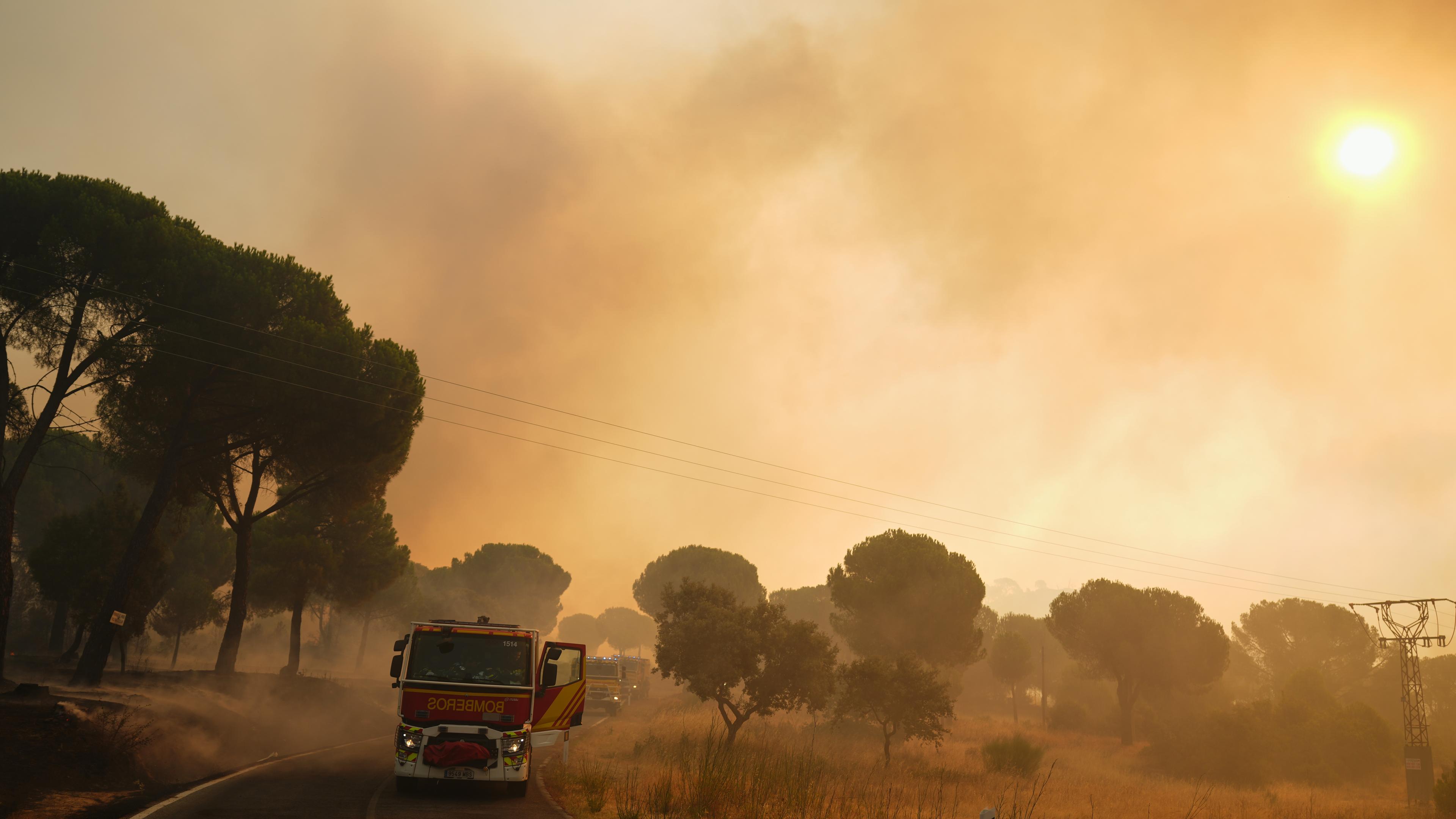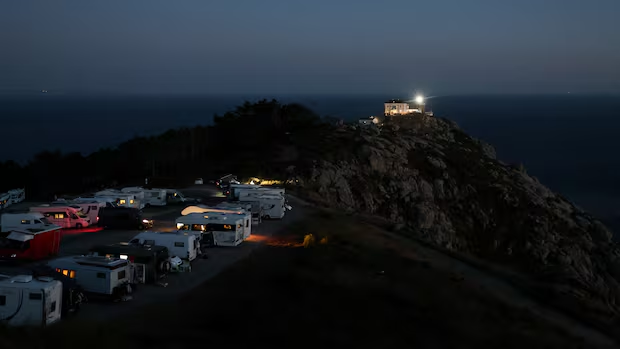
Climate·NewWith tourists flocking to northern Spain to see Wednesday’s total solar eclipse, authorities are deploying police and preventative measures to mitigate the risk of more fires sparking as the country battles a heatwave and wildfires.Authorities taking measures to monitor and stamp out new fires during Wednesday's eclipseAlexandra Mae Jones · CBC News · Posted: Aug 12, 2026 4:00 AM EDT | Last Updated: 13 minutes agoListen to this articleEstimated 6 minutesThe audio version of this article is generated by AI-based technology. Mispronunciations can occur. We are working with our partners to continually review and improve the results.Tourists in camper vans and motorhomes wait in front of Cape Fisterra lighthouse the day before the solar eclipse, on the Costa da Morte ('Coast of Death') in northwestern Spain on Tuesday. Spain is deploying thousands of police officers to help fight potential fires during eclipse day due to the influx of tourists. (Nacho Doce/Reuters)Hundreds of thousands of tourists have descended on Spain in the hopes of experiencing Wednesday's solar eclipse.But the celestial event comes amid elevated temperatures and an increased risk of wildfires in Spain, raising alarm bells for authorities hoping to ensure the boom in astrotourism doesn’t come with lasting fire damage. "We've had an extremely tough summer in Spain, with yet another series of major forest fires. That's why we must restrict any kind of activity that could generate a spark," Virginia Barcones, secretary general for civil protection and emergencies at Spain's Interior Ministry, told Reuters.A heat wave has been smothering much of Europe since May, and Spain is currently grappling with a devastating wildfire season. More than 603,000 acres (2,440 square kilometres) of land have been burned in around 400 fires so far this year, according to the European Forest Fire Information System.To ensure that eclipse tourists don’t add to this number, authorities are deploying 35,000 officers on Wednesday to large, outdoor gatherings in the hopes of spotting and stopping any new fires that may start, according to Barcones.Forest rangers work in a wildfire-scorched area near Casillas, Avila province, Spain on July 30. (AP Photo/Olmo Calvo)Spain is one of the best viewing locations for Wednesday's solar eclipse — the narrow band of totality, around 200 kilometres across, also crosses northern Russia, eastern Greenland and western Iceland, clipping the northeastern tip of Portugal and curving across a wide swathe of northern Spain, ending at the Balearic Islands. Around 15 million people live in its path, mostly in Spain. Only those in the path of totality will witness the moon fully covering the sun. In Canada, a partial eclipse will be visible, with those in Newfoundland seeing the most coverage. Authorities are reminding viewers to always use eclipse glasses to protect their eyes. This will be the first time a full solar eclipse has been visible from mainland Spain in 120 years, and the excitement has sparked a flurry of travel. A fishing boat is silhouetted during a partial solar eclipse in Halifax on March 29, 2025. (The Canadian Press/Darren Calabrese)Earlier this summer, authorities in Spain announced that special measures approved by the Ministry of the Interior would be in place for the solar eclipse to handle the large crowds anticipated. Searches for lodging along the eclipse’s path of totality spiked as the event grew nearer, according to Expedia Group, with Valencia, Spain, seeing a 245 per cent increase in searches compared to the previous year. Get ready for 'meteor Christmas' with an added bonus: a partial solar eclipseA total of 660 official viewing sites have been outlined by regional governments in the hopes of handling the expected influx of more than 440,000 people. Authorities estimate around 1.5 million people could be on the road during the day to head to viewing sites. Both national and local authorities are warning tourists against using barbecues or going into dry countryside where fire risk is higher. The eclipse is anticipated to contribute more than 347 million euros to Spain's economy, according to a July economic impact study by the Ministry of Economy, Trade and Business. Dry conditions, fire fearsThree major wildfires are still burning in the provinces of Huelva, Segovia and Huesca. Only one of the severe blazes is in the path of totality, according to Joe McNorton, a scientist with the European Centre for Medium-Range Weather Forecasts: the Las Peñas de Riglos wildfire active to the north of Zaragoza, which "could pose a danger if astro-tourists venture into the area."Burnt trees stand in an area scorched by a wildfire near Vila Vella, Valencia province, Spain, on July 30. (Damian Torres/The Associated Press)But the forest fire index across much of the Iberian Peninsula and the Balearic Islands is expected to reach "very high or extreme levels" on the day of the eclipse, according to AEMET, Spain's meteorological agency. And the country is perilously dry: last month, only 4.3 millimetres of rainfall was recorded across mainland Spain, a quarter of the normal precipitation expected this time of year. It was the driest July on record, according to AEMET. "Around 90 per cent of wildfires are human-caused, so the presence of many more people in rural areas inevitably brings more potential ignition sources," McNorton told CBC News. WATCH | Heat wave in Europe threatens to fuel further wildfires:Heat wave threatens to further fuel Europe’s wildfiresJuly 28|Duration 2:02Wildfires in France have forced 4,000 more people along the Atlantic coast to evacuate as another heat wave threatens to fuel the flames there and in neighbouring Spain.AEMET is forecasting temperatures upwards of 35 C on eclipse day, with some regions reaching 40 C, although peak temperatures will be down two to five degrees by the time of the eclipse. Reykjavík, Iceland, will see totality at 5:48 p.m. local time, but viewers in Spain won’t see the eclipse enter totality until just before sunset, with northwestern Spain entering totality starting at around 8:28 p.m. local time. At its maximum, totality will last two minutes and 18 seconds, although this will vary by location. Eclipse fervor holdingEven amid a heat wave and wildfires, eclipse travelers have not been deterred. Jan Cami, a professor in the physics and astronomy department at the University of Western Ontario in London, Ont., says he is unsurprised. "It’s an event where you don't need to be a scientist at all to actually enjoy that this is an absolute spectacle that nature has provided for us," Cami told CBC News.During maximum totality, the temperature drops, and stars and planets become briefly visible during the day, an experience so "overwhelming" that those who witness it often start making plans for their next trip to see it again, he said. He has colleagues both in Spain and on a cruise in Iceland waiting for their chance to see the sun vanish on Wednesday. A view of totality during the solar eclipse on April 8, 2024, in Hot Springs National Park, Ark. (Nick Ingram/The Associated Press)"I think [travelling for celestial events] is a great opportunity at the same time to learn about other parts of the world."It’s this sense of shared meaning that Cami is hoping will touch tourists in Spain – that those who battle the heat to see the eclipse will reflect on the struggles of the country they’re in, and how far-reaching the impacts of climate change are. The 2026 eclipse is just the first in a trio of solar eclipses in the next few years that will be visible from Spain. Two more are expected, on Aug. 2, 2027, and Jan. 26, 2028, respectively. The 2027 solar eclipse could prompt even more astrotourism, Cami predicts. The path of totality will cross southern Spain before continuing to Morocco, Algeria, Tunisia, Libya, Egypt, Saudi Arabia and Yemen. "You can see the total eclipse of next year while [at] the pyramids of Giza," he said. ABOUT THE AUTHORAlexandra Mae Jones is a senior writer for CBC News based in Toronto. She has written on a variety of topics, from health to pop culture to breaking news, and previously reported for CTV News and the Toronto Star. She joined CBC in 2024. You can reach her at alexandra.mae.jones@cbc.caWith files from Reuters
Spain still grappling with wildfires amid influx of solar eclipse tourists | CBC
With tourists flocking to northern Spain to see Wednesday’s total solar eclipse, authorities are deploying police and preventative measures to mitigate the risk of more fires sparking as the country battles a heatwave and wildfires.
1,351 words~6 min read