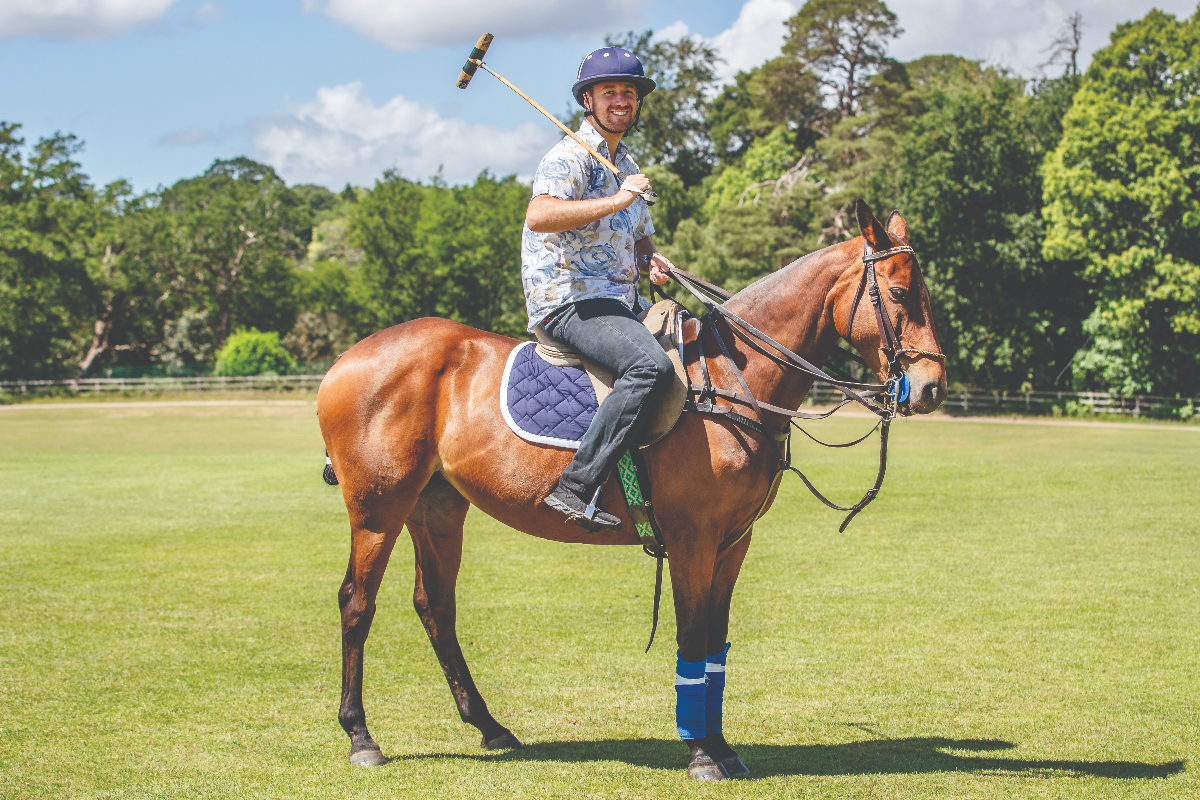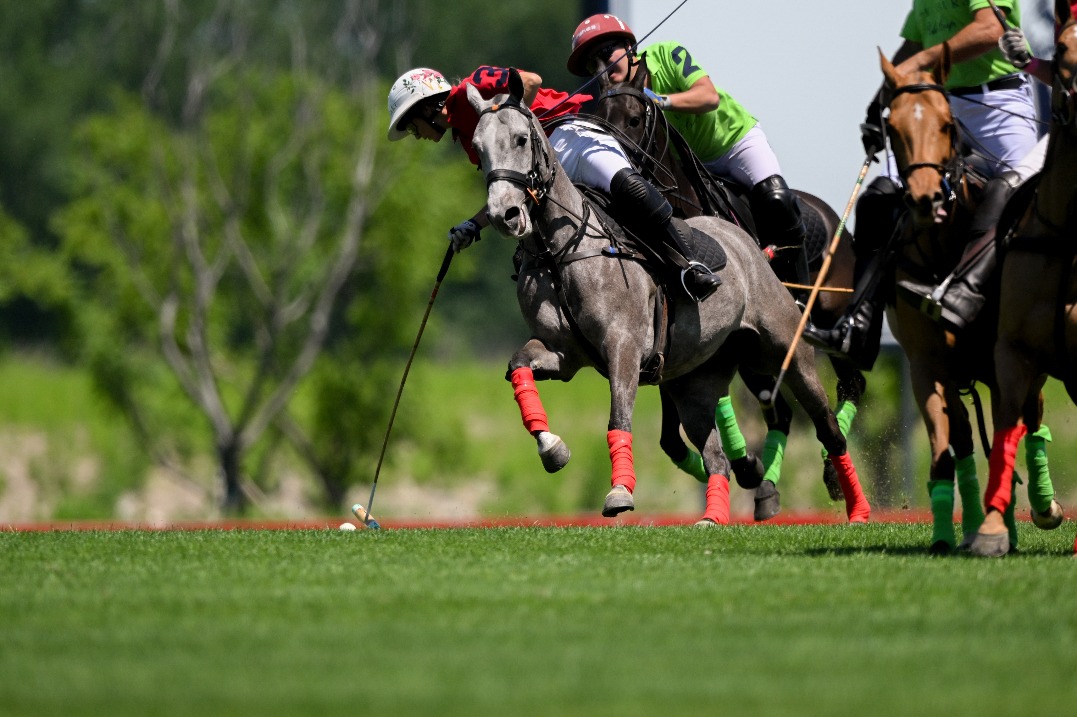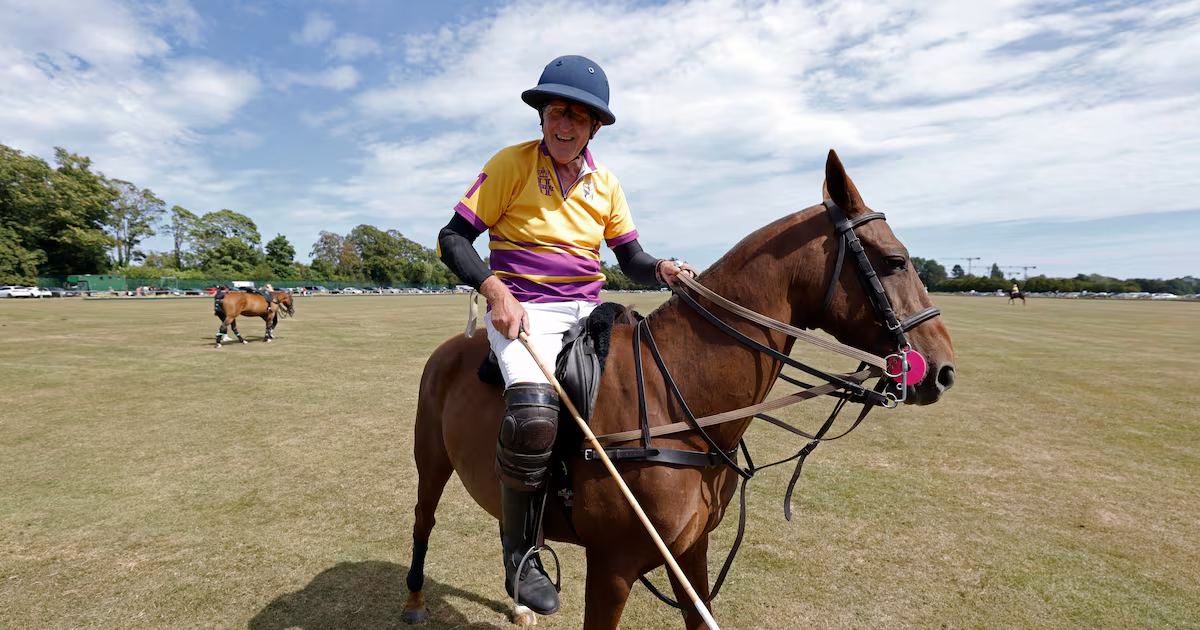
“The animals we hear the most are the elephants trumpeting and the monkeys,” says Derville Meade, who is wearing a little gold stirrup pendant around her neck.She’s indicating towards Dublin Zoo’s green fence that runs adjacent to the pristine nine-plus acres in the Phoenix Park that is occupied by the All Ireland Polo Club.At one end of the site are a number of horse lorries, with various picnics going on around them. On the polo ground itself are eight beautiful silken horses, galloping around while their riders try to score team goals by hitting a white ball with fairly hefty mallets. In the distance are the park’s Wellington Monument and the Dublin Mountains. Meade is the first woman president of the Polo Club, which has been in existence since 1873. Her predecessors include the Duke of Connaught (1900), the Lord Lieutenant (1919), the Governor General (1929), and the Marquis of Waterford (1987). For a very long time, women did not make up any significant part of the membership. “When I joined the club first, in 2003, there were maybe four women in the club. Now there are loads of really good ladies playing,” says Meade.All Ireland Polo Club president Derville Meade. Photograph: Nick Bradshaw She gives me a crash course in the basics of polo. “There are four people on a team, and you need at least two horses per person. There are two umpires. There are four chukkas [a time section of play of seven and a half minutes].”The aim of the game is to score as many goals as possible. In between each chukka, players change what they refer to as “polo ponies”. They’re not actually ponies, though, they are “small horses”, as Meade explains. Most of the horses have their tails plaited and tied up, and hogged manes, so that mallets or reins don’t get caught in them. What is the allure of the game to Meade?“I love the fact it’s a team sport,” she says. “An awful lot of horse sports are solitary, like showjumping. It’s just you and the horse, and you’re doing that on your own. Dressage, you’re doing that on your own. Whereas with polo, you’re out there as one of eight people having the craic.”The polo season runs from May to September, and all matches are open and free to the general public to watch. The tournament being played in the glorious sunshine over this August weekend is for the Freebooters Six Goal Cup. Each sport has its own vocabulary, and so does polo. Players have “handicap goals” ranging from minus 2 to 10 depending on their skill level. There are four on a team, and, for this competition, they collectively need to have a handicap, or “goal” number of six. The idea is to make the teams as equal as possible. Commentator Mark Ronan stands in front of the polo clock on the clubhouse roof. Photograph: Nick Bradshaw Mark Ronan, a long-time club member and polo player, is up on the roof of the lovely club building with a mic, commentating on the match. There are a good 100 or so seats up top, of which about a fifth are occupied. There are also several dogs running round in the vicinity, including an endearing pair of identical chestnut-brown spaniels. Ronan is bellowing out the names of the players, doing an entertaining running commentary on what’s happening on the ground. Ronan explains: “Being the chief commentator for the polo club means you have to be very loud and boisterous. The sound travels on a really, really good clear day. So mates of mine were in town once and they could hear this kind of echoing buzzing hum, and eventually one said, ‘That sounds like Mark.’ And I got this text saying, ‘Are you doing commentary today?’ They could hear me down in town.” The distance between the polo grounds, which is at a slight elevation, and Grafton Street is about 3km. Ronan clearly has a voice that would be useful in alerting people to an emergency. The club has 40 active playing members, and about 100 non-playing members. Cost of joining for playing members is €450 and, up to now, has been €200 for non-playing members. Who funds the club?Players in action at the All Ireland Polo Grounds in the Phoenix Park. Photograph: Nick Bradshaw Teams compete in the Freebooters Six Goal Cup in the Phoenix Park. Photograph: Nick Bradshaw “All of this is all us,” Ronan says, gesturing around the grounds. “The upkeep of the fields, the upkeep of the club, the clubhouse here, everything is done by us as club members with club funds.”“We need to get more sponsors; we need to fundraise,” Meade says. “The building always needs a lot of maintenance.” Out on the grounds, the two teams in competition are Tyrone and LKR, playing in red and blue respectively. LKR are up five goals to one. Also on the roof is a large “Polo Clock” which runs for seven and half minutes at a time, and is paused when someone falls off (nobody falls off while I am there), or the umpire rules a foul. I remain unclear on what constitutes a foul, other than being sneaky about blocking access to the ball – which definitely happens a couple of times.One thing I had never realised about polo, never having watched any before, is how fast and skilled it is. It’s like hurling on horses. Several of these horses, I learn, are former racehorses that have been trained to stop and turn quickly. In fact, my only prior knowledge of polo of any kind is that it is played by some members of the British royal family. I ask Ronan how he rates Britain’s prince Harry as a player.The Stone family from Rathoath, Co Meath – grandparents David and Carol, sons Mark and David, and grandchildren Max, Gio and Lochlainn. Photograph: Nick Bradshaw Horses hitched to a trailer at the All Ireland Polo Grounds in the Phoenix Park. Photograph: Nick Bradshaw “Not very good as an individual,” he says right away. “He has solid ponies and is always surrounded by good team players. But the Duke of Edinburgh was very good; a very solid player.” (The late duke – otherwise known as prince Philip, husband of queen Elizabeth II – had a handicap of five. Prince Harry’s is either one or two, depending on where the internet leads you; in polo, unlike in golf, the better the player the higher the handicap.)Speaking of royalty, how about the fact that polo is often considered to be an elitist sport, due to the cost of maintaining several horses?Meade says, “You can always rent horses to play polo. You don’t have to own them.”“Some people say polo is completely inaccessible, which I completely disagree with,” Ronan says. “Polo is one of the only sports that men and women can play together, and that generations of family can play together. There is a team going out there later on where there are three generations of the one family playing on the team.” He is referring to grandfather David Stone, his two sons, and a grandson.“Although it gets portrayed as an elitist sport, it is probably one of the most inclusive sports. I have travelled all over the world with polo. Winston Churchill said that a polo handicap is a passport to the world,” Ronan says.Time counts down and a hooter is sounded to mark the end of the match. The end result is eight goals to one, with the winning team being LKR. They will go on to play the winners of the next match the following day.[ ‘People look over the fence, taking photos’: The pros and cons of living in the Phoenix ParkOpens in new window ]I cross the field to find Michael Connolly from Milltown, Dublin, one of the players on the winning team. Connolly has been playing polo for 20 years, since he was 16. He rode two horses today, Sahara and Luna, both former racehorses. Out of the eight goals for his team, he scored five.Is it usual, I ask, to win by such a large number of goals?“It’s very unusual,” he says. “It’s usually within one goal at the end. It’s all about tactics. The tactical side of it is what makes it so attractive to me.”Tara Moore, a professor of personalised medicine at Ulster University, is watching her daughter Luca out on the field. Luca is one of seven daughters, all of whom play polo.“My daughter Amelie should be out there too,” Moore says. “But she got a call two days ago to say that Miss Northern Ireland had dropped out of Miss World due to illness, and as Amelie was first reserve, would she go instead?” So as we speak, instead of playing polo alongside her sister, Amelie Moore (18) is flying to Vietnam to compete in the 73rd Miss World, representing Northern Ireland.
It’s like hurling on horses: The polo players of Phoenix Park
From May to September the park resounds to the thunder of galloping hooves, players’ shouts and enthusiastic commentary at the All Ireland Polo Club
1,491 words~7 min read