Story audio is generated using AI
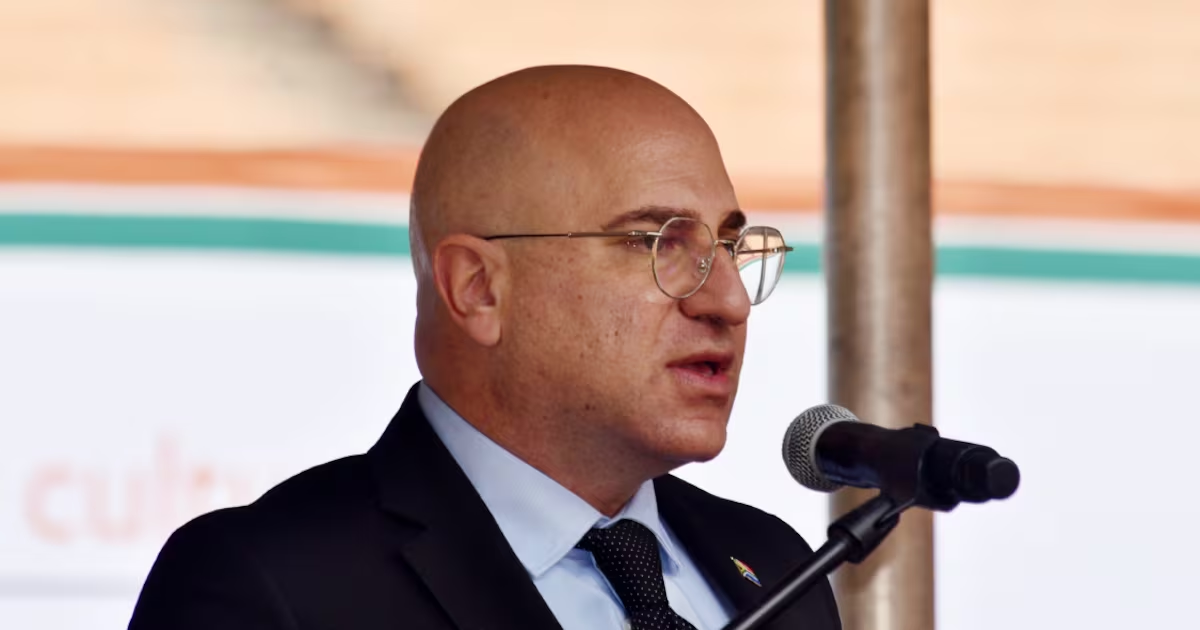
The General Industries Workers Union of South Africa (Giwusa) has called on the government to nationalise the multibillion-rand pharmaceutical sector after a recent announcement by drug manufacturer Adcock Ingram that it planned to retrench more than 240 workers. Giwusa president Mametlwe Sebei said the sector lost 2,500 direct jobs in the past 18 months due to the closure of nine local manufacturing plants. He said the decimation of domestic production capacity is not a statistical tragedy, but rather “it is a systemic indictment of the policy frameworks that have prioritised short‑term cost‑cutting over sustainable local production”. “The recent announcement of retrenchments of over 240 workers at Adcock Ingram, on which we are currently being consulted, underscores that this trend is continuing.” Giwusa, an affiliate of the South African Federation of Trade Unions (Saftu), organises workers in the pharmaceutical sector and is a party to the bargaining council for the industry. The South African pharmaceutical market was valued at $7.88bn-$8.3bn in 2024/25, acting as Sub-Saharan Africa’s largest and most sophisticated medical hub. It is dominated by major drug manufacturers including Aspen Pharmacare, Adcock Ingram and Cipla Medpro, among others, and accounts for about 20,000 jobs. Sebei said Giwusa demands the immediate nationalisation of the pharmaceutical industry, as the production of essential medicines is too critical to be left in private hands. “The state must take direct ownership and control of manufacturing facilities to ensure that production is driven by social need, not private profit. We demand a public, integrated pharmaceutical company to guarantee the production of essential and life‑saving drugs, ensuring security of supply and creating stable, dignified employment,” he said. “This nationalisation must go hand‑in‑hand with genuine workers’ control over production and a comprehensive reindustrialisation strategy, placing the industry firmly under democratic stewardship to serve public health needs — producing medicines based on social necessity rather than profit margins and capital accumulation. The state must reclaim the capacity to produce medicines for the people.” Sebei also called for the nationalisation of private healthcare and medical aid schemes, saying, “The existence of a two‑tier health system — one for the wealthy and one for the poor — is a structural barrier to universal health. Private hospitals and medical schemes serve to extract resources from the working class while providing care only to a privileged few.” To build a truly National Health Insurance (NHI), Sebei said these assets must be socialised. “The resources currently hoarded in private schemes must be pooled into a single, unified public fund to finance healthcare for all, ending the fragmentation that benefits only the shareholders of private medical aids and hospital groups.” The Giwusa president said the “hollowing out of the pharmaceutical sector and the commodification of health are the inevitable consequences of a system that places private profit above people’s wellbeing”. “Giwusa calls on the workers of this country to recognise that their health, their jobs and their future are intertwined. We will fight against the destruction of these industries. We call for a united front to demand the state take full control of the means of producing health — from the factory floor to the hospital bed. The only solution is democratic public ownership on the basis of working-class control. The workers must control the means of their own health and survival,” he said.Adcock Ingram has been approached for comment, which will be added once received.Business Day