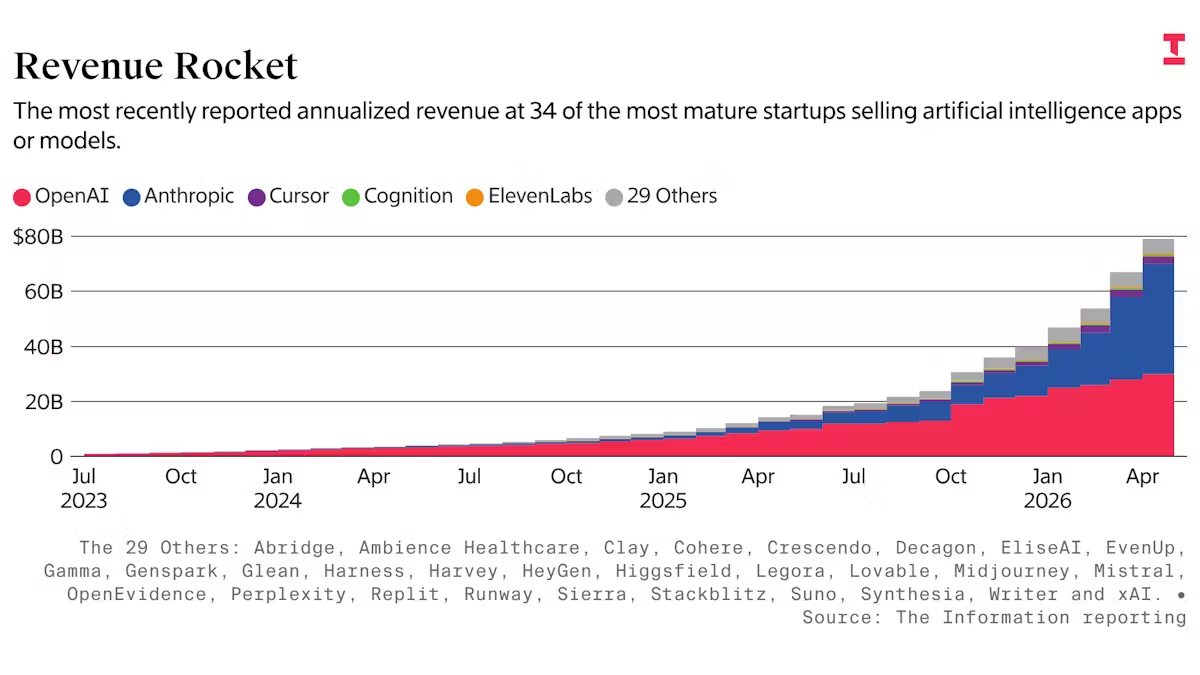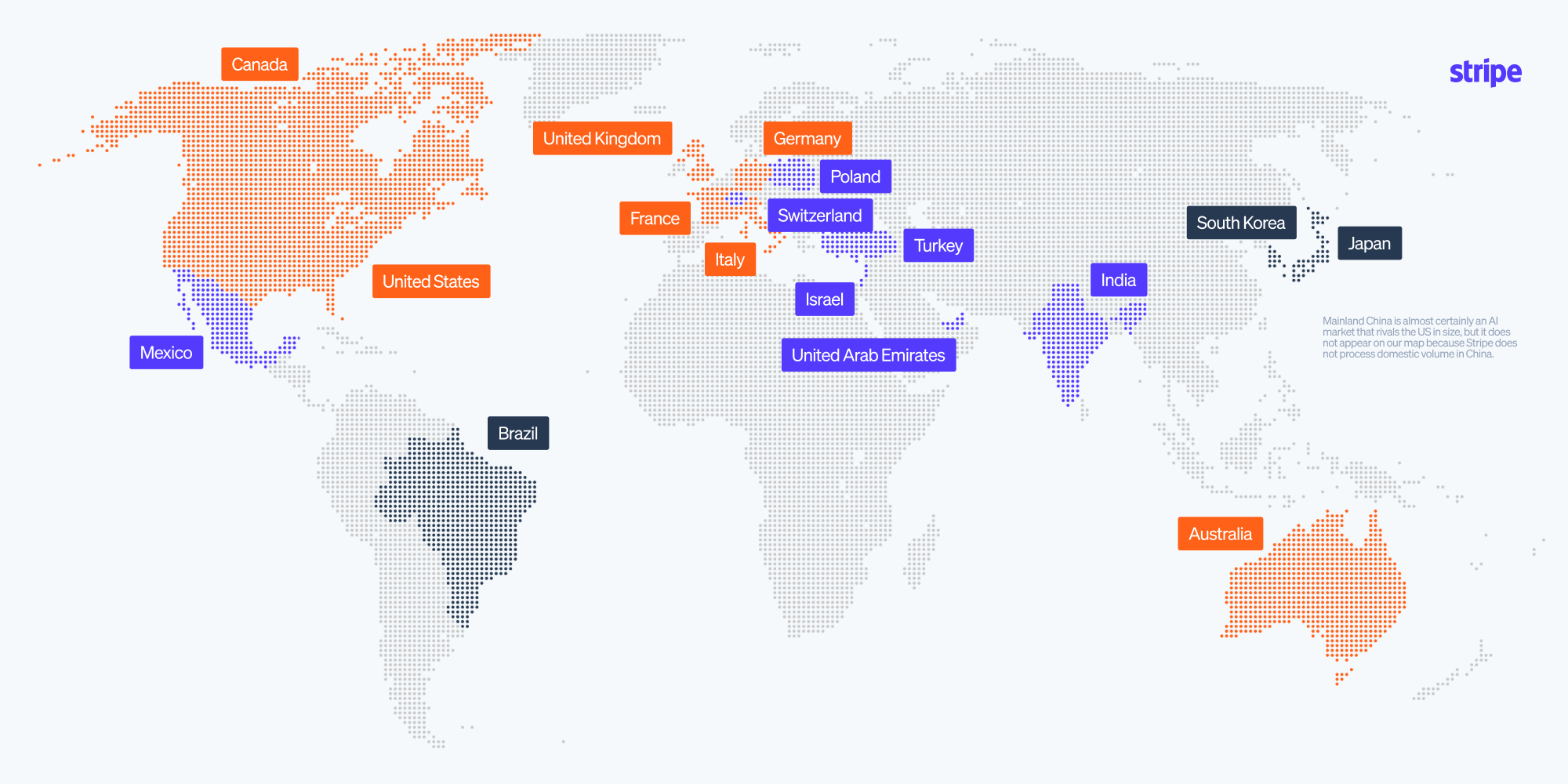
As the revenue infrastructure provider for thousands of AI companies, including 88% of the 2026 Forbes AI 50, Stripe data offers a unique view of the AI economy. Our data shows that AI companies are growing their global footprints quickly: the 100 largest by revenue reached 120 markets on average by their third year of operation. But where is market demand actually strongest? Who’s on the other side of the AI growth engine, and what’s the best way to convert their demand to revenue? To understand, we looked at the transaction data for all AI companies on Stripe and mapped the landscape. We looked beyond simple market size: the countries spending the most on AI on Stripe largely corresponded to high-GDP countries that would make good expansion candidates for any kind of company. More interesting markets emerged when we considered additional signals, like countries with growing AI spending, or AI spending that was disproportionate to their overall payment volume on Stripe.While it’s easier than ever to sell globally, presence alone doesn’t always translate to revenue. To build a truly international revenue base—like the 100 largest AI companies on Stripe, which collectively draw 48% of their revenue from outside their home markets—it’s often necessary to localize the product and offering. This geographical analysis shows where companies might prioritize launches and investments in local marketing, translations, payment methods, and more. Here’s what we found. 1. Outsized AI spend puts new markets in the spotlight
Mapping the AI economy
AI companies are undergoing rapid global expansion while achieving unprecedented rates of growth. We analyzed Stripe data to understand where global demand is the strongest, and how companies can build to best capture that demand.
TL;DRAI
Stripe data: 100 largest AI companies earn 48% revenue abroad; India/Mexico/Poland emerging as high-momentum expansion targets. Localization drives 12-17% revenue gains—fastest platforms use 2x local payment methods; Gamma +22% via UPI, Runway +17.7% LTV.
939 words~4 min read