view more
The brain's immune cells are increasingly recognized as key players in Alzheimer's disease, but exactly how they change as the disease develops has remained unclear. A new study published in Nature Genetics [DOI: https://10.1038/s41588-026-02716-6] provides the most comprehensive map to date of these cells, identifying a protective subtype of brain immune cell that expands as Alzheimer's disease progresses and uncovering the molecular pathway that enables these cells to help defend the brain. The findings offer new insights that could inform future Alzheimer's therapies.
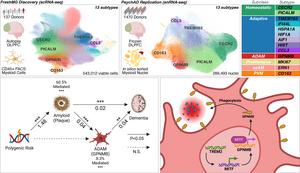
Researchers from the Icahn School of Medicine at Mount Sinai, led by Donghoon Lee, PhD, Assistant Professor of Genetics and Genomic Sciences and Psychiatry, and Panos Roussos, MD, PhD, Mount Sinai Professor of Translational Psychiatry, analyzed more than 830,000 myeloid-origin immune cells of the brain—including microglia, the brain’s resident immune cells, and perivascular macrophages, cells crucial for modulating the brain’s immune response—from the prefrontal cortex of 1,607 donors spanning the lifespan and representing a wide range of Alzheimer's disease pathology. By profiling brain tissue at an unprecedented scale, the team identified six subclasses comprising 13 distinct subtypes of myeloid cells and characterized how these populations change during aging and disease progression.