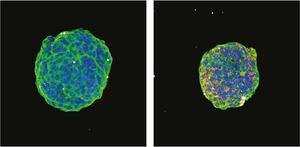
view more
Antisense oligonucleotides (ASOs) have been proposed as a therapeutic approach to shut down the production of faulty proteins in a wide variety of diseases, including cancer. In a study to be published August 11 in the Journal of Cell Biology (JCB), researchers at the Cancer Research UK Scotland Institute and the University of Glasgow identify a pathway by which ASOs enter cells and reach their targets, suggesting new ways to enhance the effectiveness of antisense therapy.
ASOs are short strands of DNA designed to bind to specific protein-encoding messenger RNAs (mRNAs) inside cells. The resulting DNA–mRNA complexes can then be degraded by a cellular enzyme, preventing the mRNA from being used to generate a disease-causing protein. This could potentially halt the production of toxic proteins that underlie certain neurodegenerative disorders or switch off the expression of mutant proteins driving proliferation of cancer cells.
ASOs are taken up into cells via a process known as endocytosis. But exactly how this happens, and how the ASOs subsequently find their target mRNA, is unclear. “Despite the importance of endocytic trafficking for ASO efficacy, the mechanisms governing their uptake and intracellular routing remain poorly understood,” says Jim C. Norman, a professor at the Cancer Research UK Scotland Institute and University of Glasgow.