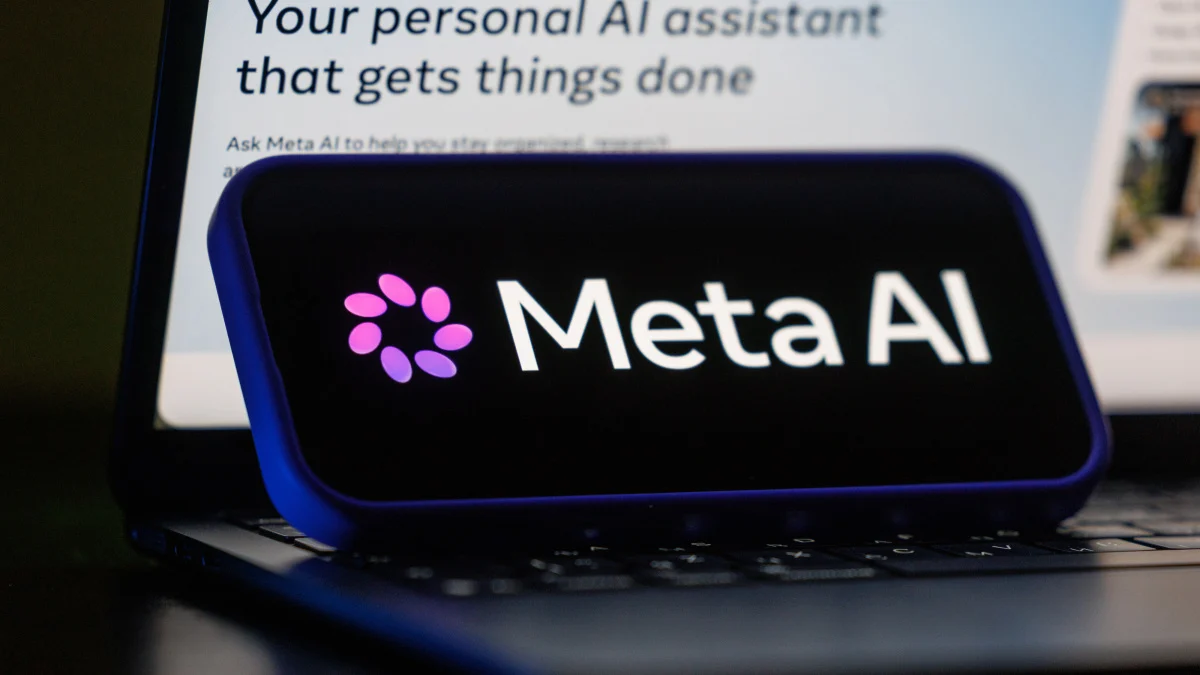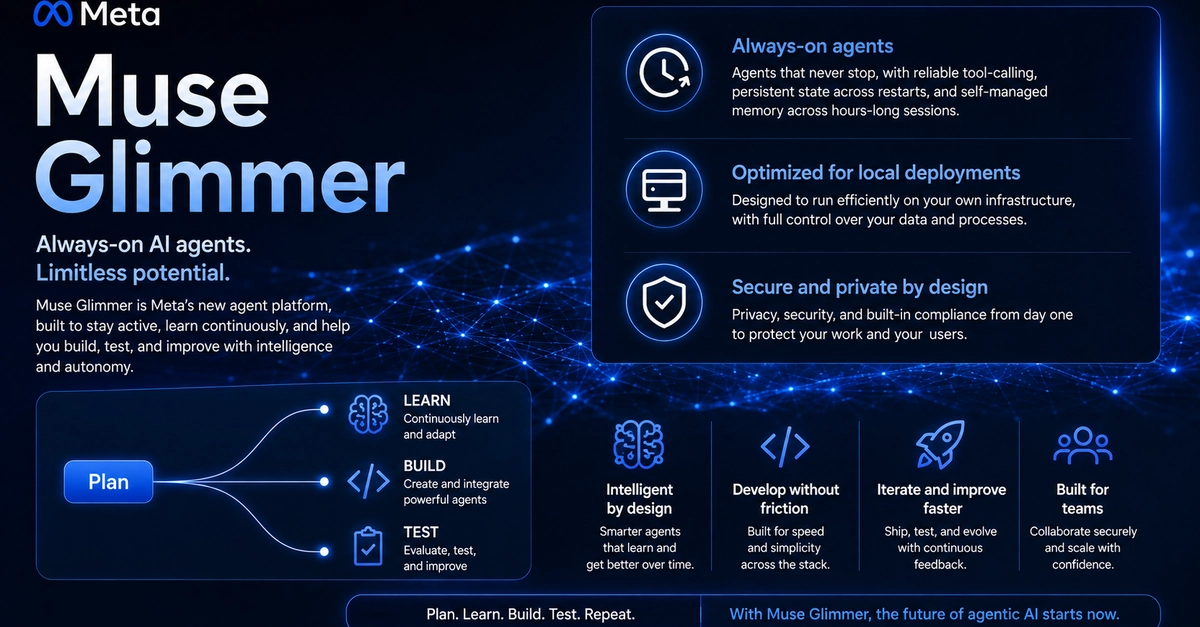
The Meta AI logo is displayed on a smartphone screen placed on a reflective surface onto which the Muse Image presentation webpage is projected, in Creteil, France, on July 9, 2026. Meta announces the launch of Muse Image, its first proprietary image generation model. (Photo by Samuel Boivin/NurPhoto via Getty Images)NurPhoto via Getty ImagesMeta’s release of Muse Glimmer marks a shift in the AI market: a capable model that runs entirely on consumer hardware and costs nothing to use, directly pressuring rivals whose business depends on selling access to the cloud. A file small enough to sit on a gaming PC now does a fair share of the work people pay monthly API bills to get done. Meta’s Superintelligence Labs released Muse Glimmer on Aug. 10, a 30‑billion‑parameter model tuned for agent work, coding and evaluation, under the permissive Apache 2.0 license. Quantized to four bits, it drops under 20 gigabytes and runs on a single consumer graphics card or a Mac with no account, no cloud and no metered tokens. The obvious story is that Meta returned to open source after more than a year away; the sharper one is about who can afford to do this and who cannot.What Meta Actually ShippedMuse Glimmer comes distilled from Muse Spark, Meta’s proprietary flagship, with the larger model acting as teacher. It reads text and images, carries a 131,000-token context window and uses a smaller drafter model to guess several tokens ahead at once, which roughly triples generation speed on a high-end consumer card. Meta says it beats similarly sized models from Google and Alibaba across half of two dozen benchmarks, with clear leads on coding and research tasks and a deficit on computer-use tests.None of that reaches the frontier, and it does not try to. The design target is the always-on assistant that lives on your own machine. It sorts files, drafts replies, runs a coding loop and grades another model's output without a round trip to a data center. Meta built the version of capable AI that never sends a request to anyone's server, then handed it out for free.Why Giving It Away MattersStart with the arithmetic the market keeps skipping. A standalone model is a product only when someone pays to run it. OpenAI and Anthropic hold valuations in the hundreds of billions of dollars because access to their models is the entire business, and every token is revenue. For Meta, a token is a cost.MORE FOR YOURunning models locally enables you to use AI anywhere, anytime, with or without an internet connection.The above line from Meta’s announcement reads like a feature note. It works better as a competitive strategy. Meta does not sell model access. It sells attention, advertising and increasingly hardware, and its Ray-Ban glasses sold more than seven million units in 2025, triple the prior year.A free, capable model running on the user's own silicon feeds all of that while charging nothing for the layer rivals depend on selling. Commoditize the part of the stack you do not monetize, and the part your competitors do monetize gets cheaper to compete with.This is the Google 2000 lesson pointed at a new target. Back then the worry was that search was a commodity and the value would drift up to the applications built on top of it. Instead Google owned the layer everything relied on and gradually absorbed the businesses above it. Meta places the same bet from a different seat. It owns the data and the distribution surface, so it can treat the model itself as the free complement that makes its real assets worth more.Meta’s Return To Open ModelsThe context most coverage skips is how far Meta had drifted from here. Its last open release was the Llama family more than a year ago. After Llama 4 landed flat, the company restructured its AI group into Superintelligence Labs and went proprietary with Muse Spark, and critics read that as the quiet end of Meta's open-source posture.Muse Glimmer reverses that move, and the license tells the story. Llama shipped under Meta’s own restrictive terms with a user cap and usage limits. Muse Glimmer ships under Apache 2.0, the standard permissive license with no such strings. Meta did not just return to open weights; it returned on terms more generous than it ever offered.Superintelligence Labs chief Alexandr Wang has committed to an open-weights release of Muse Spark 1.2, the company's most capable model, "soon." The schedule matters more than any single file. A company shipping free, local, near-useful models on a cadence keeps steady downward pressure on anyone whose margin depends on charging for the same capability.The Shift To On‑Device AIA second signal sits in the file size. A 20-gigabyte model that runs a working agent on your desk creates demand for the hardware in the machine, not the hardware in the cloud.The logic here is old and reliable. As the cost of a capability falls toward zero, it gets built into everything, and total consumption climbs rather than falls. Cheaper tokens mean AI in every laptop, every phone, every pair of glasses, running constantly because running it is nearly free. Intelligence cheap enough to run anywhere ends up everywhere, and a model that fits on a consumer GPU shows that future early. The same shift widens the market for the silicon inside those devices rather than shrinking it.What Investors Should WatchThe reframe sidesteps the tired question of whether open models are good or bad. What matters is that a single object means opposite things depending on where a company makes its money. For a pure model lab, a free local competitor pushes on the core product. For a company that earns its living from attention and hardware, the same model becomes a cost-free weapon and a wall around the business it actually runs.Companies like Meta, which own the data and the distribution and treat the model as a complement, can give away what others have to sell. That asymmetry is the thing to hold onto while the market keeps pricing every model as a product and every giveaway as generosity. The download costs nothing, and the strategy behind handing it out is the part worth paying attention to.
Meta Turns Muse Glimmer Into A Local AI Model That Undercuts The Cloud
Meta’s Muse Glimmer brings a free, local AI model to consumer devices, reshaping cloud economics and pressuring rivals that rely on selling metered access.
TL;DRAI
Meta releases Muse Glimmer, a 30-billion-parameter model (20GB, Apache 2.0) that runs locally on consumer hardware. Commoditizes inference—OpenAI/Anthropic's core business—shifting leverage to companies with data and hardware over pure model vendors.
1,032 words~5 min read