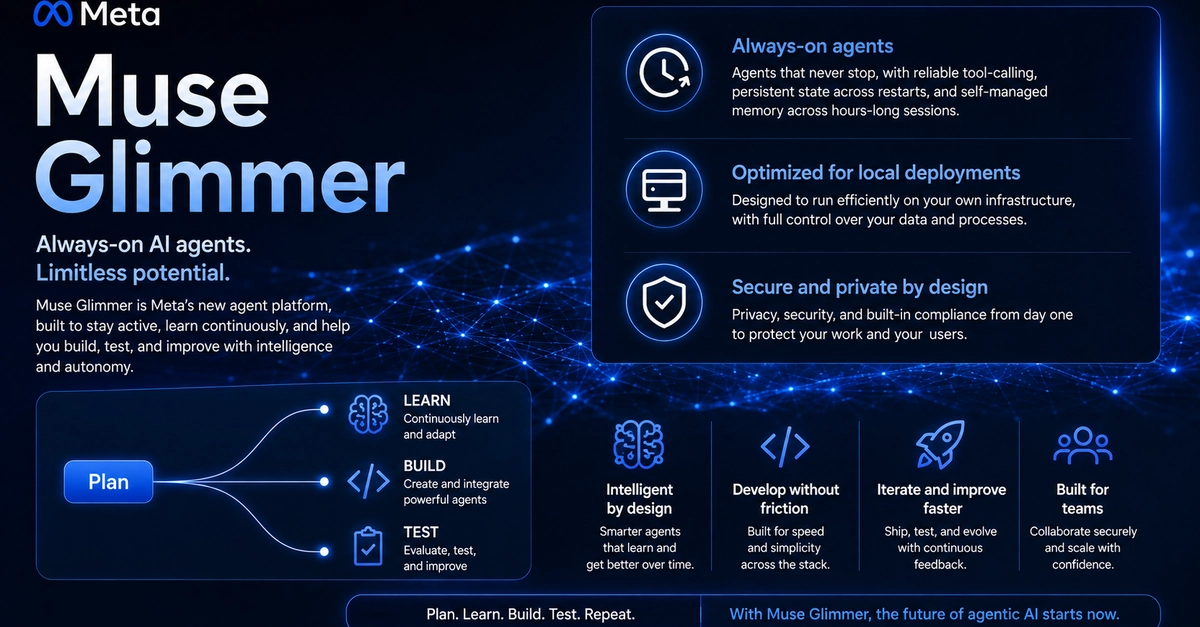
On August 10th, Meta released Muse Glimmer, a 30-billion-parameter open model built specifically to run local AI agents on consumer hardware — scheduling, file organization, tool calling, multi-step tasks — without shipping any of it to Meta's servers. Weights are on Hugging Face under an Apache 2.0 license, so there's no commercial restriction on using it.
Why this one is different from the last wave of "local" models
The 7B and 13B models that filled up Ollama's library over the last couple of years were solid text generators, but weak agents. Multi-step reasoning fell apart, tool calls failed halfway through, and they'd lose track of what happened three steps back in a task.
Glimmer is Meta's answer to that gap specifically — it's a simplified, efficiency-focused derivative of Meta's larger Muse Spark 1.2 model, purpose-built for "always-on" agentic workflows: the kind of thing that needs to keep running continuously on a personal machine rather than answering one prompt at a time.
What it actually needs to run