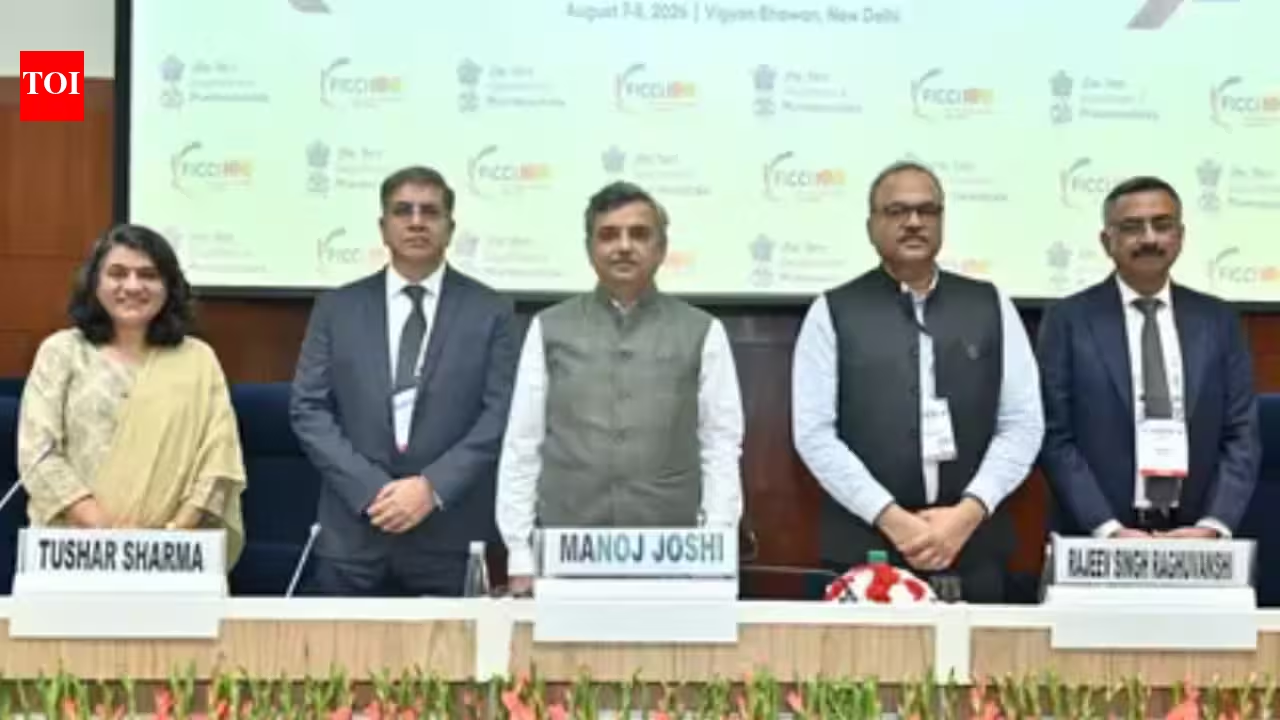
The 11 association that jointly submitted the letter represented manufacturers, traders, healthcare providers, hospitals, clinicians, and patient advisory groups.
Close to a dozen medical device and civil society organisations, among others, have sought a National Medical Devices Regulatory Authority, with the autonomy of telecom body TRAI or insurance’s IRDAI, and regulatory oversight of food authority FSSAI.In their letter to the Union Health Minister JP Nadda, they said, medical devices continue to be seen as “an adjunct to pharmaceuticals” , despite scientific, engineering and regulatory distinctions between the two. Calling for a re-examination of the draft Drugs, Medical Devices & CosmeticsBill, 2026, the letter said, the present approach undermined India’s ambition to become a global medical device manufacturing hub, reduce import dependency, and achieve exports exceeding ₹1,00,000 crore in the next 5–7 years.The ask for a dedicated medical device authority and governance structure has been a long standing plea from the industry, and their latest letter pointed out that other Government agencies had also made similar suggestions in the past. The 11 association that jointly submitted the letter represented manufacturers, traders, healthcare providers, hospitals, clinicians, and patient advisory groups.The “drug-centric framework” of the draft is one of the key concerns they have raised, with the bill retaining “pharma‑style terminology such as “adulterated” and “spurious,” applying criminalisation to engineering deviations.” Criminalisation of technical lapses, the letter points out includes imprisonment of anywhere between one to seven years for labelling errors, documentation lapses, and licensing issues — contrary to global norms where administrative enforcement is the standard, the letter said. It also pointed to expanded police‑style powers, arrest and cessation powers for inspectors, creating “a climate of regulatory fear that deters investment,” it added.Repeated recommendations“Despite repeated recommendations, the bill fails to establish a dedicated National Medical Devices Regulatory Authority,” it said, despite the industry’s ask being echoed by the other Government panels and agencies, it said refering to the Parliamentary Standing Committee Reports 138 & 146, that recommended a separate law and department for medical devices; NITI Aayog’s Draft Medical Devices Bill (2019), which proposed a modern, engineering‑aligned framework, and the World Health Organizations’s global principles, emphasising risk‑management, lifecycle safety, and shared responsibility, it said.The draft omits engineering concepts and standards such as biocompatibility (ISO 10993), usability engineering (IEC 62366), and software lifecycle safety (IEC 62304). And, “the bill applies the same punitive framework across low‑risk and high‑risk devices, ignoring risk‑proportionate regulation,” it added.The joint letter called for - a new expert committee with engineering, biomedical, clinical, and patient safety representation; enactment of a separate Medical Devices Act, aligned with global regulations and the decriminalisation of non‑mensrea (guilty state of mind) offences, replacing imprisonment with administrative enforcement.“India’s medical devices sector cannot be shackled by a pharma‑centric law. Eleven national associations...urge the government to enact a standalone Medical Devices Act. Without this, India risks discouraging investment, innovation, and patient safety — undermining Make in India and Atmanirbhar Bharat.” said Rajiv Nath, Forum Coordinator, AiMed (Association of the Indian Medical Device industry).Published on August 11, 2026