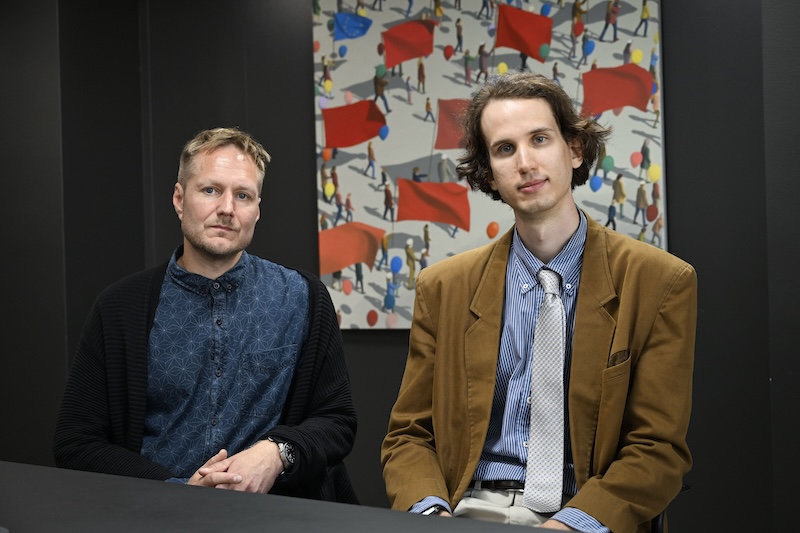
Forecasters rarely get it right, says a social democratic-leaning think tank.Lauri Finér and Jussi Systä examined the accuracy of economic forecasts and found that they are often wrong. Image: Esa Syväkuru / YleYle News15:10Economic forecasts are frequently wrong, according to a new report by the Kalevi Sorsa Foundation. Despite this, they continue to play an important role in political decision making.The social democratic-leaning think tank criticises the close link between economic forecasts and government policy. Its latest report finds that organisations forecasting the development of the Finnish economy rarely get it right."Economic forecasts are largely accurate by chance," says Lauri Finér, the foundation's executive director, summarising the report's findings.Everybody's wrongThe foundation examined GDP growth forecasts produced by seven economic forecasting institutions. The topic is relevant now, as the government prepares to negotiate next year's state budget in September.Researchers found that all of the forecasters were wrong by roughly the same amount. Even predicting economic growth for the current year is often difficult. According to their report, forecasts made in the autumn for growth in the following year differ from the actual outcome by an average of one percentage point."Forecasting institutions are unable to predict economic turning points or even economic growth for the year ahead," Finér says.According to the report, the Ministry of Finance has generally overestimated economic growth.Finér says this can lead to unnecessarily large spending cuts.In addition to the finance ministry's forecasts, the Kalevi Sorsa Foundation examined economic outlooks published between 2016 and 2025 by the Bank of Finland, the Research Institute of the Finnish Economy (Etla), Pellervo Economic Research, the Labour Institute for Economic Research (Labore), Nordea and OP Financial Group.Big differencesThe report also argues that the accuracy of economic forecasts is undermined by the theoretical assumptions on which they are based.Forecasters' models assume that the economy will grow in much the same way as it has in the past. In reality, however, that rarely happens, according to the report.The group also criticises the opacity of economic forecasting. Economists routinely adjust forecasts using their own expertise and judgement, leaving a personal imprint on the numbers."They are, in a sense, adding spices to the pot according to their own taste, but those ingredients are not written into the recipe," Finér says, comparing forecasting with culinary finesses.To improve accuracy, the researchers call for policymakers to rely less rigidly on economic forecasts and to adjust decisions as new data emerges. They also urge forecasting institutions to make their methods more transparent.
Economic forecasts often miss the mark, yet governments still rely on them
Forecasters rarely get it right, says a social democratic-leaning think tank.
411 words~2 min read