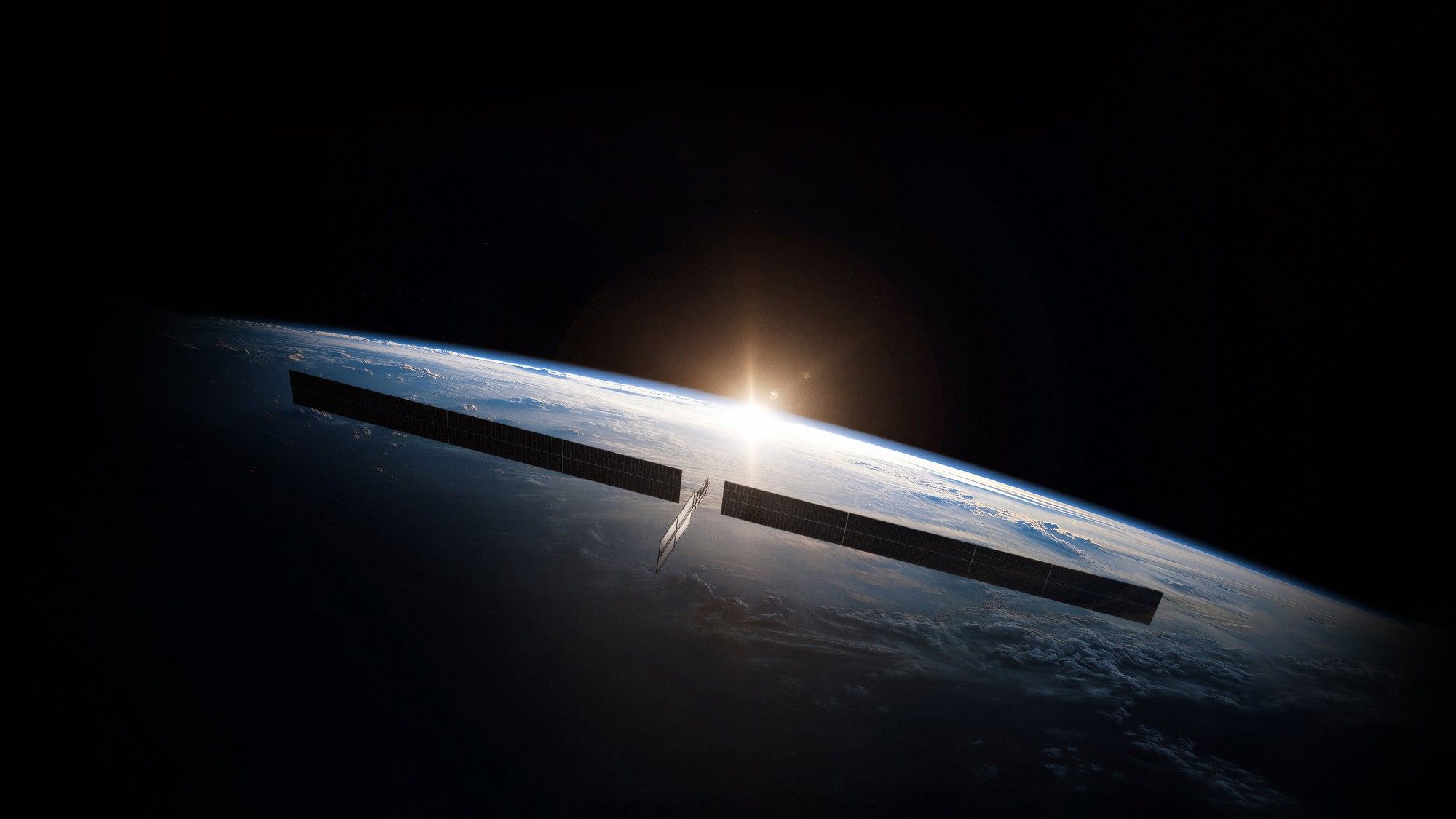
A rendering of one of SpaceX's planned "Starmind" AI satellites in orbit.
(Image credit: SpaceX)
Concentrations of dangerous pollutants from rocket launches and satellite reentries in Earth's upper atmosphere might reach treacherous tipping points if constellations of hundreds of thousands of orbiting data centers get deployed in the next decade, experts say.There's no question that Earth has an AI data center problem. By 2030, AI data centers may be responsible for up to 17% of electricity consumption in the U.S., according to a forecast by the Electric Power Research Institute. New fossil fuel power plants are being built to feed the growing demand for electricity, and aging ones are kept online despite decarbonization plans. On top of that, huge amounts of water are taken from already strained reservoirs to cool the computers.Companies such as SpaceX, Amazon and Blue Origin say they have a solution: moving the power-hungry data crunching infrastructure into space, where solar power is easy to produce, and heat can be radiated out into the frigid vacuum. Combined, those companies have filed applications to the U.S. Federal Communications Commission to launch more than a million orbiting data centers in the next 10 years. Most of those will belong to SpaceX, if all goes to plan; Elon Musk has said the company wants to operate a million-satellite AI constellation all by itself.The plans are making atmospheric scientists tear their hair out. If all these projects come to fruition, the number of satellites being launched to space and reentering the atmosphere will increase 100 times compared to today's numbers.Moreover, the data center satellites will be much larger than the spacecraft orbiting Earth today. This large mass will translate into higher quantities of polluting propellant needed to loft these systems off Earth and a much larger amount of metals vaporizing in Earth's atmosphere during reentry. Neither is good news for our planet's air.Pristine upper atmosphere"Launches and the reentries are really the only things that humans do that deposit material directly into the upper atmosphere," Aaron Boley, an astronomy professor and space sustainability researcher at the University of British Columbia, told Space.com. "And the way things mix in the upper atmosphere means that the launch and reentry emissions are by far more impactful."Most rockets emit black carbon, which could worsen global warming. Satellite bodies are mostly made of aluminum, which likely turns into aluminum oxide when burned in the presence of oxygen. Aluminum oxide is known for its ability to trigger ozone depletion, a hazardous process that was successfully thwarted by the Montreal Protocol of 1987.Currently, scientists don't have a precise understanding of the chemical reactions that occur between the pollutants and the atmospheric gases at high altitudes. They also don't understand the tipping points, which may mean the difference between minor and major impacts on the climate. What is worse, pollutants in the upper atmosphere remain much longer than those emitted by cars and factory chimneys close to the ground."Close to the ground, we have rain and wind that removes pollution from the atmosphere within weeks," Eloise Marais, a professor of atmospheric chemistry at University College London, told Space.com. "If we put it into the higher layers of the atmosphere, we rely on very slow atmospheric processes to bring this pollution back down."Too many launchesBlack carbon from rockets, for example, can stay in the atmosphere for three years, scientists think, meaning its concentrations could dangerously rise in the near future.SpaceX's Starship megarocket is likely to play a key role in the deployment of data center constellations. Unlike SpaceX's current workhorse launcher Falcon 9, which burns a form of the aviation fuel kerosene, Starship combusts the much cleaner combination of methane and liquid oxygen. But Marais cautions that Starship's size and the much more frequent launches that will be needed to deploy the vast constellations would result in an overall increase in the pollution injected into the upper atmosphere."Starship is a bigger rocket burning more propellant," Marais said. "So, in terms of each rocket launch, the difference almost offsets. It has potential per launch to produce quite similar amounts of black carbon."Andrew Wilson, a space sustainability researcher at Glasgow Caledonia University in the U.K., told Space.com that every single Starship launch produces around 76,000 metric tons of carbon dioxide equivalent. That's about as much as 17,727 gasoline-powered passenger cars emit in a year.And up to 77,000 Starship launches — some 15,300 per year — might be needed, according to estimates by Ars Technica, to deploy SpaceX's planned million-data-center constellation. That's a lot of rocket pollution added into the atmosphere. For comparison, there were just 324 orbital rocket liftoffs globally in 2025, according to Space News.