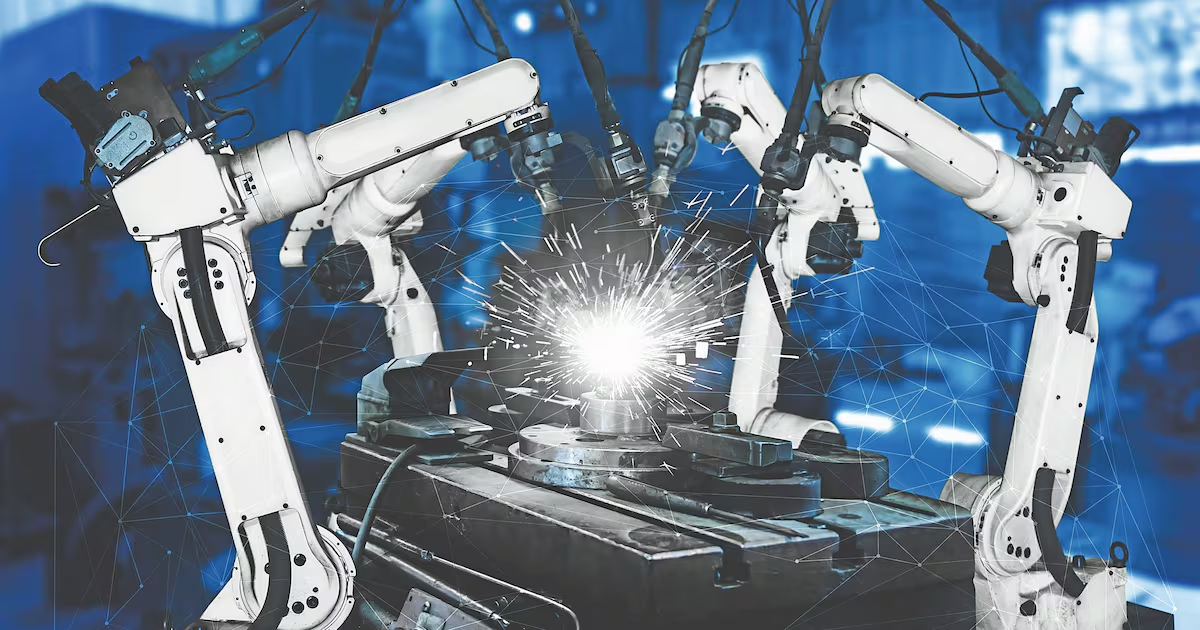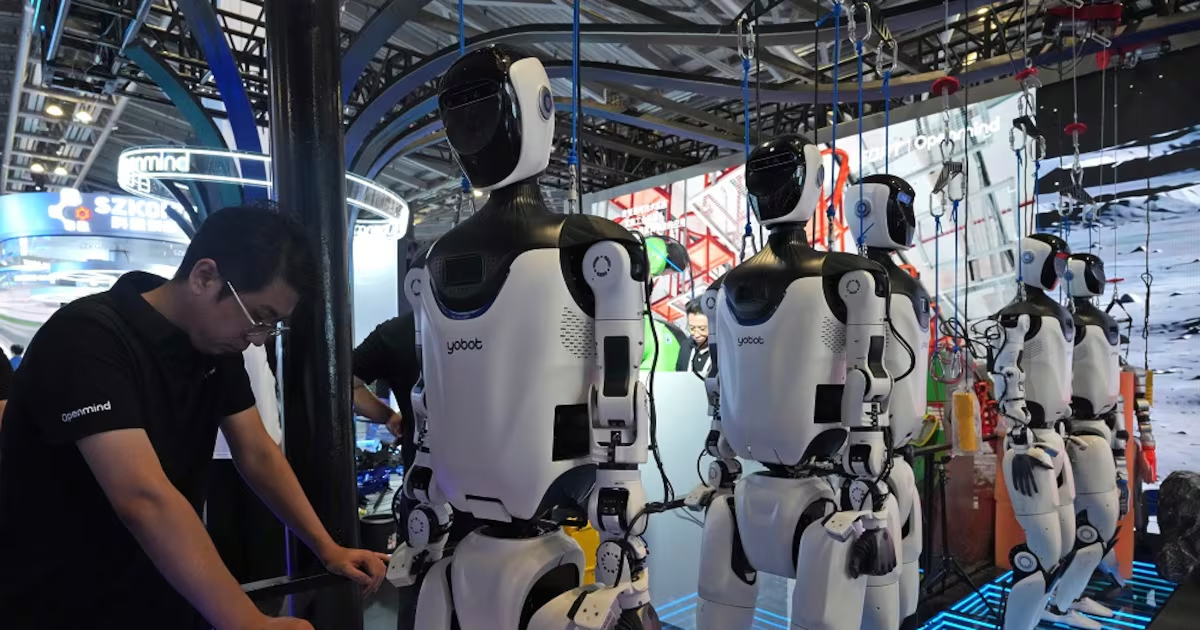
Over the past three years we’ve watched AI evolve at an astonishing pace. Large language models have transformed how we write, code, learn and create. Just as AI was the first chapter of this new technological era, robotics is about to become the second.Computer scientist Ray Kurzweil predicted AI would move beyond our screens and into the physical world. Singularity University co-founder Peter Diamandis often reminds us the greatest breakthroughs happen when exponential technologies converge. Today we’re witnessing exactly that: AI, robotics, sensors, computer vision and advanced manufacturing are colliding to create a new generation of intelligent machines.The question is no longer if robots will become part of everyday life. The question is: where does Africa fit into this story?Every week seems to bring another breakthrough. In July, Norwegian robotics company 1X unveiled the latest version of its Neo humanoid robot hand. With 25° of freedom — remarkably close to the human hand’s 27° — it can delicately sort grapes, pour tea, plug in a USB-C cable and even communicate using sign language. It’s a level of dexterity many roboticists once believed was decades away. Meanwhile, China’s Unitree is pushing robotics into the mainstream through affordability. Its humanoid platforms have dramatically lowered the cost of entry for research and commercial deployment, signalling a future where intelligent robots are no longer limited to billion-dollar laboratories. We will soon see them in businesses and homes. In the US, Figure AI is deploying humanoids into automotive manufacturing, while Tesla, Apptronik and Boston Dynamics are advancing general purpose robots capable of operating in environments originally designed for humans. Europe is responding through companies such as Germany’s Neura Robotics, while China has made robotics a national strategic priority backed by significant manufacturing investment. According to the International Federation of Robotics, 542,000 industrial robots were installed globally in 2024, more than double the annual installations from a decade ago. The 2025 number is about 575,000 industrial robots worldwide. Annual installations are expected to exceed 700,000 units by 2028 if the current growth continues. This is no longer hype. It’s industrial policy. It’s economic strategy. It’s the next global platform shift.Where is Africa?This is the question we should all be asking. Africa has no shortage of brilliant engineers, entrepreneurs or researchers. Our universities are producing world-class talent. We have incredible robotics work emerging in mining automation, agricultural drones, autonomous logistics and healthcare technologies. Yet when we look at the companies defining the future of humanoid robotics, almost none are African.We’re consuming innovation. We’re not yet exporting it. Imagine if 20 years ago we had asked: who will build Africa’s Google? Today we should be asking: who will build Africa’s Figure AI? Who will build Africa’s Unitree? Who will create robots designed specifically for African challenges?This is where I think we often get it wrong. Africa shouldn’t be trying to build the next Optimus. We should be building the first robot for Africa pioneered by Africans.Imagine robots that assist overworked healthcare professionals in rural clinics. Robots that help small-scale farmers improve yields despite labour shortages. Mining robots designed specifically for African conditions. Construction robots capable of helping to tackle our housing backlog. Autonomous maintenance robots for renewable energy infrastructure. Educational robots speaking Zulu, Xhosa, Swahili, Yoruba or Arabic.The opportunity isn’t imitation. It’s localisation. History shows us Africa often leapfrogs technology rather than following traditional development paths. We skipped landlines and embraced mobile banking. We pioneered fintech innovations that the world now studies. Why can’t robotics become the next leap?The real opportunity is convergenceThe most exciting part isn’t robotics alone. It’s robotics powered by AI. Large language models are rapidly becoming the “brains” of robots. Computer vision gives them eyes. New dexterous hands allow them to manipulate the world with incredible precision. Advances in batteries, sensors and manufacturing are making them increasingly affordable. What we should be envisaging isn’t a robot. We need to work towards embodied intelligence. Machines that don’t simply think. Machines that can act.Kurzweil predicted intelligence would increasingly merge with the physical world. Watching today’s breakthroughs unfold, it’s difficult not to feel we’re moving steadily in that direction.Every major technological revolution creates new global leaders. The internet created Google. Smartphones created Apple and Xiaomi. Social media created Meta. Large language models created OpenAI. The robotics revolution will create entirely new companies we haven’t even heard of yet.Why shouldn’t one of them come from Nairobi? Or Kigali, Cape Town, Lagos or Johannesburg? Perhaps the company that defines African robotics hasn’t been founded yet. Perhaps its founders are still sitting in a university engineering lab. Perhaps they’re reading this article.We often ask people to think exponentially rather than linearly. Robotics represents exactly that kind of thinking. While today robots have limitations, with many remaining expensive, specialised or needing supervision, every month they become more capable, more dexterous and more affordable. The real question isn’t whether robots will become commonplace. We know they will. The question is whether Africa will simply import millions of robots designed elsewhere or whether we will build robots that reflect our own challenges, our own cultures and our own ambitions.I remain optimistic because every exponential technology begins with someone asking a different question. Here’s mine: who will build Africa’s first globally recognised robotics company? I have a feeling they’re already here. We just haven’t met them yet.Mann is co-CEO of Singularity South Africa.Business Day
MIC MANN | Africa’s own robots don’t exist, but they will come
Homegrown innovation holds the key to solving the continent's unique challenges
TL;DRAI
Robot installations surged to 542k in 2024, projected 700k+ by 2028, as Figure AI and Unitree scale affordable humanoids. Emerging markets' advantage: localize robotics for local needs (healthcare, agriculture, mining) rather than import, seeding next-gen leaders.
890 words~4 min read