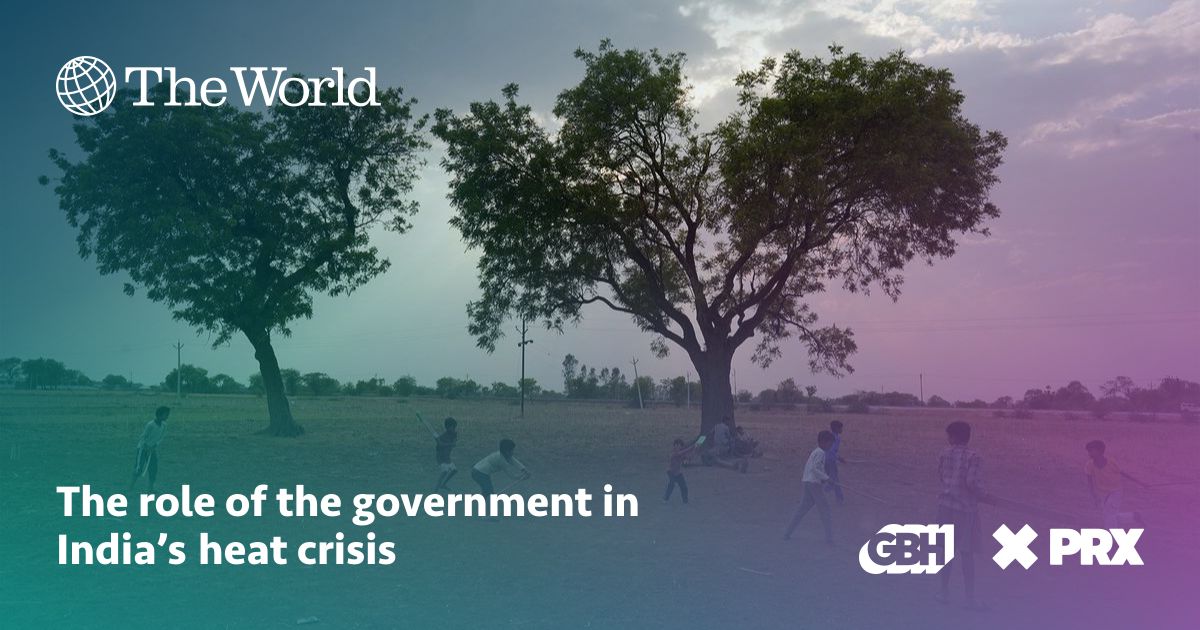
Public radio’s longest-running daily global news program.AboutContactDonateMeet the TeamPrivacyTerms of use©2026 The World from PRXPRX is a 501(c)(3) organization recognized by the IRS: #263347402.The role of the government in India’s heat crisisThe Indian government has declared heat waves an official natural disaster. The World’s Host Marco Werman speaks with climate adaptation researcher Aditya Pillai about what the government’s role is in heat adaptation and the gap between short- and long-term solutions. EnvironmentAugust 10, 2026Updated: August 10, 20269:00Children play cricket on a parched field during a heat wave in Banda, Uttar Pradesh, India, June 21, 2026.In India, heat waves now fall under the classification of official disaster. The government in Delhi announced the designation last week. It is a major change and reflects the growing reality that extreme heat is a deadly threat to people across India. Heat waves that kill more than 3,000 people a day have become normal there. Until now, the main response at the government level has been through so-called “Heat Action Plans.”Low-income communities have been trying to find their own solutions to the heat. The new disaster designation means local governments in India could access a lot more money in response to a heat wave. Aditya Pillai, a researcher at King’s College London who focuses on climate adaptation and extreme heat, told The World’s Host Marco Werman that the disaster designation also carries psychological significance.“Heat existed in this very odd liminal space where it was becoming increasingly clear to observers and indeed everyday people going about their lives that heat was becoming a major problem,” Pillai said. “And so, this is part of a broader slew of declarations across the world where countries are thinking, ‘OK, this is something that we need to be prepared for and deal with.'”Children gather around a mobile phone as local residents rest at a railway station to escape the heat in Banda, northern Indian state of Uttar Pradesh, June 20, 2026.Rajesh Kumar Singh/APAditya Pillai: Heat Action Plans basically tell different government departments what they should do in the event of a heat wave. So, if you’re a local government official thinking about electricity grids, it tells you, “OK, go and buy 20% more power because AC demand is going to go through the roof.” If you’re a government official working in agriculture, it says, “OK, you send out these alerts to apple farmers because they are likely to be affected in this way.” So, it’s supposed to be hyper-specific, but the format is sort of the same across the world. Two things that, in general, Indian heat action plans, European heat action plans, a lot of American heat action plans don’t do is finance the actions and also build legislative scaffolding. So, by that I mean, say that this is a plan under X law, which then gives it legal defensibility and gives it far more teeth.Cattle make their way across a parched field during a heat wave in Banda, Uttar Pradesh, India, as extreme temperatures continue to affect the region, June 21, 2026.Rajesh Kumar Singh/API’m not entirely sure what the long-term stuff even looks like. I think we really need a vision collectively, and this is not just true of India, I think what cities in hot countries look like moving forward. So, you can do a patchwork quilt approach of retrofit the electricity grid here, shade-lined avenue here. But I think this is a much deeper conversation about what cities look like, what the future of work looks like, especially if a large proportion of your economy is already heat-exposed. Because you can build the shade-lined avenue or construct shade. It’ll take you five years to do it. By then, the baseline of the problem shifted, as you very correctly point out.So, the tricky part is, if you’re a national government, you really do need to figure out this very fine balancing act of making sure you build some sort of framework within which states can do what they want based on their localized heat threat. So, you cannot have the same set of actions for an apple farmer in the Himalayan foothills as you do for a beach resort operator on the beaches of South India. You just can’t, right? So, you build a framework and you have to then make sure you give local governments the capacity to act to their local heat and their local population vulnerabilities. And that’s really threading a needle.A child drinks water from a bottle wrapped in a cloth during a hot day in Banda, Uttar Pradesh, India, June 21, 2026.Rajesh Kumar Singh/APIt’s hugely important. I think there is a very important conceptual question at the heart of it, which is, “Is heat even the responsibility of just the state to fix?” By the state, I mean the government. In my opinion, in a perfect world, 20% of the actions being taken will be taken by governments. And then about 80% ends up being stuff like trying to reduce your heat exposure, trying to make sure that your house is built the right way. And these are thousands, millions, billions of individual decisions taken every day that cumulatively become the sum total of heat adaptation in a country or a community.And so, those individualized solutions are hugely, hugely important. You need the 20% of government actions to be the catalytic sort of lever that unlocks the 80%. And that’s the dance that has to be played between these two elements. And that’s the art of heat policy, I think. It’s not about ham-handedly prescribing a whole bunch of things and then just hoping that it happens. It’s about incentivizing things. It’s about nudging. It’s about cajoling. It’s about awareness-building. It’s a lot of soft, it’s a lot of vague, it’s a lot of gray stuff.No, I’m not confident. Because we don’t know the scale of the problem. When I started working on climate policy 13, 14 years ago, I had no idea 2026 would look like this. We seem to have undercounted the rate of global warming by quite a bit. So no, I don’t think anyone can be confident that we’ll outrun this problem because we’re currently losing that race. I sort of see it more as a question of how do you limit suffering now and going into the future and do what you can pragmatically on a day-to-day basis.And the hope is there is some solution, some fix, some major economic transformation that sort of reduces overall heat vulnerability across poor people across the world because poor people tend to get the most heat. And I think a lot of that is out of our hands. And so, you sort of roll up your sleeves and do the day-to-day work of pushing for more financing, pushing for national disaster declarations and so on.People cool off in a freshwater stream at a Mughal garden on a hot summer day in Srinagar, Indian-administered Kashmir, July 6, 2026.Mukhtar Khan/APThis interview has been lightly edited and condensed for clarity.
The role of the government in India’s heat crisis - The World from PRX
The Indian government has declared heat waves an official natural disaster. The World’s Host Marco Werman speaks with climate adaptation researcher Aditya Pillai about what the government’s role is in heat adaptation and the gap between short- and long-term solutions.
1,167 words~5 min read