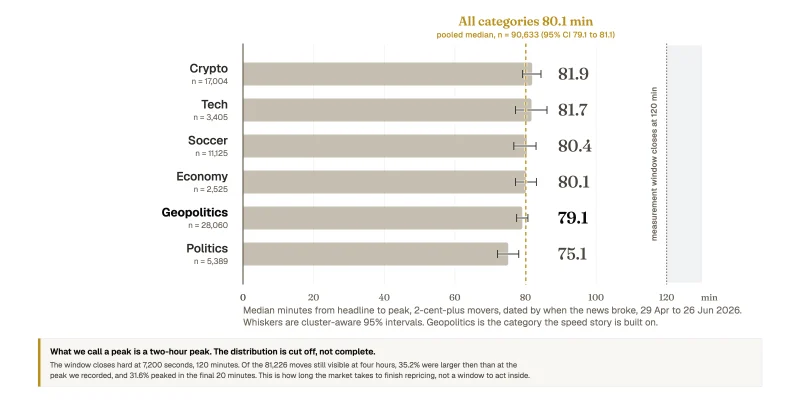
The world’s largest prediction market isn’t nearly as fast as you’d think. Despite operating on blockchain infrastructure capable of near-instant settlement, Polymarket’s prices take a surprisingly long time to fully digest breaking news, with full repricing stretching out to approximately 80 minutes after major events hit the wire.
For a platform that has positioned itself as the internet’s real-time truth machine, that’s a meaningful lag. It suggests prediction markets, for all their hype as superior forecasting tools, still process information more like a slightly caffeinated human than a high-frequency trading algorithm.
The underreaction problem
Academic research has started to quantify just how sluggish these markets can be. A study examining high-frequency trading on prediction market contracts found that price changes carry a coefficient of roughly 0.64 relative to benchmark probabilities derived from public data. In simpler terms: when new information suggests a contract should move by 10 percentage points, these markets tend to move only about 6.4 points initially.
That gap doesn’t close instantly. Instead, prices drift toward their “correct” level over the subsequent minutes. Most of the observable retracement happens within a 1-to-30-minute window after major news breaks.