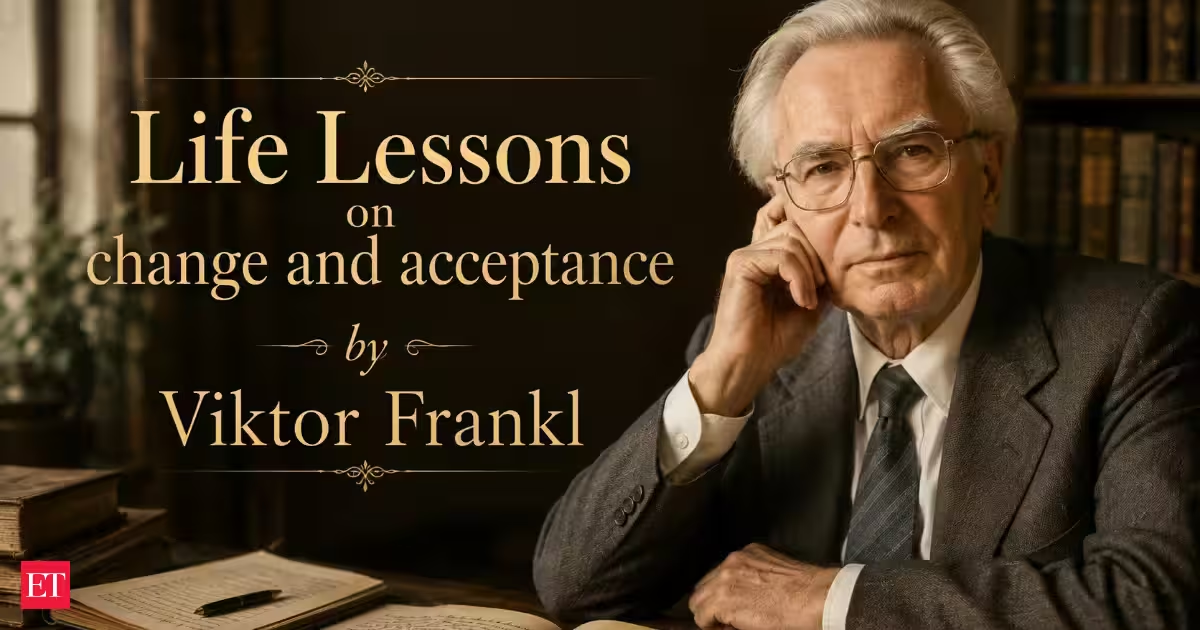
“The one who plants trees, knowing that he will never sit in their shade, has at least started to understand the meaning of life.” – Rabindranath TagoreThis article is part of a four-part series on supporting your mental health in the face of personal and global crisis. When faced by a crisis, there is nothing worse than feeling you have no control. Your distress is intensified when you have no agency or feel that your actions have no impact.One of biggest challenges of modern times is that we are constantly tuned into crises and tragedies that are beyond our control. Our newsfeeds are filled 24/7 with increasing stories of international wars and genocide, of people fleeing wildfires and floods, as well as many more human and environmental tragedies.This constant exposure to trauma and tragedy can distress and traumatise us, or make us feel guilty as “bystanders” who are failing to act.In the face of huge problems such as climate breakdown, we can feel powerless as our personal actions can feel too puny in the face of global government inaction. Any plans we might make to reduce our carbon footprint are dwarfed by global corporations’ intensified energy consumption in the pursuit of new data centres. This can cause us to give up action altogether and/ or cut off from our natural instinct to care and to want to make a difference. This can lead us to feeling further depressed or seeking to numb our distressed emotions in distraction or addiction.The importance of actionDiscovering a sense of personal agency and taking meaningful action in line with our values is key to preserving our mental health. In his book, Man’s Search for Meaning, Victor Frankl drew on his experience of surviving the Nazi concentration camps to create his model of psychotherapy. Even in circumstances we can’t change, we can always choose our attitude to these circumstance and choose to live purposefully regardless.For Frankl, this meant a focus on daily meaningful actions to get through the day, such as working to get a better meal, a good conversation with a friend or helping another one out, etc – Frankl was driven by the overall purpose to survive with the goal of meeting his family again.Four-part seriesUnderstanding and facing your feelingsFocusing on what you can doFocusing on what you love (Aug 24th).Positive intention and accessing support (Sep 7th)When facing a personal mental health crisis, you can easily feel overwhelmed and feel powerless to move forward. Depression can sap you of any energy and motivation to act, making you feel more stuck and more depressed. Anxiety can cause you to worry and ruminate and to avoid making a decision, which further increases your anxiety.In both depression and anxiety, the way forward is to rediscover your purpose and agency to take a positive step forward.For anxiety, it can be a case of learning to “feel the fear and do it anyway” – the fear dissipates once you start to act. For depression, the goal is to not to wait until you feel motivated to take action. Instead, you aim to “act before you feel like acting”. The feeling of motivation can come after the first small step and not before.When, as a therapist, I am supporting someone who is immobilised in depression or anxiety, my question is what small daily action can they access to improve their wellbeing?What might be the smallest step towards recovery?For someone who is depressed this might be reaching out to a friend, or getting out for a short walk in nature or eating a healthy meal. Once their mood starts to lift then they can begin to address the problems that underpin their depression.Think global and act localIn a similar way, responding to global crises is about discovering our agency and choosing personally meaningful action. Though the problems are vast and pervasive it is about choosing constructive action that might make a difference. While we don’t know the outcomes, it is through engaging and taking action that we live purposefully and in line with our values. Action is the antidote to anxiety and depressionConstructive action might mean becoming politically active and campaign for societal change or it might mean you donate to emergency organisations supporting people affected by war or climate extremes or that you participate in conservation projects to preserve nature and biodiversity. It might also mean focusing on building your personal resilience by learning to grow food or reduce your energy consumption as well as increasing your community’s resilience by connecting with neighbours, creating a community garden or supporting the local economy. Let yourself be informed by global challenges and then choose your best personal and local actions that are within your horizon.Facing up to the reality of climate and environmental breakdown is scary and overwhelming, and it can easy to take flight into denial or to avoid the subject altogether. However, the world needs us to act constructively in the best way we can. By acting in service of a purpose bigger than ourselves, we not only only help others, we also feel better and reduce our own suffering too. By discovering a shared purpose and acting together we create the best chance of a better future.Journal exerciseIn the first article in this series, I discussed the importance of therapeutic journaling as a way to nurture your mental health and to choose your response to life’s problems. I invited you to use your journal to honestly identify and compassionately reflect about your thoughts and feelings. Now I invite you to identify your priorities and goals and to decide important daily actions. 1) Take a pause to notice your current concerns and priorities. Write these down in your journal.2) Reviewing the list, write down three important things that are priorities to get done today.3) What single action can you do today that will make the biggest difference and make you most satisfied at the end of the day?The next article will look at the importance of focusing on your passions and what you love in the face of crisis.John Sharry is a social worker and an adjunct professor at the UCD School of Psychology. See solutiontalk.ie
When faced by a crisis, there is nothing worse than feeling you have no control
Part 2: Taking action in the face of crisis
1,026 words~5 min read