Lucky are the cities exalted by their buildings. San Francisco has its Victorian rowhouses, and Paris has the Second Empire mansard roofs that frame nearly every vista. But some cities’ architectural treasures aren’t so obvious, and that’s one reason I found myself exploring Helsinki last year.Tourism to Finland has boomed in recent years, with many visitors drawn by the country’s consistent ranking as the world’s happiest country, not to mention its forests, lakes and, yes, saunas.I had travelled to Finland to research a biography I am writing about the early-20th-century Finnish architect Eliel Saarinen. Perhaps less famous in America than his architect son, Eero — who designed icons like the Gateway Arch and the TWA Flight Center — Eliel played a key role in creating Helsinki’s dreamy, modern look, before moving to the United States at age 50.
The Esplanadi is a lively, linear park in downtown Helsinki. (Photo: The New York Times/ Vesa Laitinen)
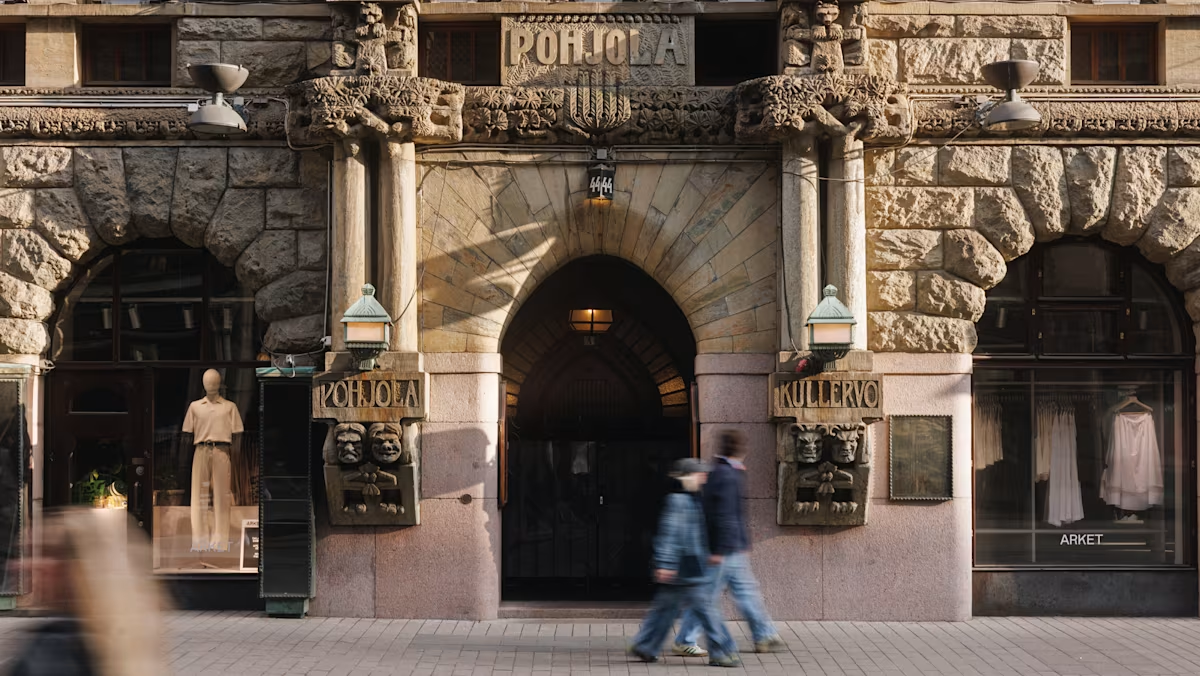
And what a look. Time and again I was beguiled by Helsinki’s charms. The city, founded in 1550, is a relative newcomer compared with its grander, older siblings Stockholm and Copenhagen. But Helsinki has a lyrical cast that speaks of fin de siecle optimism, defined by the radical architecture sweeping Europe circa 1900: Art Nouveau.However whimsical it looks to us now, Art Nouveau — or Jugendstil (German for “youth style”) — was revolutionary, Modernism’s first stirrings 20 years before the Bauhaus emerged in Germany. While short-lived, the movement — with its emphasis on asymmetry and the curving line — would ultimately help lead to the more geometric Art Deco.Art Nouveau was born in Brussels in the early 1890s, and quickly came to define large parts of cities like Barcelona and Paris. But Helsinki, with 600 Jugendstil buildings, is an overlooked wonderland that unspools like a series of stage sets. Block after block of sensuous facades form a surprisingly uniform urban fabric. Undulating towers and turrets define streetscapes, with an assist from idiosyncratic windows and doors. Curious woodland creatures carved in stone peer down from above.A NORDIC PILGRIMAGEEliel Saarinen, the son of a Lutheran pastor, burst onto the scene in 1897 as a 24-year-old university student, nabbing the commission for the Finnish Pavilion at the 1900 Exposition Universelle in Paris. His design, in the National Romantic style — a rough-granite version of Art Nouveau — took its inspiration from Finland’s medieval churches. It attracted widespread coverage, putting the country on the international creative map, and making Saarinen and his two architecture partners overnight stars.