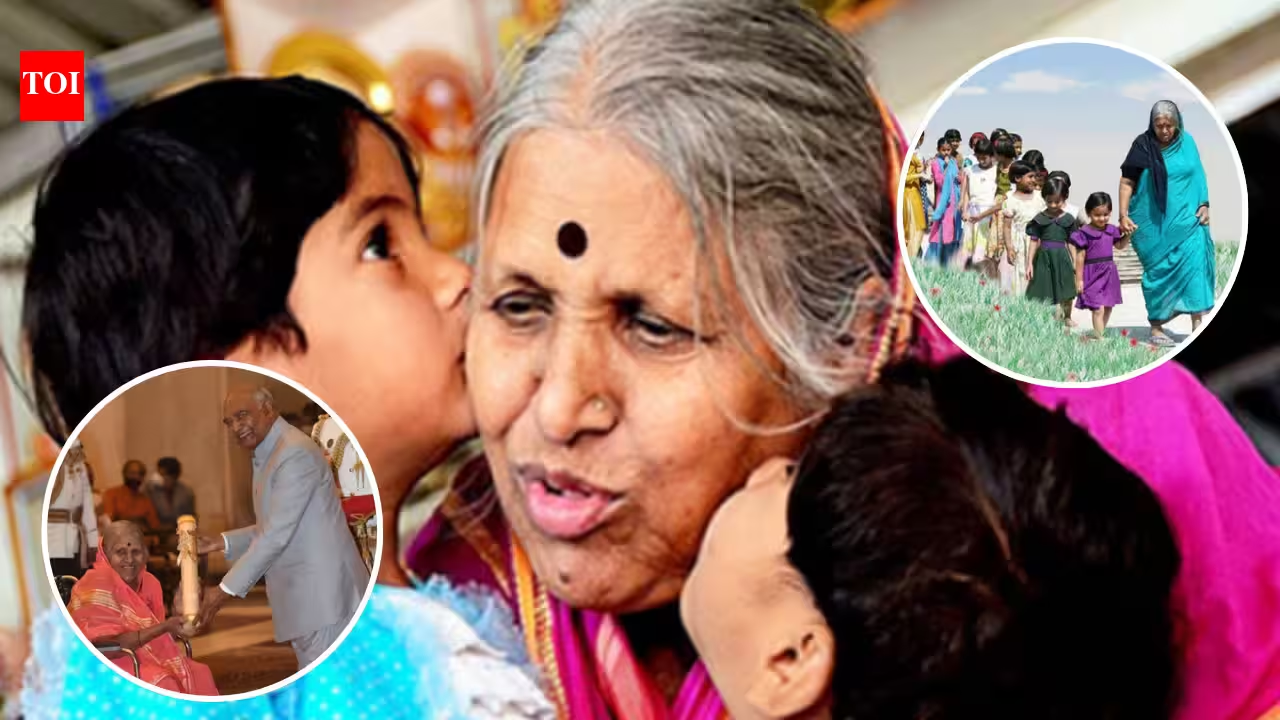
Photo source: The Mother Global FoundationThere is something almost unbelievable about Sindhutai Sapkal’s story. A young woman, pregnant and with nowhere to go, was pushed out of her home. She had little education, little money and no safety net to fall back on. For a time, she survived by begging at railway stations and other public places.And yet, somewhere in that period of utter helplessness, she began noticing children who were even more alone than she was. That is where the story takes an unexpected turn.13 Jul 2026 | 13:11What's one stereotype about women that you're tired of hearing?The woman who had struggled to find a home for herself would go on to create homes for orphaned and abandoned children. Over the years, she became known affectionately as ‘Maai’ (mother) and is credited by her foundation with nurturing more than 2,100 orphaned children and destitute people. In 2021, the Government of India honoured her with the Padma Shri for Social Work.A childhood that did not look promisingSindhutai was born in 1948 in Maharashtra’s Wardha district and grew up in poverty. Her formal education ended around the fourth standard. According to her official foundation profile, she was married while still very young to Shrihari Sapkal, who was considerably older than her.She was barely 20 when her life took a devastating turn. Pregnant and already a mother, Sindhutai was thrown out of her marital home. The circumstances surrounding her expulsion have been recounted over the years as part of her life story, including by The Mother Global Foundation, the organisation associated with her legacy. Its account describes her as being left homeless and forced to beg to feed herself and her child.It would have been understandable if survival became her only concern. For a while, it was. She had to find food. She had to protect her child. She had to somehow make it through each day. But hardship did something else to her. It made her notice hardship in other people.Then she began seeing children like herWhile living on the margins, Sindhutai encountered orphaned and destitute children who had nowhere to turn. They were children she could have simply walked past. Instead, she started helping them. The connection was personal. She knew what it meant to be unwanted. She knew what it meant to have no secure roof over her head. She knew the humiliation of having to depend on strangers.And slowly, the woman who was struggling to feed one child began taking responsibility for more.According to The Mother Global Foundation, Sindhutai eventually nurtured more than 2,100 orphaned children and destitute people. The organisation says its present-day work continues through homes providing food, shelter, education, healthcare and emotional support.Photo source: Official Sindhutai Sapakal Donation WebsiteWhy did everyone call her ‘Maai’?Because for many of the children she raised, she became much more than a caretaker. She became family. The foundation founded by Sindhutai says that more than 2,100 children have been nurtured through her work and that many have gone on to earn livelihoods and build families of their own. It currently reports supporting more than 260 children across four orphanages.There is also something striking about the way her family evolved.Her biological daughter, Mamata, was raised for a period by the Dagdusheth Halwai Trust. The foundation's account says Sindhutai made this decision because she did not want her biological child to receive preferential treatment over the many adopted children in her care.It is one of the most complicated parts of her story. And perhaps it should remain complicated. Sindhutai was not a fictional heroine making perfectly neat choices. She was a woman trying to solve impossible problems with the limited resources available to her. That is what makes her story feel real.She built a family without having one herselfOver the years, Sindhutai’s children became part of an enormous extended family. Her adopted children eventually became adults. Some established careers. Some married. Some returned to help continue her work.Her foundation says more than 1,000 children nurtured through her work are now earning a stable livelihood, while hundreds have married and built families of their own. These figures are reported by the foundation itself as part of its account of her continuing legacy.That is perhaps a more meaningful measure of her work than the number of awards on a shelf. A child who once had no home now having a job. A child who once had nobody to call family now raising a family of their own. A child who might otherwise have remained on the streets being given the chance to imagine a different future. That was Sindhutai’s real achievement.Recognition came, but much laterSindhutai’s work eventually attracted national attention. The Government of India’s official Padma Awards database lists Dr Sindhutai Sapkal as a 2021 Padma Shri awardee in Social Work, Maharashtra.Her story also reached the cinema through the Marathi biographical film Mee Sindhutai Sapkal, directed by Anant Mahadevan. Her life was so extraordinary that even turning it into a film came with its own challenge: separating what sounded unbelievable from what had actually happened. That is perhaps the strange thing about Sindhutai’s life. Some of its most dramatic moments sound like something written for a film. They weren't.Photo source: Official Sindhutai Sapakal Donation WebsiteEven her past came back to herThere was another deeply human chapter in Sindhutai’s life. Her husband, who had abandoned her years earlier, eventually returned to her life. By then, Sindhutai had become a mother to countless children. According to the foundation's account, she chose to accept her aging husband into her life and introduced him as one of her children.It is a story that can easily be turned into a simple lesson about forgiveness. But it deserves more nuance than that. Forgiving someone does not erase the hurt they caused. Nor does it make abandonment acceptable. What it perhaps reveals is that Sindhutai did not want to spend the rest of her life carrying the anger that had once consumed her. She had built a life so much larger than the one she had been denied.A Padma Shri, and then goodbyeSindhutai Sapkal died on January 4, 2022, in Pune. Following her death, the Press Information Bureau (PIB) published a statement from the Prime Minister recalling her work for children and marginalized communities and noting that she had been awarded the Padma Shri in 2021.Sindhutai Sapkal began with very little. No privileged upbringing. No elaborate education. No institution waiting behind her. So when she saw children experiencing the same thing, she did something extraordinary. She made room for them. That is why ‘Maai’ became more than a nickname. For thousands of children, it became another word for home.
Abandoned while pregnant, she had nowhere to belong, yet became a home for thousands: How Sindhutai Sapkal became ‘Maai’
There is something almost unbelievable about Sindhutai Sapkal’s story. A young woman, pregnant and with nowhere to go, was pushed out of her home.
1,108 words~5 min read