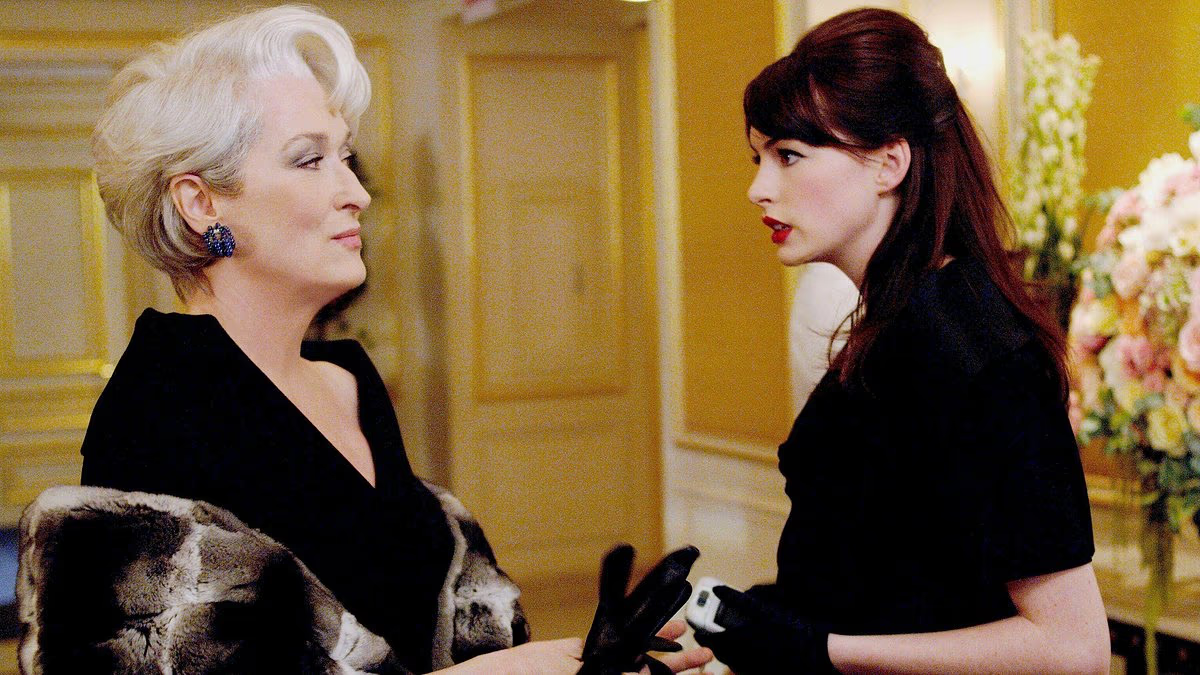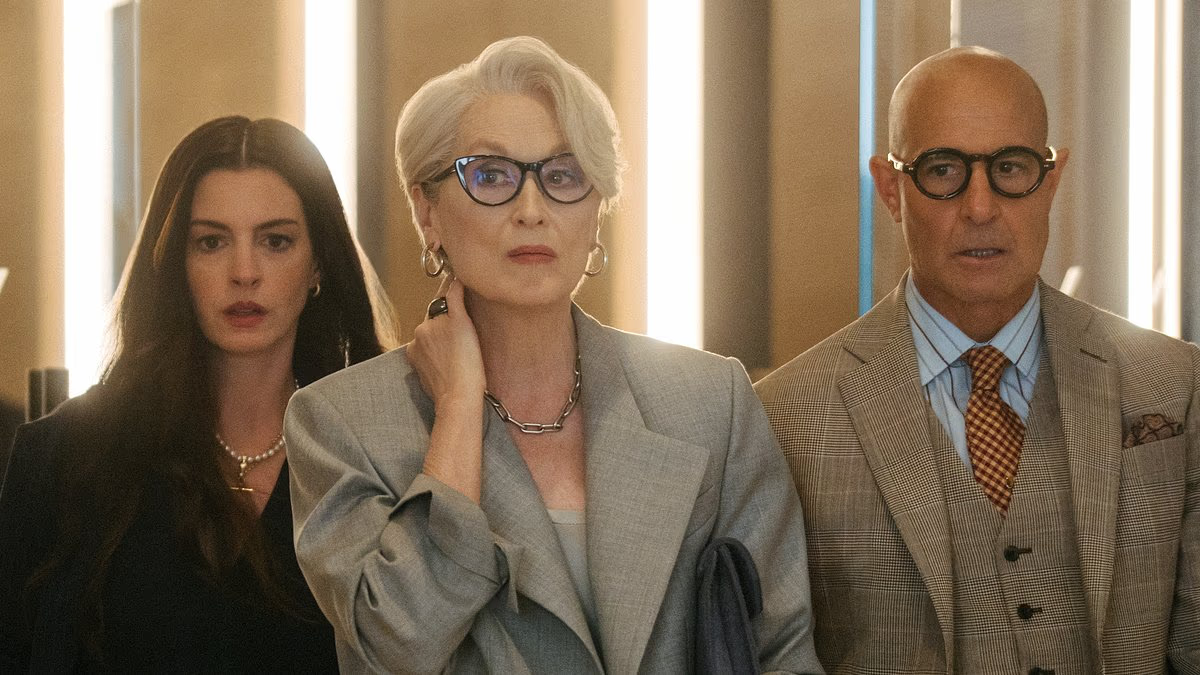
In the middle of an argument with your better half, or jokingly from a friend, you might have had the phrase 'you're such a narcissist' thrown at you – but are you actually? Or do you just have a healthy ego?Thankfully Dr Carmen Harra, American author of You Are What You Feel: Redefining Your Emotional Identity For Greater Intelligence, Awareness, And Understanding, has revealed the questions to ask yourself to determine whether you actually have a narcissistic personality.Speaking to the Daily Mail, she said: 'The word narcissist is derived from the Greek myth of Narcissus, a handsome young man who became so captivated by his own reflection that he lost himself entirely. 'While the legend may be dramatic, modern narcissism is far more nuanced. All of us occasionally act self-centered, crave recognition and enjoy admiration, but such behaviors alone do not quality a person as a narcissist. 'In fact, healthy self-esteem is essential for emotional well-being because it allows us to value ourselves while also valuing others.'So where does one cross the line from esteem into entitlement? Psychologists generally distinguish between healthy confidence, vulnerable (covert) narcissism, grandiose (overt) narcissism, and the far rarer Narcissistic Personality Disorder (NPD). 'Covert narcissists often feel misunderstood, overlooked, but secretly superior despite deep insecurities. 'Overt narcissists openly seek admiration and status. Individuals with NPD typically display a pervasive pattern of privilege, lack of empathy, exploitation of others, and an excessive need for admiration that significantly impairs relationships.'While no test can truly determine whether someone has a personality disorder (only a qualified mental health professional can make that assessment), answering the following questions from Dr Carmen may offer insight into where your personality perhaps falls on the spectrum.Following the quiz, the psychologist reflects on what your answers could mean... Meryl Streep as narcissistic Runway editor Miranda Priestly (centre) in The Devil Wears Prada 2, which also stars Anne Hathaway as Andy Sachs (left) and Stanley Tucci as Nigel Kipling (right)Join the discussionIs society too quick to label confidence as narcissism, or do we ignore real narcissists among us?What's your view?1. When I accomplish something I'm proud of, my first thought is:A. 'I'm proud of the work I put in, and I'm grateful it paid off.'B. 'I wish people realised how much effort and talent this actually took.'C. 'This is exactly the kind of success I expect from myself.'D. 'This proves what I've always known: that I'm simply better than most people.'2. When someone else receives recognition that I wanted:A. I'm genuinely happy for them, even if I'm a little disappointed.B. I can't help wondering why people never seem to notice my strengths.C. It motivates me to outshine them next time.D. I usually think they were overrated or didn't really deserve it.3. In a close relationship, this is most important to me:A. Feeling respected while offering my partner the same level of respect.B. Feeling emotionally understood and reassured.C. Feeling admired and appreciated for what I bring to the relationship.D. Feeling like my needs and expectations take priority.4. What I enjoy most about social media is:A. Sharing moments and keeping in touch with people I care about.B. Expressing parts of myself that people don't usually appreciate in everyday life.C. Inspiring others with my accomplishments, experiences, or lifestyle.D. Showing people what they're missing and reminding them how successful my life is.5. If I walk into a crowded party where I don't know anyone:A. I look forward to meeting new people.B. I worry whether people will like me, but I hope I make a good impression.C. I assume people will eventually notice me since I naturally stand out.D. I expect to become one of the most interesting people in the room.6. When someone gives me constructive criticism at work:A. I consider whether I can learn something from it.B. Even if it's fair, it bothers me more than I'd like to admit.C. I usually explain why I made my decision and stick to it.D. I question whether they're qualified to criticise me in the first place.7. When someone hurts my feelings:A. I try to understand what happened before reacting.B. I withdraw and wait to see whether they notice they've hurt me.C. I confront them directly because they should know they crossed a line.D. I remove them from my life because people who disrespect me don't deserve another chance.8. I think my friends enjoy spending time with me because:A. We genuinely care about and support one another.B. They appreciate qualities in me that most people overlook.C. I'm someone they admire or look up to.D. Being associated with me improves their own lives or reputation.9. Looking back on past relationships, this best describes my experiences:A. Every relationship teaches both people something.B. I often felt unappreciated or misunderstood.C. I usually wanted more from my partners than they were able to give.D. Most of my ex partners simply weren't good enough for me.10. This statement feels most accurate to me:A. I know my value, but I know everyone else has value too.B. I often feel like people don't recognise how much I have to offer.C. I believe I have qualities that naturally set me apart from most people.D. Very few people are truly my equal.11. When someone sincerely apologizes after hurting me:A. If they're genuine and change their behaviour, I usually forgive them.B. I accept the apology, but it's difficult for me to trust them again.C. It depends on whether they've earned another chance.D. Once someone betrays me, they no longer deserve my time.12. Complete this sentence: Most people would describe me as someone who...A. is confident without needing to prove anything.B. is often misunderstood despite having good intentions.C. has high standards and isn't afraid to stand out.D. expects excellence from others and rarely settles for less. Did you answer mostly As, Bs, Cs or Ds? Psychologist reveals what that could mean... If you answered mostly As, you display a healthy sense of self-esteem:Dr Carmen said: 'Your confidence appears to rest on a solid foundation rather than a fragile ego. 'You recognize your strengths without needing to diminish others, and you generally value mutual respect, accountability, and empathy. 'While everyone enjoys praise from time to time, your self-worth doesn't depend on constant validation. You understand that confidence and humility can coexist, allowing you to build healthy and lasting relationships.'If you answered mostly Bs, you display covert (vulnerable) narcissistic tendencies:Dr Carmen said: 'You may possess qualities associated with vulnerable narcissism. 'Rather than openly seeking attention, you may feel underappreciated, misunderstood, or overlooked despite believing you have exceptional qualities. 'Criticism may sting deeply, and you might quietly compare yourself to others while longing for greater recognition.'The encouraging news is that greater self-awareness, emotional resilience, and learning to separate self-worth from external validation can help foster healthier relationships and a more secure sense of confidence.'If you answered mostly Cs, you display overt (grandiose) narcissistic tendencies:Dr Carmen said: 'Your answers suggest characteristics commonly associated with grandiose narcissism. You likely enjoy recognition, leadership, competition, and being admired. 'Confidence can certainly be an asset, but when admiration becomes a necessity or other people's needs become secondary to your own, relationships will suffer. 'Developing greater empathy, listening more than speaking, and becoming comfortable sharing the spotlight can strengthen both your personal and professional life without diminishing your ambition.'If you answered mostly Ds, you display strong narcissistic traits:Dr Carmen said: 'Your responses suggest a pattern of attitudes that may resemble strong narcissistic traits, including entitlement, difficulty accepting criticism, a need for superiority, and reduced empathy for others.'If these patterns are longstanding, occur across many areas of your life, and repeatedly damage your relationships or work, they can overlap with features seen in Narcissistic Personality Disorder (NPD).'Self-awareness begins with a desire to reflect on how your beliefs and behaviors affect both you and the people around you. 'With mindfulness, any willing person can change detrimental personality patterns that foster happier and healthier human connections.'
Are YOU a narcissist? Take this test to find out
In the middle of an argument with your better half, you might have had the phrase 'you're a narcissist' thrown at you - but are you? Or do you just have a healthy ego?
1,310 words~6 min read