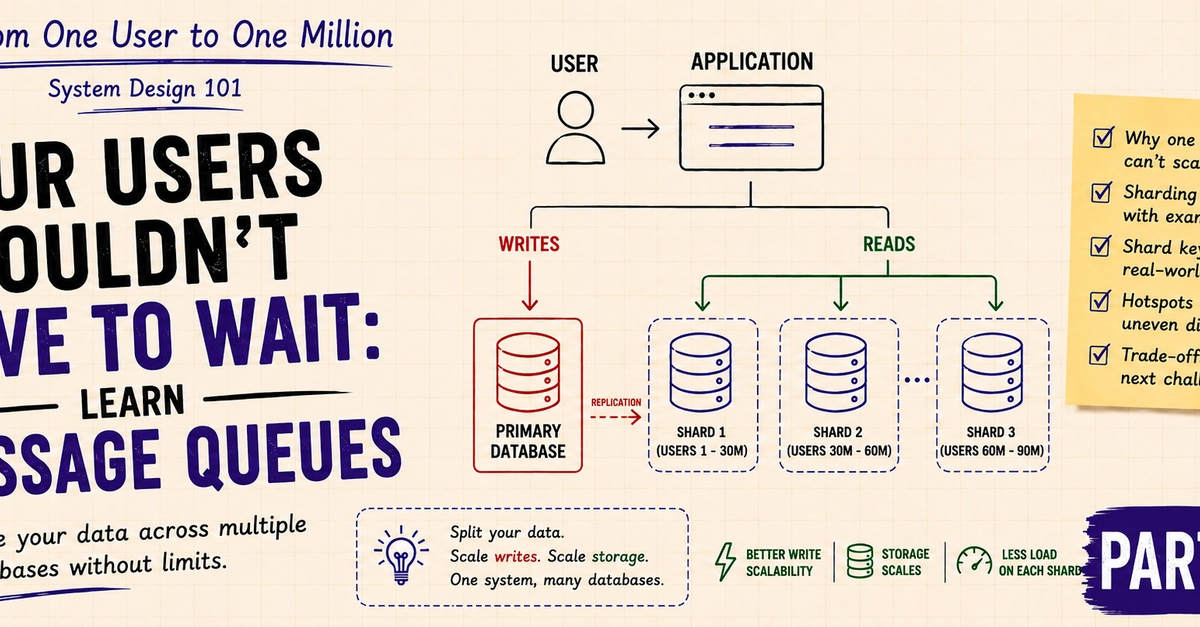
This is Part 10 of my "From One User to One Million" series, where we'll build an understanding of System Design by following a simple application as it grows from a single user to millions. Instead of memorising technologies, we'll learn why they exist by solving real problems as they appear.
In Part 9, we solved the problem of data that had grown too large for a single database. We split it across multiple shards, each holding its piece of the whole, so that no single machine ever had to carry everything.
At that point, the architecture could scale in almost every direction we'd tried to push it. Traffic was distributed across application servers. Repeated database work was absorbed by the cache. Read traffic was spread across replicas. Data itself was partitioned across shards.
And yet.
We ended Part 9 by noticing something that none of those solutions addressed. Some user requests trigger a lot of downstream work. Saving an order is one thing. But saving the order, sending a confirmation email, generating an invoice, updating inventory, firing off a notification, recording an analytics event, triggering the recommendation engine: that's an entirely different conversation.