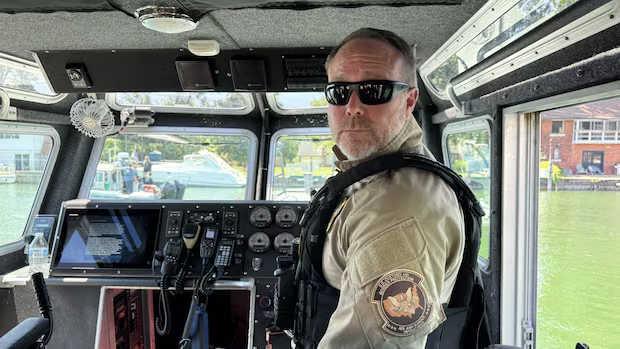
WorldWhile U.S. President Donald Trump has accused Canada of allowing illegal drugs and traffickers across the border, the reality on the ground appears very different. CBC News recently spent two days with U.S. Customs and Border Protection in and around Detroit.CBC News gets behind-the-scenes look at U.S. Customs and Border Protection as it patrols in and around DetroitWilly Lowry · CBC News · Posted: Aug 08, 2026 4:00 AM EDT | Last Updated: 6 hours agoListen to this articleEstimated 6 minutesThe audio version of this article is generated by AI-based technology. Mispronunciations can occur. We are working with our partners to continually review and improve the results.Tim Thayer is a marine interdiction agent with U.S. Customs and Border Protection, assigned to the Detroit sector, which covers Michigan, Ohio, Indiana and Illinois. (Willy Lowry/CBC)Clad in a black bulletproof vest, a gun clasped to his hip, Tim Thayer gently pushes down the throttles of four 350-horsepower engines — and the 18,000-pound U.S. Customs and Border Protection boat jumps to life on the Detroit River.Thayer is a marine interdiction agent, part of a team that patrols the waterways that make up the Canada-U.S. border in this part of the country.He's assigned to the Detroit sector, an area that encompasses Michigan, Ohio, Indiana and Illinois. The border with Canada here is entirely water — all 1,388 kilometres of it — which poses a unique challenge.A peculiar quirk in the geography of the two countries is that Windsor, Ont., lies south of Detroit, separated by the river and connected by two bridges and a tunnel, with some seven million people crossing back and forth here alone annually.A U.S. Customs and Border Protection boat is shown navigating the Detroit River, near Windsor, Ont., on Aug. 4. (Willy Lowry/CBC)On a warm Wednesday afternoon, Thayer scans south, looking toward the Windsor shoreline, his eyes searching for anything out of the ordinary. "When we do our enforcement patrols out here on the Detroit River, what we're seeing is both people, narcotics and guns going back and forth between the U.S. and Canada," he said.Canada prepared to halt booze bans, meet other U.S. demands in exchange for tariff relief: sourcesDuring the Prohibition era of the 1920s and '30s, the Windsor-Detroit corridor was the main route smugglers used to bring alcohol into the U.S. illegally from Canada. While illegal activity on the Detroit River is perhaps not nearly as bustling today, the sheer number of recreational boaters who are frequently out presents a challenge for law enforcement.WATCH | Trump's fentanyl claims aren't materializing at this Canada-U.S. crossing:Trump’s fentanyl claims aren’t materializing at this Canada-U.S. crossingAugust 7|Duration 2:05U.S. President Donald Trump declared a national emergency at both the northern and southern borders in 2025, citing the fentanyl crisis to justify tariffs levied against Canadian and Mexican imports. Ottawa, for its part, has committed roughly $1.3B in multi-year investments to beef up border security with the U.S. At the Detroit-Windsor border, the CBC’s Willy Lowry takes a look at how the U.S. handles things on their side of the fence."We saw how many boats today? And every boat could be a smuggler unless we stop every single boat," asked Kris Grogan, chief of external communications at CBP's air and marine operations. "You have to use intelligence and partnerships to be able to secure this area up here."Trump's claims aren't materializingJust days into his second term in 2025, U.S. President Donald Trump accused Canada of failing to prevent drugs, especially fentanyl and human traffickers, from entering the U.S., using the flow of drugs as justification to declare a national emergency and slapping 25 per cent tariffs on an array of Canadian goods under the International Emergency Economic Powers Act (IEEPA) of 1977. In February of this year, the U.S. Supreme Court struck down those tariffs.And while Trump has painted a picture of a porous and dangerous border, the reality is much more complicated.Republicans portray Canadian border as a threat, but U.S. statistics tell a different storyCanada has 'nasty leadership,' says Trump during Las Vegas speechIn 2025, U.S. border officials in the Detroit sector seized more than 4,200 kilograms of illegal drugs, including nearly 15 kilograms of fentanyl, according to statistics provided by CBP. But the statistics don't reveal the direction the drugs were travelling."It's really not that big of a problem for inbound," said Lavarah Miller, a CBP watch commander on duty when CBC News toured a brand new American port of entry facility at the newly opened Gordie Howe International Bridge. "A lot of the stuff that we actually get, we get a lot of it going out."A view from the new American port of entry facility at the just-opened Gordie Howe International Bridge, which runs between Windsor, Ont., and Detroit. CBC News recently spent two days with U.S. Customs Border and Protection agents stationed in the region. (Willy Lowry/CBC)And guns, too, are travelling north, recent statistics show. In 2024, 87 per cent of the guns recovered in crimes in Ontario were traced back to the U.S, according to figures compiled by Ontario Provincial Police. In Toronto, police say 88 per cent of guns recovered were illegally smuggled into the country."Firearms, for sure. But also, the United States is the middle ground for drugs coming up into our country from Mexico and South America," said Kelly Sundberg, a professor of criminology at Mount Royal University in Calgary.What tariffs are still in place? Tracking the Canada-U.S. trade warWhile the flow of drugs and weapons between the two countries is primarily northward, Sundberg said, Canada still poses a threat to the U.S. — just not the one Trump continues to accuse Canada of."There is virtually no fentanyl getting smuggled into the United States, especially when you compare it to what's coming in from Mexico," he said. "Nevertheless Canada does have some serious issues with staffing [at our border] — we don't have enough officers. "The officers we do have need to be better educated, better trained, better selected, better equipped. There needs to be a significant investment in the human side of our border security."A tale of 2 bordersCanada's fentanyl czar — a role created in the early days of the trade war to try and assuage Trump's concerns about the northern border — has also pushed back against suggestions that Canada poses a major drug-trafficking threat.In an interview with CBC's The House in June, Kevin Brosseau pointed to new data from CBP that shows less than half a kilogram of fentanyl was seized at the Canada-U.S. border in May, compared to 358 kilograms at the Mexico-U.S. border.The total amount of fentanyl seized by U.S. officials so far this year at the Canadian border is approximately three kilograms. At the Mexican border, it's approximately 3,221 kilograms.U.S. claims about higher drug trafficking from Canada don't match the data: fentanyl czarAs Trump complains about Canada, data shows most crime guns seized in GTA come from U.S.Despite ongoing political tensions between Washington and Ottawa, the U.S. border agents who spoke with CBC News over our two-day tour insisted the working relationship with their Canadian counterparts has remained unchanged over the last 18 months. "Locally, we still have great partnerships with those agencies right across the water," said Tim Balkus, the patrol agent in charge of the Detroit sector.Meanwhile, Thayer nods his head as an RCMP boat flies past, the Gordie Howe bridge looming large in the distance — a symbol of both how strong and strained the bond between the two countries is today.ABOUT THE AUTHORWilly Lowry is an award-winning correspondent for CBC News in Washington, D.C., where he provides breaking news and analysis across radio and television. Prior to that, he served as the senior U.S. correspondent at the National newspaper in D.C., where he covered the U.S. State Department, American foreign policy and its impacts on the Middle East and the wider world. Willy covered the Israel-Hamas war extensively, travelling to Israel and the occupied West Bank several times. He also covered the fall of ISIS in Syria. He started his career at CBC News in Montreal, where he worked his way up from intern to research assistant and eventually to video journalist.
Trump's fentanyl claims aren't materializing at this Canada-U.S. border | CBC News
While U.S. President Donald Trump has accused Canada of allowing illegal drugs and traffickers across the border, the reality on the ground appears very different. CBC News recently spent two days with U.S. Customs and Border Protection in and around Detroit.
1,357 words~6 min read