view more
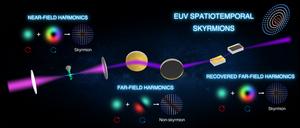
Paraxial optical skyrmions can be viewed as the coherent superposition of a vortex beam and a Gaussian beam with the same frequency and opposite spin directions. The optical skyrmions, whose topological structures are mapped onto the plane perpendicular to the propagation axis, are thus termed 'spatial skyrmions'. In recent years, optical pulses carrying transverse orbital angular momentum (T-OAM)—namely, spatiotemporal optical vortices (STOV)—have been realized experimentally. By replacing the vortex beam with an STOV, the skyrmionic topology can be extended into the spatiotemporal domain, with the topological plane parallel to the optical axis, giving rise to 'spatiotemporal skyrmions'.
Extreme-ultraviolet (EUV) spatiotemporal skyrmions hold great promise, owing to their high photon energy, ultra-fine polarization structures in the spatiotemporal domain, and potential as a novel attosecond light source. The development of such EUV spatiotemporal skyrmions offers broad application prospects. However, conventional light manipulation techniques face significant challenges when extended to the EUV band, primarily due to the strong absorption of optical elements and the difficulties in designing EUV-compatible devices.