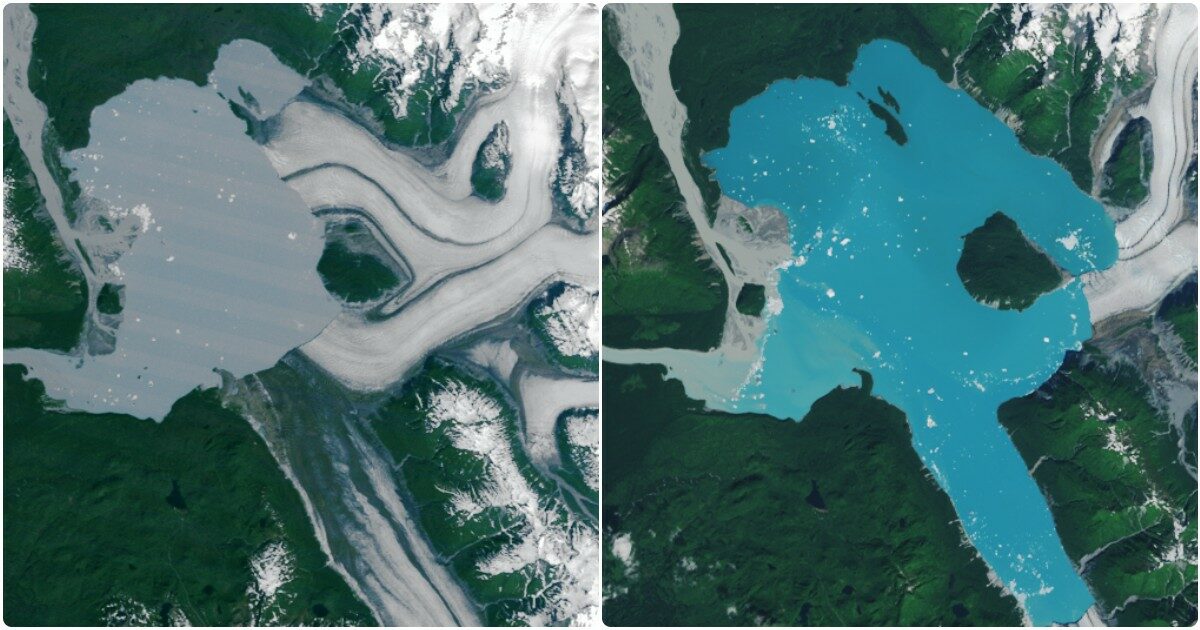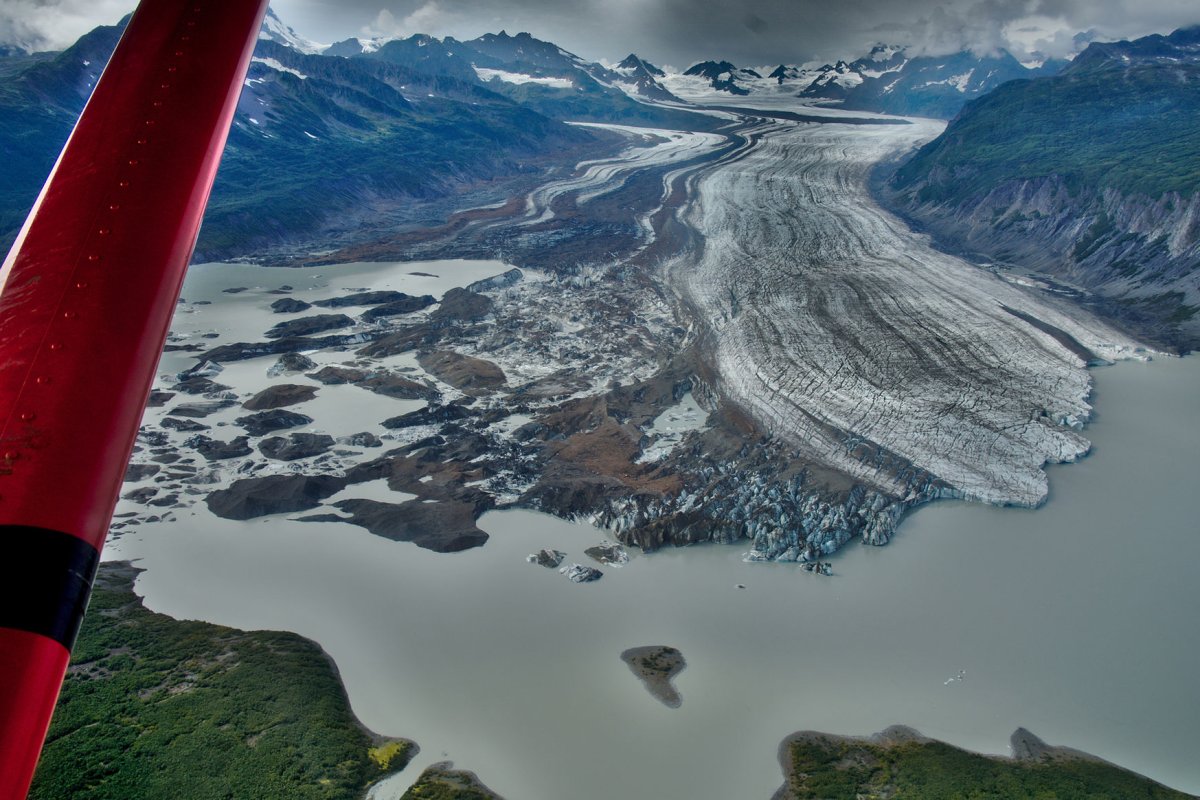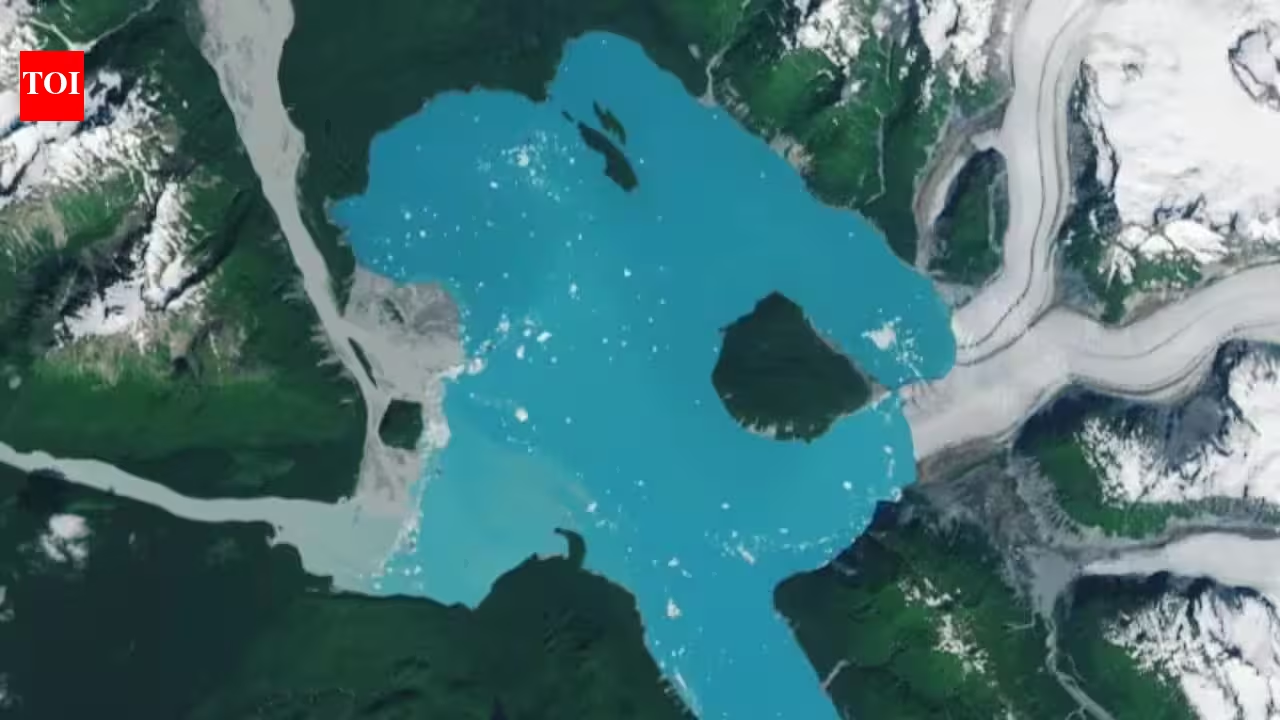
Alsek on July 5, 1984. Image Credit: NASA Earth Observatory images by Michala Garrison, using Landsat data from the US Geological Survey.The coastal plain of southeastern Alaska is currently witnessing a rapid transformation where water is replacing ice at an unprecedented rate. Glaciers in this region are melting, which leads to the formation of vast proglacial lakes. A significant incident in this environmental shift occurred during the summer of 2025 when a new island emerged from beneath the ice of the Alsek Glacier.This landform, known as ‘Prow Knob,’ was previously a small mountain surrounded by the final point of the glacier. Recent satellite data from Nasa confirms that the glacier has now lost contact with this landmass, leaving it entirely covered by the water of Alsek Lake. Measuring approximately two square miles, the island stands as a visual indicator of the dramatic changes occurring in Alaska’s frozen landscape as global temperatures continue to rise.What is the reason behind the birth of this new island in AlaskaAccording to reports from Nasa, the Alsek Glacier has thinned so much that it got detached from the landform now known as Prow Knob. Satellite imagery obtained from the Landsat 9 mission reveals that the final separation took place somewhere between 13 July to 6 August 2025.For centuries, geologists called this rocky structure a 'nunatak' (a mountain peak surrounded by a sea of ice). Now, as the glacier retreats eastward, the basin it once occupied has filled with meltwater, creating the Alsek Lake. Nasa Earth Observatory notes that this new island covers roughly five square kilometres, or two square miles, and serves as an example of how rapidly the Alaskan ecosystem is changing.The process of 'calving', where large chunks of ice break off the front of a glacier into the water, has accelerated because the ice has lost its grip on the ground of Prow Knob. Without the island to act as a physical anchor, the glacier's edge has become less stable. This cycle of melting and breaking away has allowed the surrounding lake to expand in the region.Alaska's Prow Knob (the big island on the right of the lake) used to be surrounded by ice. Image Credit: NASA Earth ObservatoryWhat is the historical background of Prow KnobThe landmass was known to researchers, but its status as an island is entirely new. Nasa reports that the late glaciologist Austin Post took aerial photographs of the area during August 1960. He named the feature Prow Knob because its sharp, rocky shape reminded him of the front, or prow, of a ship. At that time, the ice was still thick and firmly wrapped around the base of the knob, and the glacier ended several kilometres further to the west.Glaciologist Mauri Pelto, who has been monitoring the site since 1984, observed that the glacier remained connected to the landmass for several decades, but its eventual isolation was inevitable. Pelto has used satellite imagery for years to record these changes, checking the progress of the Alsek Glacier at least once a month. Interestingly, Pelto and Post had predicted in earlier studies that the separation would occur around the year 2020, based on the retreat rates observed in the late 20th century. However, the ice proved slightly more resilient, holding on for five additional years before the waters of Alsek Lake finally breached the connection.How has the landscape of Alsek glacier changed since the 1980sThe speed of the landscape's transformation is clearly visible through 40 years of satellite records. Nasa Earth Observatory compares images from 1984 to those taken in 2025, showing a dramatic reduction in ice cover. In the early 1980s, the Alsek Glacier was still a massive force of ice connected with the neighbouring Grand Plateau Glacier. Since then, both of the Alsek's main arms have retreated by more than five kilometres.This retreat has caused Alsek Lake to grow in size at an alarming speed. Nasa data indicates the lake grew from 45 square kilometres in 1984 to 75 square kilometres by 2025. When combined with neighbouring proglacial lakes, the total expansion of water in this specific region of Alaska has more than doubled over the last 40 years. This transition from solid ice to open water makes the remaining glacier even more vulnerable to the relatively warmer lake water.Why does the retreat of Alsek Glacier matter for the futureThe emergence of Prow Knob is only one part of a much complex environmental story. The US National Park Service, warns that the retreat of the glaciers in this area is creating serious dangers for nature and people. One of the major concerns is that if the glaciers continue to thin then the Alsek River, a major waterway that flows through Canada and Alaska, may soon abandon its current path and find a new outlet 20 miles to the south.This shift would move the river's mouth from a designated National Preserve into the protected wilderness of Glacier Bay National Park. Under current management rules, many of the activities that people rely on today—such as commercial fishing camps and hunting lodges—are not permitted inside the National Park. Furthermore, salmon would have to find new ways to navigate the waters. The birth of Prow Knob as an island is a beautiful but stark reminder that as the ice disappears, the world we have built around it must also change.
A new island has emerged in Alaska after a glacier melted away: Nasa images reveal a stark sign of climate change
The coastal plain of southeastern Alaska is currently witnessing a rapid transformation where water is replacing ice at an unprecedented rate. Glaciers in this region are melting, which leads to the formation of vast proglacial lakes.
888 words~4 min read