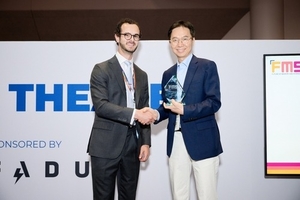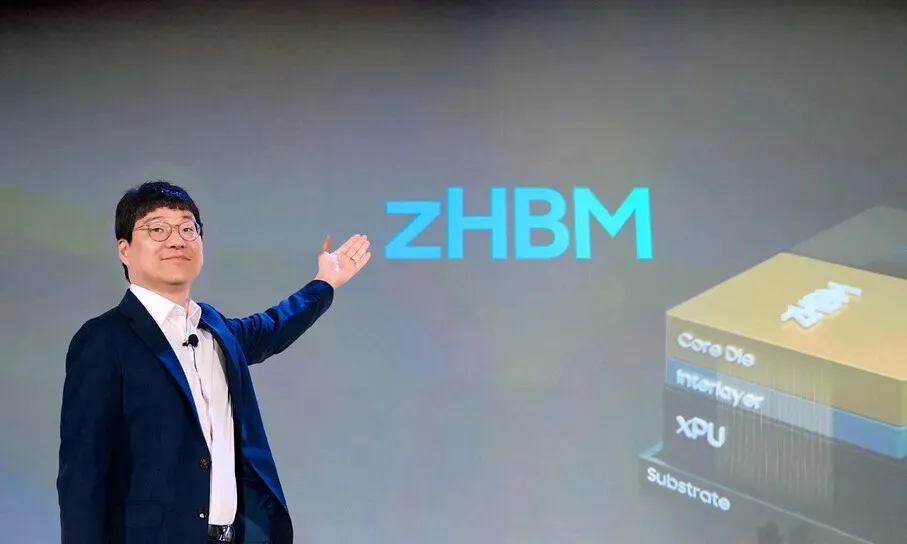
Kim Kyung-ryun, senior vice president and project leader of Samsung Electronics' DRAM Design Team, presents at Future of Memory and Storage in Santa Clara, California, on Aug. 9, 2026. (courtesy Samsung Electronics)
Domestic semiconductor manufacturers like Samsung Electronics and SK Hynix have unveiled their latest memory products and technologies to the world, igniting a full-scale competition to capture global market share.Thanks to aggressive investment by chipmakers, Korea is forecast to maintain its world-leading position in memory chips over the next five years.At the Santa Clara Convention Center in California, Samsung Electronics on Tuesday unveiled for the first time a prototype of its next-generation memory chips featuring a new design method and structure at the Future of Memory and Storage expo. Attending this convention were representatives from Korean companies as well as global players in semiconductors and information and communications technology like Micron, SanDisk, AMD and IBM of the US and Kioxia of Japan.
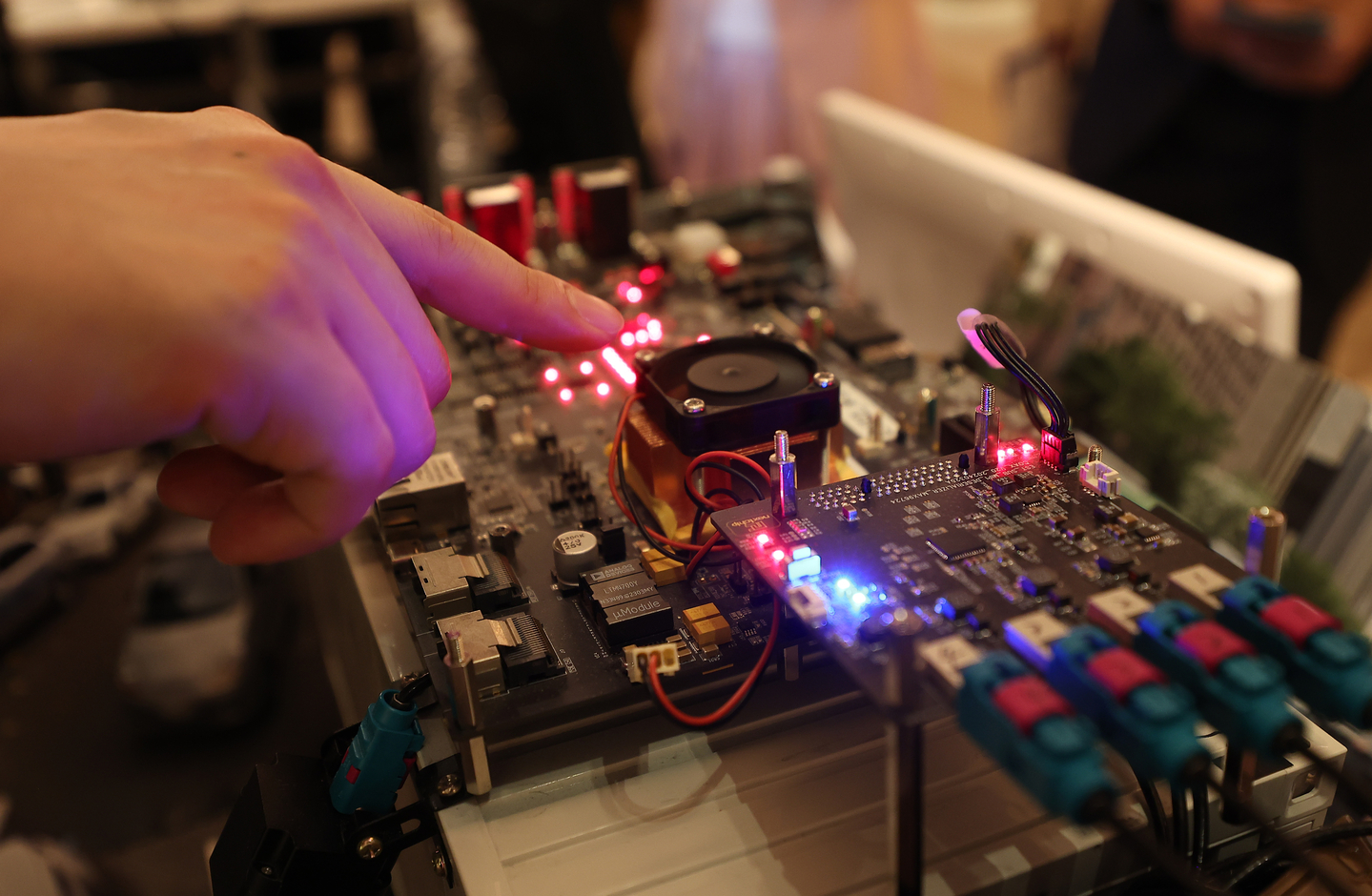
A concept model of Samsung Electronics’ zHBM. (courtesy Samsung Electronics)
Kim Kyung-ryun, the senior vice president and project leader of Samsung Electronics' DRAM Design Team, unveiled a prototype of the next-generation 3D memory zHBM in his keynote speech. Instead of the conventional method of arranging high-bandwidth memory (HBM) alongside the artificial intelligence accelerator (xPU) chip — the brain of AI computation — a new structure was applied in which memory chips are stacked vertically atop the accelerator like the floors of an apartment building.Samsung Electronics said minimizing the distance data must travel between the AI accelerator and memory boosts data transfer speeds and power efficiency, enabling performance of up to eight times higher than that of eighth-generation HBM (HBM5), a next-generation memory technology.“Samsung is back,” Kim confidently declared. The company had a more than 700-square-foot exhibition space at the event, where it unveiled its concept model for the zNAND-O, a next-generation high-performance NAND solution optimized for on-device AI on digital devices, including smartphones. Samsung also unveiled its V10 BV-NAND product, which stacks more than 400 layers. Both products improve data read and write performance for data-intensive AI applications.