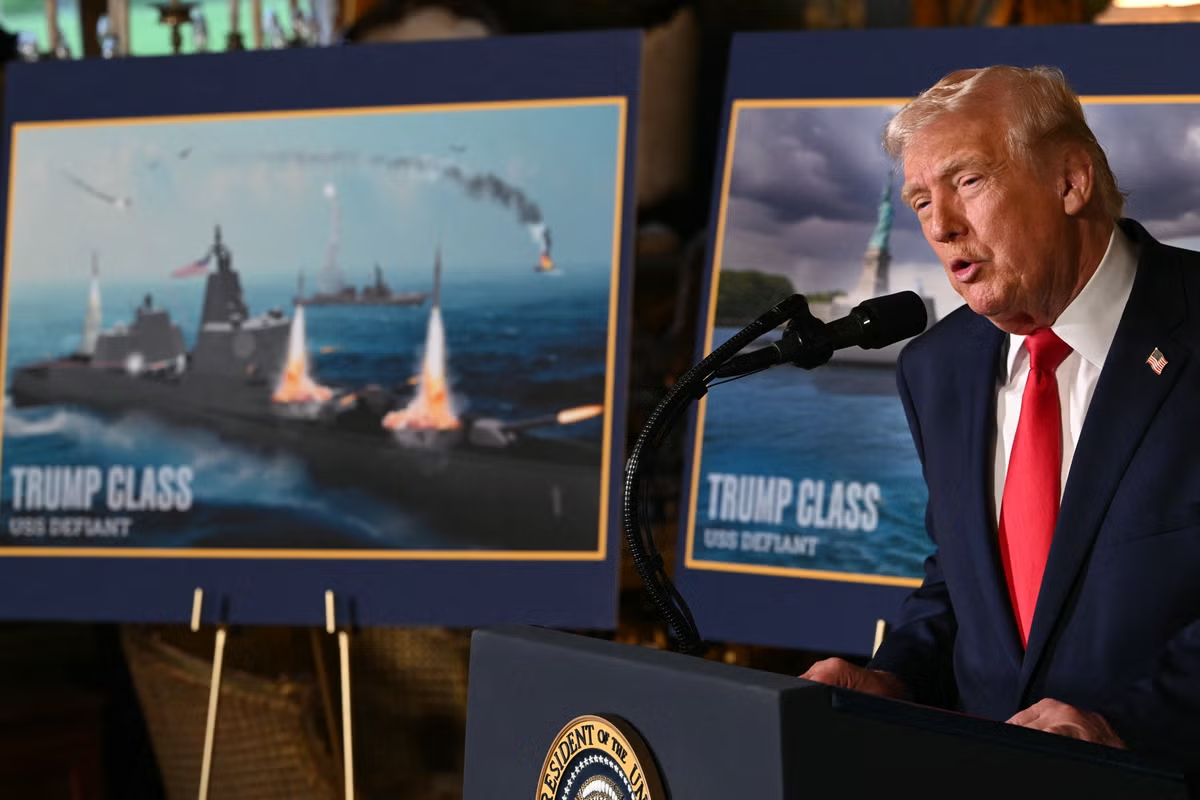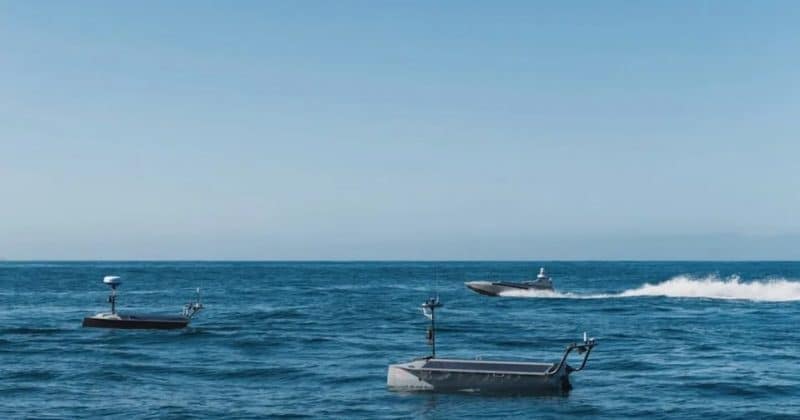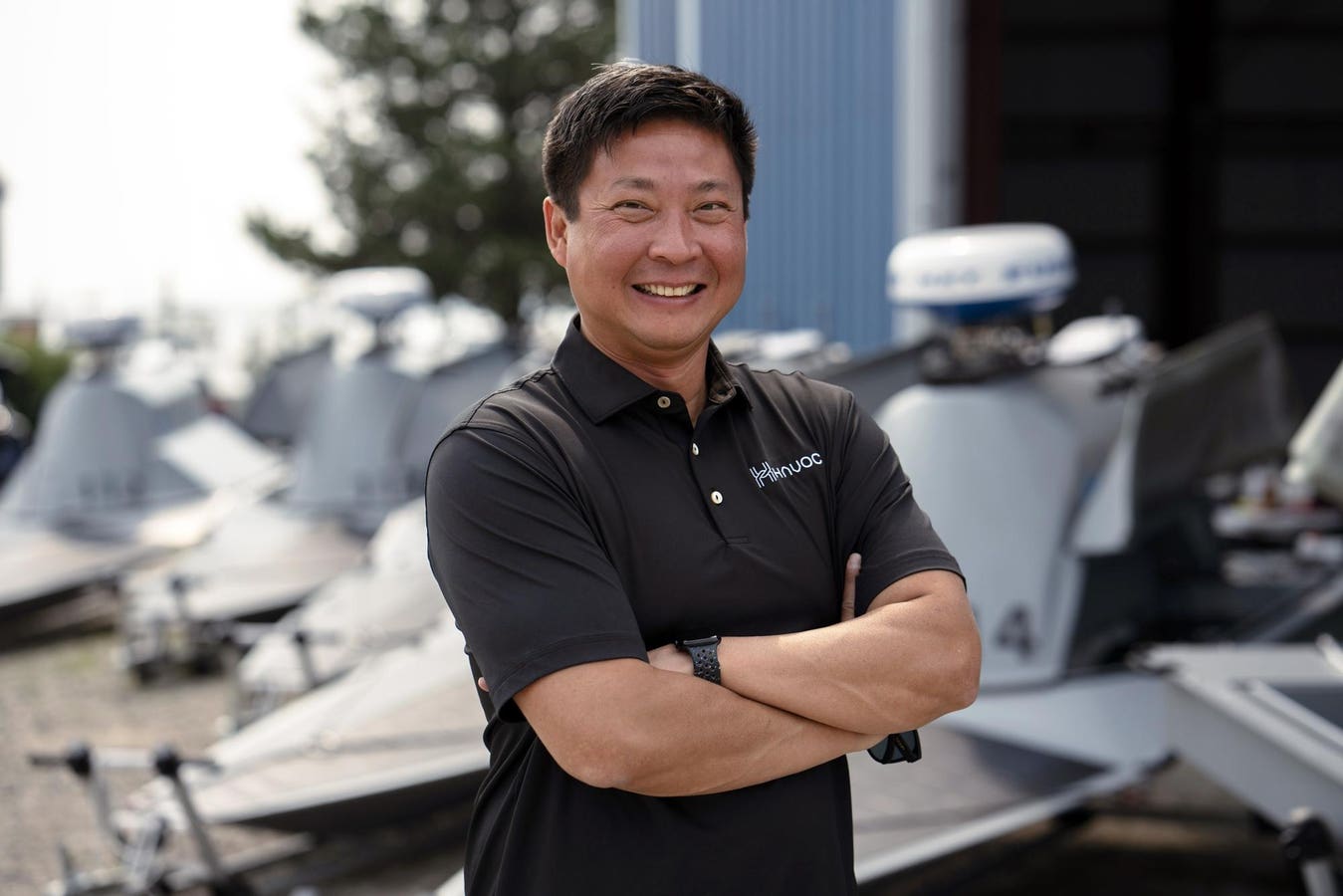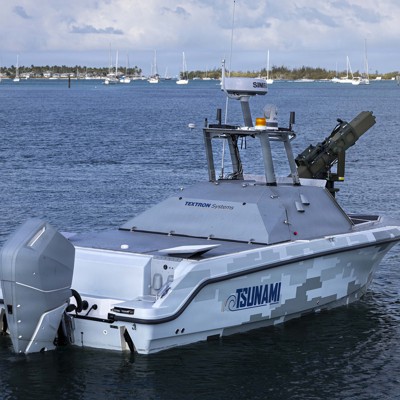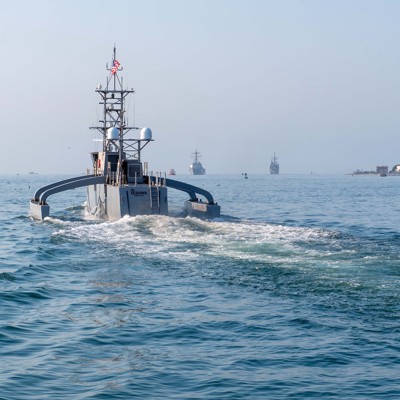
Seasats CEO Mike Flanigan isn’t really interested in building ship-sized drone boats. “We don't plan to build bigger systems,” Flanigan told Defense One. Instead, Seasats is all in on small unmanned surface vessels with three variants: Lightfish, which is about 12 feet long; the 20-foot Quickfish; and Heavyfish, the company’s largest offering at 35 feet long. The latter will make its water debut later this year. “All of our substantial business is on Lightfish, so that's really where 95 percent of our focus is. That's what's supporting Marine Corps, Navy, Special Forces…what we're doing internationally,” he said. Quickfish, which is in production, serves as a “reactionary tool” that can be used to reposition an asset or intercept a target. And Heavyfish is “essentially a Lightfish, but stretched out, where you don't need an expeditionary force to carry it off a beach with no equipment,” Flanigan said. “You can fit significant amounts of payloads, both subsea and aerial.”The San Diego-based company has long been working with the Navy and other militaries; one of its Lightfish vessels used for surveillance recently spotted a Chinese warship near the Philippines. Last year, a Lightfish traversed the Pacific from San Diego to mainland Japan autonomously. There’s admittedly a lot of excitement, churn and chatter around larger USVs, but for Flanigan, smaller can be strategically important and avoid some of the pitfalls of building bigger. “All of these platforms have this long endurance characteristic to them,” he said. “Small USVs have a strategic advantage against large platforms. [Vessels] under 40 feet are much harder to spot. They're much faster to build. You can use them with much less regret. So you actually end up with strategic value over something larger, like over 100 feet.”And now that Navy doctrine and planning is starting to include maritime drones in more detail, there’s a rush to adopt. “There's some understanding now that's like, oh, you can put vessels that are 12 feet long anywhere in the world,” Flanigan said. And that’s good for business.“Right now we're seeing huge adoption…definitely, we're in the thick of scaling and hiring” as “people are trying to move faster than each other.”WelcomeYou’ve reached the Defense Business Brief, where we dig into what the Pentagon buys, who they’re buying from, and why. Send along your tips, feedback, and song recommendations to lwilliams@defenseone.com. Check out the Defense Business Brief archive here, and tell your friends to subscribe!Sticker shock: President Donald Trump’s battleship costs keep growing. The Congressional Budget Office estimated the nuclear-powered ship program would cost about $275 billion, with the first battleship costing about $23.4 billion—up significantly from the administration’s original $15.1 billion estimate. That cost would drop to about $18 billion per ship as the fleet of 15 are built through 2056, according to the CBO report released this week. Sen. Jeff Merkley, D-Ore., and the ranking member of the Senate Budget Committee, ordered the CBO analysis.
Defense Business Brief: The enduring case for small USVs | Battleship costs balloon | Rainey joins Bain Capital
Seasats CEO Mike Flanigan isn’t really interested in building ship-sized drone boats. “We don't plan to build bigger systems,” Flanigan told Defense One. Instead, Seasats is all in on small unmanned surface vessels with three variants: Lightfish, which is about 12 feet long; the 20-foot Quickfish; and Heavyfish, the company’s largest offering at 35 feet long. The latter will make its water debut later this year. “All of our substantial business is on Lightfish, so that's really where 95 percent of our focus is. That's what's supporting Marine Corps, Navy, Special Forces…what we're doing internationally,” he said. Quickfish, which is in production, serves as a “reactionary tool” that can be used to reposition an asset or intercept a target. And Heavyfish is “essentially a Lightfish, but stretched out, where you don't need an expeditionary force to carry it off a beach with no equipment,” Flanigan said. “You can fit significant amounts of payloads, both subsea and aerial.”The San Diego-based company has long been working with the Navy and other militaries; one of its Lightfish vessels used for surveillance recently spotted a Chinese warship near the Philippines. Last year, a Lightfish traversed the Pacific from San Diego to mainland Japan autonomously. There’s admittedly a lot of excitement, churn and chatter around larger USVs, but for Flanigan, smaller can be strategically important and avoid some of the pitfalls of building bigger. “All of these platforms have this long endurance characteristic to them,” he said. “Small USVs have a strategic advantage against large platforms. [Vessels] under 40 feet are much harder to spot. They're much faster to build. You can use them with much less regret. So you actually end up with strategic value over something larger, like over 100 feet.”And now that Navy doctrine and planning is starting to include maritime drones in more detail, there’s a rush to adopt. “There's some understanding now that's like, oh, you can put vessels that are 12 feet long anywhere in the world,” Flanigan said. And that’s good for business.“Right now we're seeing huge adoption…definitely, we're in the thick of scaling and hiring” as “people are trying to move faster than each other.”WelcomeYou’ve reached the Defense Business Brief, where we dig into what the Pentagon buys, who they’re buying from, and why. Send along your tips, feedback, and song recommendations to lwilliams@defenseone.com. Check out the Defense Business Brief archive here, and tell your friends to subscribe!Sticker shock: President Donald Trump’s battleship costs keep growing. The Congressional Budget Office estimated the nuclear-powered ship program would cost about $275 billion, with the first battleship costing about $23.4 billion—up significantly from the administration’s original $15.1 billion estimate. That cost would drop to about $18 billion per ship as the fleet of 15 are built through 2056, according to the CBO report released this week. Sen. Jeff Merkley, D-Ore., and the ranking member of the Senate Budget Committee, ordered the CBO analysis.
Seasats' Lightfish (12ft) drives 95% of Navy revenue as maritime-drone doctrine adoption accelerates. At $23.4B per unit, Pentagon battleship costs validate the shift toward small distributed autonomous systems, reshaping defense procurement and technology priorities.