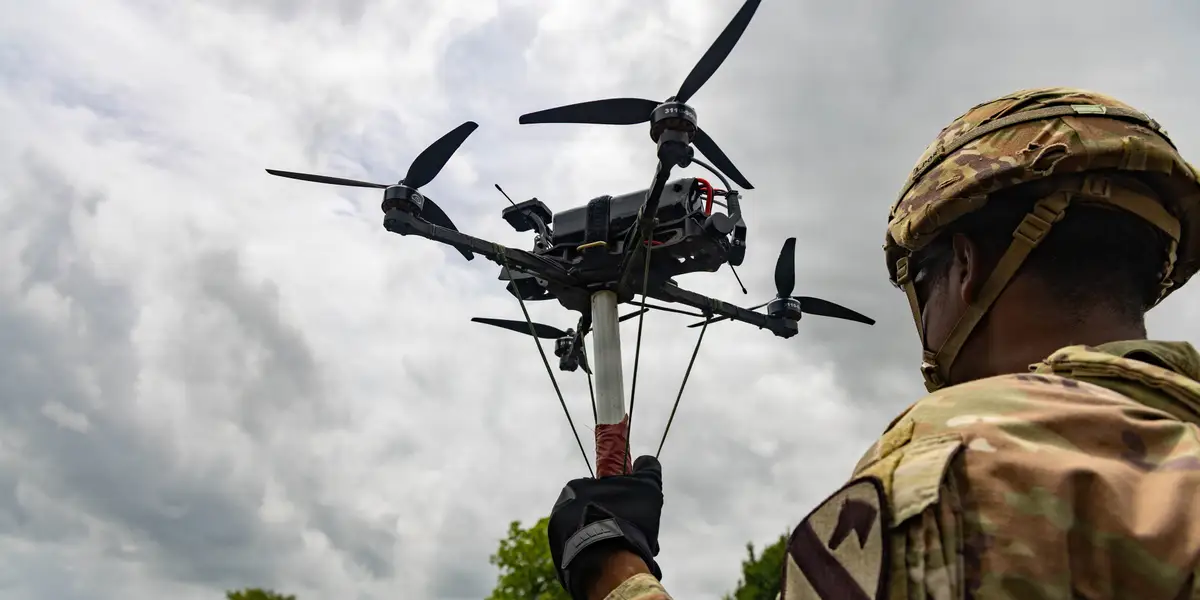
ARLINGTON, Va.—From rockets to tanks, the Army wants to expand its current Amazon-esque marketplace where soldiers, allies and partners now buy drones and counter-UAS tech. “The grand strategy of conflict going forward is compatibility,” Army Secretary Dan Driscoll told reporters Tuesday during the Army’s industry day for low-cost interceptors. “The way that small nations like Finland are going to be able to partner with large nations like the United States, and we are going to be able to parachute into a theater where a lot of our stuff doesn't exist, is that our allies have compatible equipment to us.”To do that, everyone needs to have the right “plumbing” for information-sharing, “and then—in theory, in a perfect world, you want everyone buying from the same places. They don't have to buy the same thing, but they want to buy that compatible stuff,” Driscoll said. “We're functioning almost like Consumer Reports, where we are reviewing many of the products on there, we're allowing other countries to put their reviews on there, and then…just let free market forces dictate what are the best products.”The service already has dedicated marketplaces for cUAS and aerial drones and, last week, inked a deal with NATO allies and partners to use the platforms. Nine partner countries signed a letter of intent at the Eurosatory conference: Denmark, Finland, France, Italy, Lithuania, Netherlands, Norway, Sweden, and the United Kingdom, the Army confirmed to Defense One. They join the eight nations already signed on: Australia, Argentina, Estonia, Poland, Romania, Singapore, South Korea, and Thailand.The unmanned aerial system marketplace has approximately 45 companies represented and more than $200 million in sales, said Brent Ingraham, the Army’s acquisition chief. It’s also generating sales from allies and partners. The ultimate goal is to have just one platform with virtually all Army materiel available. And when a soldier places an order, it goes directly to the vendor within 24 hours.“We're merging the marketplaces together,” Ingraham told reporters. “When a soldier goes in and says: I want to buy 110, 300 of some product on this on the current UAS or counter-UAS marketplace, that automatically kicks directly over to an order that flows to that company.” Driscoll described a future, broader digital marketplace as something that could reshape how the military positions materiel abroad vis-à-vis prepositioned stock: “It's kind of a rewriting of how we, the United States, can engage in conflict abroad.”And perhaps, one day, low-cost interceptors could be a part of that marketplace. The Army plans to release an RFI for low-cost interceptors July 6 with a four-week window for submissions, and the goal of having tech demonstrations by the first quarter of fiscal year 2027. WelcomeYou’ve reached the Defense Business Brief, where we dig into what the Pentagon buys, who they’re buying from, and why. Send along your tips, feedback, and song recommendations to lwilliams@defenseone.com. Check out the Defense Business Brief archive here, and tell your friends to subscribe!USARPAC + drone boats. Gen. Ronald Clark, commander of U.S. Army Pacific, is all about using unmanned systems for logistics and sustainment. But the key is working with companies that can build what the command needs.
Defense Business Brief: SECARMY’s dream marketplace; USARPAC + USVs; and Quantum EOs
ARLINGTON, Va.—From rockets to tanks, the Army wants to expand its current Amazon-esque marketplace where soldiers, allies and partners now buy drones and counter-UAS tech. “The grand strategy of conflict going forward is compatibility,” Army Secretary Dan Driscoll told reporters Tuesday during the Army’s industry day for low-cost interceptors. “The way that small nations like Finland are going to be able to partner with large nations like the United States, and we are going to be able to parachute into a theater where a lot of our stuff doesn't exist, is that our allies have compatible equipment to us.”To do that, everyone needs to have the right “plumbing” for information-sharing, “and then—in theory, in a perfect world, you want everyone buying from the same places. They don't have to buy the same thing, but they want to buy that compatible stuff,” Driscoll said. “We're functioning almost like Consumer Reports, where we are reviewing many of the products on there, we're allowing other countries to put their reviews on there, and then…just let free market forces dictate what are the best products.”The service already has dedicated marketplaces for cUAS and aerial drones and, last week, inked a deal with NATO allies and partners to use the platforms. Nine partner countries signed a letter of intent at the Eurosatory conference: Denmark, Finland, France, Italy, Lithuania, Netherlands, Norway, Sweden, and the United Kingdom, the Army confirmed to Defense One. They join the eight nations already signed on: Australia, Argentina, Estonia, Poland, Romania, Singapore, South Korea, and Thailand.The unmanned aerial system marketplace has approximately 45 companies represented and more than $200 million in sales, said Brent Ingraham, the Army’s acquisition chief. It’s also generating sales from allies and partners. The ultimate goal is to have just one platform with virtually all Army materiel available. And when a soldier places an order, it goes directly to the vendor within 24 hours.“We're merging the marketplaces together,” Ingraham told reporters. “When a soldier goes in and says: I want to buy 110, 300 of some product on this on the current UAS or counter-UAS marketplace, that automatically kicks directly over to an order that flows to that company.” Driscoll described a future, broader digital marketplace as something that could reshape how the military positions materiel abroad vis-à-vis prepositioned stock: “It's kind of a rewriting of how we, the United States, can engage in conflict abroad.”And perhaps, one day, low-cost interceptors could be a part of that marketplace. The Army plans to release an RFI for low-cost interceptors July 6 with a four-week window for submissions, and the goal of having tech demonstrations by the first quarter of fiscal year 2027. WelcomeYou’ve reached the Defense Business Brief, where we dig into what the Pentagon buys, who they’re buying from, and why. Send along your tips, feedback, and song recommendations to lwilliams@defenseone.com. Check out the Defense Business Brief archive here, and tell your friends to subscribe!USARPAC + drone boats. Gen. Ronald Clark, commander of U.S. Army Pacific, is all about using unmanned systems for logistics and sustainment. But the key is working with companies that can build what the command needs.