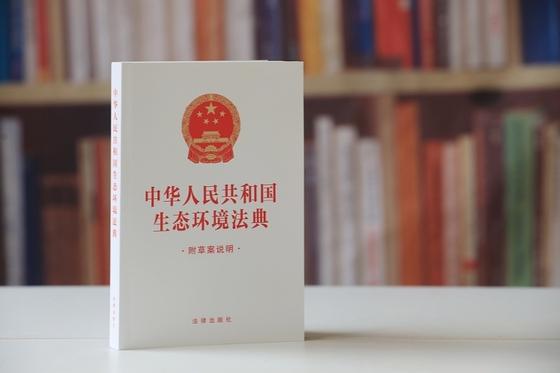
1. China has passed its second major statutory code, the Ecological and Environmental Code, following the Civil Code. This new code was approved during the fourth session of the 14th National People’s Congress on March 12 and will take effect on August 15. Its legislative process began in November 2023 and, over two and a half years, culminated in a law that legal scholars regard as innovative and globally significant [para. 1][para. 2][para. 3].2. The Ecological and Environmental Code is described as the world’s first legislation of its kind, consolidating over 30 existing environmental laws, hundreds of administrative regulations, and more than a thousand local rules. It goes beyond conventional pollution and resource legislation by introducing a standalone section focused on green and low-carbon development, thus balancing the need for environmental protection against economic growth—a legal framework considered unique globally [para. 4][para. 5][para. 6].3. Integrating disparate laws posed significant legislative challenges. Lawmakers used a “moderate codification” model, grouping existing laws and merging or retaining them as appropriate. For instance, pollution and resource laws were absorbed, while specialized issues like climate change were addressed through forward-looking guidelines. This approach led to a dual-source legal structure—“code plus standalone laws”—whose practical effectiveness is yet to be seen [para. 7][para. 8][para. 9][para. 10].4. Implementing the new code will require comprehensive revision of existing regulations and judicial processes. China’s judiciary, including the Supreme People’s Court, is preparing supporting legal interpretations to standardize enforcement when the code comes into effect [para. 11].5. The code’s development is rooted in decades of ecological legislation, with a rapid expansion of environmental laws since the 1970s. By 2024, China had 36 specialized environmental laws, over 150 administrative regulations, and 2,200 standards. Public outcry over widespread smog in 2012 prompted significant legislative reforms, culminating in stricter laws and a surge in new environmental legislation by 2015 [para. 13][para. 14][para. 15][para. 16].6. A major impetus for the code’s creation was to harmonize a fragmented legal landscape where penalties for similar violations varied dramatically. The new code unifies legal standards, aiming for consistent enforcement across regions and departments. It also introduces fresh, rigorous regulations for emerging pollutants and holds producers legally liable for unauthorized production or import of toxic substances, addressing practical demands arising from new phases of ecological development [para. 17][para. 18][para. 19][para. 20][para. 21].7. The code comprises 1,242 articles across five sections: General Provisions, Pollution Control, Ecological Protection, Green and Low-Carbon Development, and Legal Liabilities. Its pollution control section is notably large, absorbing ten previous laws entirely—making standalone versions obsolete—while ecological protection laws balancing resource use remain as separate statutes [para. 24][para. 25].8. Despite its comprehensive scope, internal friction remains. Penalties are unevenly distributed, with pollution heavily penalized compared to ecological or green development violations. This structure means China’s courts must determine how remaining standalone laws interact with or supersede the code, sparking debate among legal scholars [para. 26][para. 27][para. 28].9. Lawmakers solicited public feedback through four rounds of consultation, receiving over 20,000 comments. A central debate was the proportionality of penalties. Recent years saw fines escalate, creating inconsistencies and, at times, loopholes allowing minor violations to escape punishment while serious offenses faced inconsistent penalties [para. 29][para. 30][para. 31][para. 32][para. 33][para. 34].10. Ultimately, the code institutes a categorized penalty system rather than universal reductions. For example, unauthorized hazardous waste disposal now brings fines between 200,000 and 1 million yuan, with higher penalties of up to 5 million yuan for severe violations. Minimum fines for labeling errors have been lowered, but some overlapping fines remain unresolved, with hopes such issues will be clarified in future judicial guidance [para. 35][para. 36].AI generated, for reference only
In Depth: China Enacts Historic Environmental Code to Police Green Development
The landmark legislative overhaul consolidates dozens of laws to balance economic growth with ecological preservation, though questions over corporate penalties and enforcement remain
602 words~3 min read