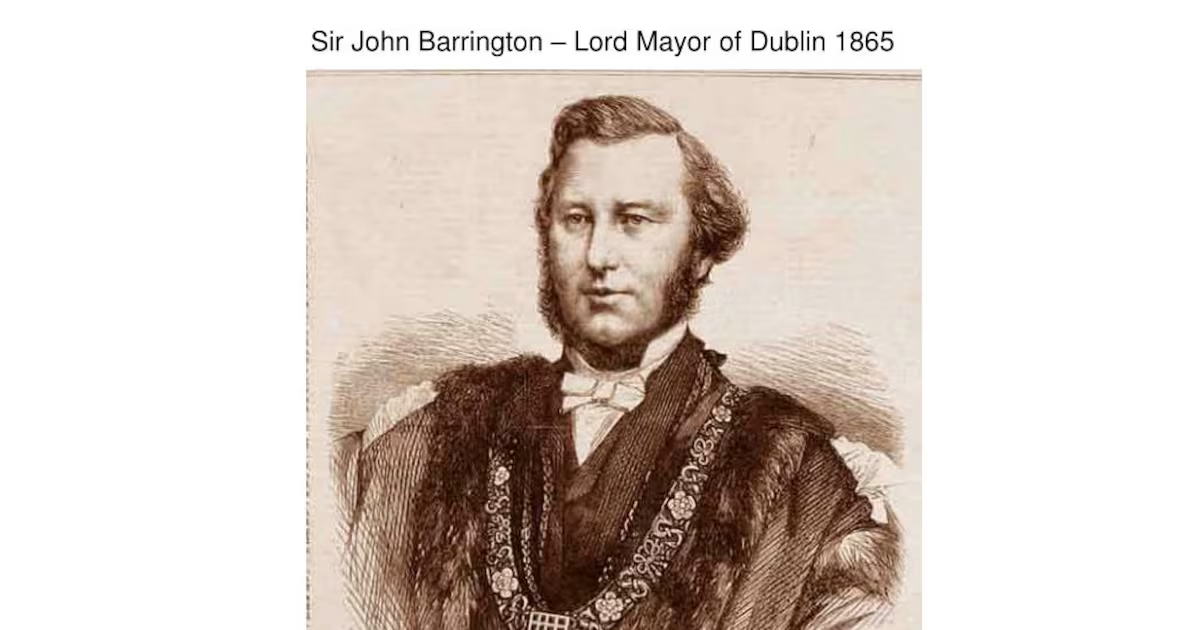
The story about Sir Jonah Barrington and the banshee (Diary Wednesday, August 5th) struck a chord with reader Karl Doyle. Not because of the banshee, but because a near namesake of Sir Jonah had featured in a tour of the Quaker burial ground in Blackrock (the Dublin one) on Tuesday, in Karl’s presence.That was Sir John Barrington (1824 – 1887), lord mayor of Dublin twice and the first Quaker ever to hold the office. But the odd thing, as my correspondent points out, is that the “Sir” appears on his gravestone, contrary to usual practice in the Society of Friends. “Titles are anathema to the Quaker faith but this one seems to have squeezed through,” writes Karl.Sure enough, in any Quaker graveyards I’ve visited, honorifics tend to be avoided in favour of simple names and dates. In some places, as if to emphasise the role of death as leveller, the gravestones are also of uniform size and shape, anticipating the great 20th-century battlefield cemeteries of Europe.But in a roundabout way, this reminds me of one of the more suspicious details in the other Barrington’s story about hearing a banshee foretell the death of his neighbour, Robert Cuninghame, aka Lord Rossmore, in 1801.I can well believe he did hear otherworldly sounds – “softer than any voice, and wilder than any music” – from his garden at 2am, and that he was petrified by them.I can also accept that, despite tradition dictating that the banshee appears only to certain old Gaelic families “of pure Milesian stock”, Cuninghame’s Scottish heritage might excuse him of cultural appropriation.The supposed climax of Barrington’s tale, however, was when the voice from the garden exclaimed “Rossmore – Rossmore – Rossmore!“ at the very moment, as it emerged later, that the man was breathing his last.Call me a purist, but I just cannot be persuaded that an ancient Irish harbinger of death would not have her target filed under his old family name; or that, in announcing his time was up, she would use an aristocratic title conferred only a few years earlier by the British House of Lords.***Jonah Barrington was himself to lose one of his honorifics late in life. Not the “Sir”, which followed him to his grave in Paris, a subject to which we’ll return. Instead, having been appointed a judge in 1798, he was stripped of that title in 1830 for financial irregularities.A strange mixture of principle and unscrupulousness, he refused as an MP in the old Irish House of Commons the usual bribes to vote for the Act of Union. But later, struggling to support his extravagant lifestyle, he misappropriated court funds.Pursued by creditors, he and his family first moved to England, and then France, which is where he was living by the time a British parliamentary commission recommended his removal from judicial office. Both houses of parliament voted in favour, and to this day he remains the only UK judge ever so deposed.His years in France, which coincided with The Hundred Days and the end of Napoleon, contributed some lively sketches to his bestselling “Recollections”. In one, from 1815, Barrington describes the spectacle of an old soldier limping home from the Battle of Waterloo along a Parisian boulevard.He had once been a fine man. Now: “His shoes were worn out; his clothes in rags; scanty hairs were the only covering on his head; one arm was bandaged up with a bloody rag, and slung from his neck by a string; his right thigh and leg were also bandaged, and he seemed to move with pain and difficulty.”Moved by the veteran’s plight, Barrington crossed the street and “put, without saying a word, a dollar into his yellow and trembling hand”. This seemed to throw the old warrior who, unsure he should accept, said in an emphatic tone: “Not for charity.”The donor attempted to reassure him – “No, my friend, in respect of your bravery. – then walked away. But after considering the situation further, the soldier hobbled after him to return the coin:“Excuse me, Monsieur,” Barrington recalled him explaining: “You are an Englishman, and I cannot receive bounty from the enemy of my emperor.”The “Englishman”, who had been born in what is now Laois, did not see fit to correct the description. Instead, he marvelled at the deposed emperor’s continuing hold on his troops: “Good God! thought I, what a man must Napoleon have been. This incident alone affords a key to all his victories.”Barrington died in 1834 and is buried at Versailles. I can’t find a picture of the headstone, but according to Findagrave.com, its inscription includes the “Sir”. It also features a line that has not aged well, claiming as it does that the deceased was “deeply deplored by his wife and family”. To modern ears, this implies they didn’t like him much. In fact, “deplored” is just another example of a word that has since evolved. On gravestones, it used to mean “lamented”.
The Last Word: gravestone honorifics and epitaphs that get lost in translation
Plus a suspicious detail about a banshee’s ominous cries
822 words~4 min read