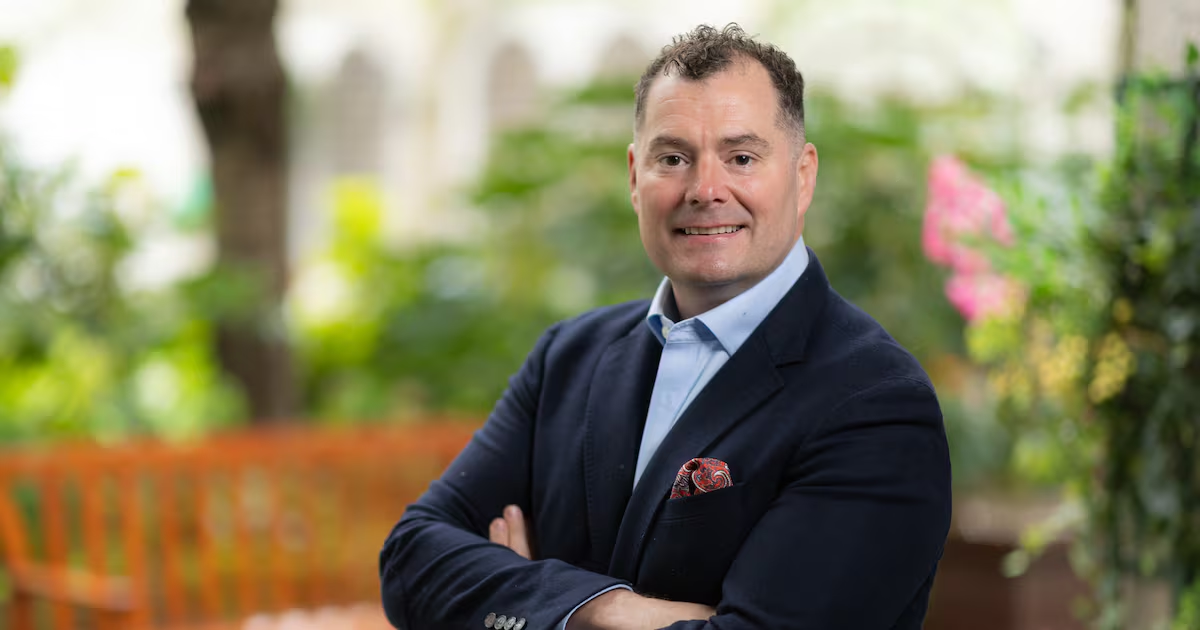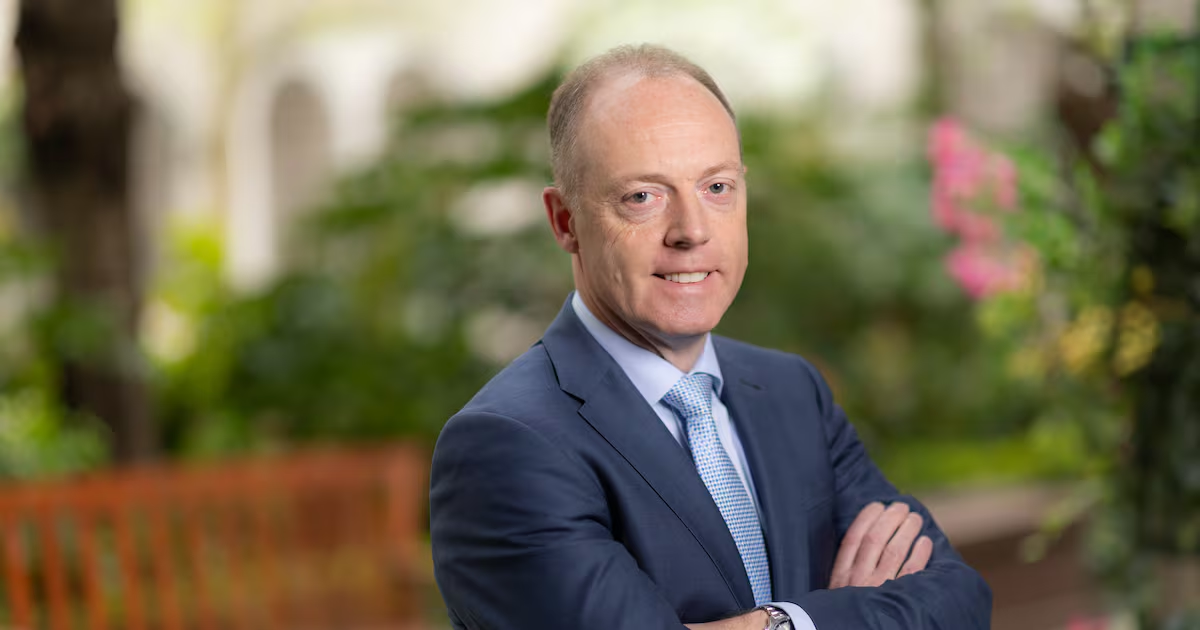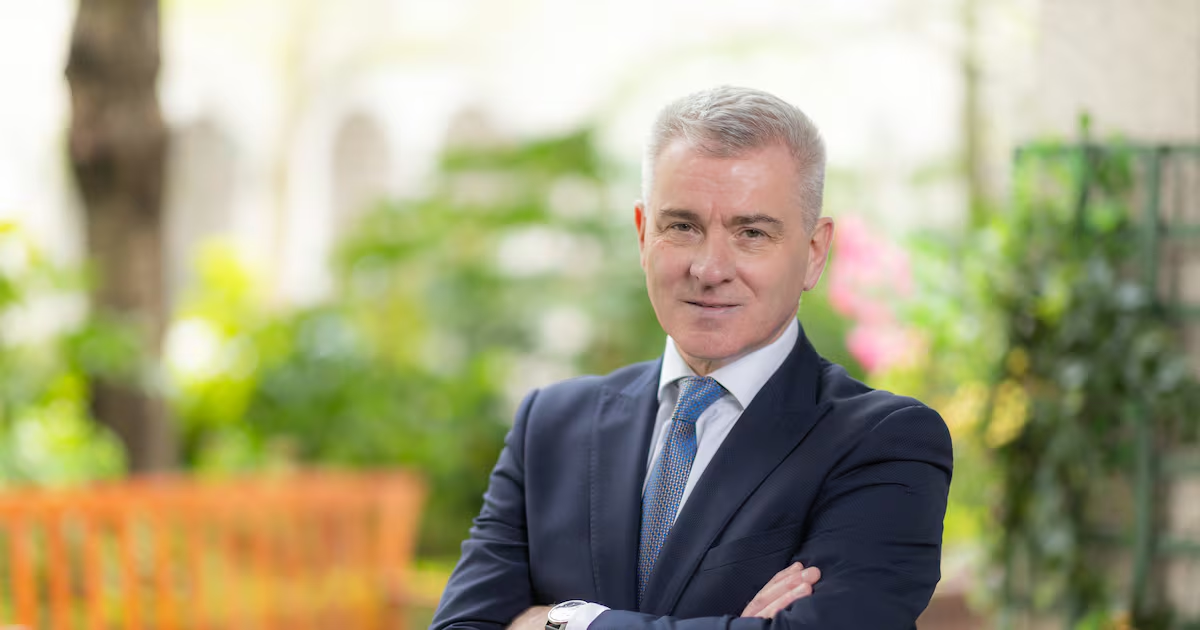
Tommy Kearns, Xtremepush: ‘We’re not adapting to the AI era. We’re defining what it looks like in regulated industries’Tommy Kearns, co-founder and chief executive of Xtremepush Tommy Kearns is the co-founder and chief executive of Xtremepush, a global customer engagement platform built for regulated industries.Its self-described aim is to help enterprises communicate with millions of customers across email, push notifications, SMS, WhatsApp and more – powering onboarding, loyalty programmes, fraud alerts, responsible gaming and real-time marketing in fully compliant environments.Founded in Dublin in 2014, Xtremepush operates across offices in Dublin, London, and New York, with a global team of more than 170 people and clients including FanDuel, Fanatics, BetMGM, Caesars Entertainment, Bank of Ireland, Barclays, An Post, Laya and Three.What vision or light bulb moment prompted you to start up in business?The app economy was exploding, but businesses had no intelligent way to talk back to their customers. When Apple and Google opened up push notifications, something clicked. I saw an opportunity to build a platform that allowed businesses to communicate personally, in real time, using data rather than instinct.Push notifications were the missing piece. That simple idea of helping businesses have timely, intelligent conversations, rather than just broadcasting messages, became the foundation of Xtremepush; everything since has been chasing that original insight. Describe your business model and what makes it unique.At its simplest, we help businesses have better conversations with their customers.If your bank needs to warn you about fraud, your insurer wants to send an important update or your favourite sports app wants to send you a personalised offer, Xtremepush decides the right message, through the right channel at the right time, all while ensuring it complies with strict regulatory rules.We help organisations build trust, not just engagement.To what extent does your business trade internationally and what are your future plans?Xtremepush is a global business.More than 70 per cent of our revenue now comes from outside Ireland, with North America being our largest and fastest-growing market. That’s something I’m incredibly proud of because it proves geography is no barrier to building world-class technology. Our ambition isn’t simply to sell into more countries; it’s to build the company that global enterprises trust when AI and customer engagement converge. That’s a challenge worth dedicating the next decade to.What are you doing to disrupt, innovate and improve your products?We’ve launched XpertOS – the world’s first Governed Agentic Operating System for customer engagement. It doesn’t just automate campaigns; it orchestrates intelligent, compliant engagement autonomously, while keeping humans in control. We’re not adapting to the AI era. We’re defining what it looks like in regulated industries. Internally, AI has already fundamentally changed how we build and run the business.What is the most common mistake you see entrepreneurs make?Falling in love with the solution instead of the problem. Too many founders focus on what they’ve built rather than whether it solves something real and meaningful. Sustainable businesses are built by solving genuine problems repeatedly – not by chasing trends or building technology for its own sake.What advice would you give a less experienced entrepreneur?I’d tell my younger self that every opportunity has a cost. As founders, we naturally want to say “yes” – to customers, new markets and new ideas. I’ve learned that every “yes” means saying “no” to something else. Our biggest breakthroughs came when we focused on the opportunities where we could genuinely be the best in the world, rather than simply another competitor. That’s why today we’re focused on governed AI for regulated industries, not AI for everyone.What was the game changer or turning point for the company?For me, the turning point wasn’t just winning a customer; it was changing how we saw ourselves. Bank of Ireland gave us credibility in one of the world’s most regulated industries, and our first big US enterprise customer proved we could compete internationally. From then on, we stopped asking whether we were good enough to compete globally and started asking how big we could become.Trevor Casey, EPH Controls: ‘From an early age I wanted to build something of my own’Trevor Casey, founder and managing director of EPH Controls Ltd Trevor Casey is the founder and managing director of EPH Controls Ltd, an Irish heating controls manufacturer and supplier.Founded in 1997, EPH designs, manufactures and distributes heating control solutions for residential and commercial applications. Its product portfolio includes smart thermostats, heating programmers, motorised valves, underfloor heating controls and energy management solutions designed to improve comfort, efficiency and sustainability.Headquartered in Cork, EPH serves customers throughout Ireland and the UK through a network of more than 2,500 plumbing and electrical merchants and OEM partners.What vision/light bulb moment prompted you to start up in business?Entrepreneurship is in my DNA. My father was a serial entrepreneur, and from an early age I wanted to build something of my own. When my employer ceased trading, I saw an opportunity rather than a setback. Being ambitious enough at 23 to secure the agency for a Swiss heating controls manufacturer became the catalyst for what would grow into EPH.What are your annual revenues and profits?The EPH Group recorded turnover of €38 million in 2025.Describe your business model and what makes your business unique.EPH designs and manufactures heating controls that improve comfort, reduce energy consumption and simplify installation. What sets us apart is our close relationship with installers and customers. We listen carefully, act quickly and develop products that solve real-world challenges. What moment or deal was a game changer or turning point for the company?The launch of a heating controls range designed specifically for the UK market in the mid-2000s was a big turning point. Its success accelerated our growth and gave us the confidence to back our own design and manufacturing capabilities. More importantly, it proved that an Irish company could compete successfully on a much larger stage.To what extent does your business trade internationally and what are your future plans?Today, almost two-thirds of our revenue comes from export markets, with the UK representing our largest market. Our ambition is to continue expanding internationally, particularly across Europe, Australia and New Zealand. We see significant opportunities to bring our products, expertise and customer-focused approach to new markets.What is the most common mistake you see entrepreneurs making?Being too focused on the product rather than the customer’s need. Great businesses are not built on features alone, but on a clear understanding of demand. Successful entrepreneurs are those who stay close to the market and ensure every product decision is grounded in solving a real-world problem.What advice would you offer to a less experienced entrepreneur?Invest in yourself and never stop learning. Build your business around genuine customer needs, focus on creating long-term value and always act with integrity. Success rarely comes from a breakthrough moment; it is usually the result of consistently making the correct decisions over time.What were the best and the worst pieces of advice you received when starting out?The best advice was to stay close to the customer and focus on solving real problems.The worst was to pursue growth too aggressively. I have learned that sustainable businesses are built on strong foundations. Growth is important, but only when supported by the right people, systems and culture.What makes your company a good place to work? As the business has developed, we have worked hard to nurture our family-orientated culture. We invest in training, development and employee wellbeing, while creating opportunities for people to progress and contribute to EPH’s succes in a meaningful way. Our growth has always been driven by our people, and building a strong culture remains a priority.Oltian Dervishi, Forte Pespa: ‘Our goal is to manufacture one balcony every 18 minutes’Oltian Dervishi, the founder and chief executive of Forte Pespa Oltian Dervishi is the founder and chief executive of Forte Pespa, an Irish off-site modular manufacturer serving the construction sector.It specialises in prefabricated aluminium balcony and balustrade systems for the construction sector, and has an estimated 45 per cent share of Ireland’s aluminium balcony market.According to Forte Pespa, its prefabricated approach reduces on-site labour, improves quality control and accelerates construction programmes.Describe your business model and what makes your business unique.We provide an end-to-end balcony solution – design, manufacture, project management and installation – built entirely off-site and installed in less than 30 minutes. That integration is what makes us unique: clients deal with one partner, not five, and get faster programmes, tighter quality control and greater certainty. It has made us Ireland’s largest manufacturer in the category, with a 45 per cent market share and systems that are 70 per cent lower carbon and 95 per cent recyclable.What was your “back-to-the-wall” moment and how did you overcome it?In 2023 we invested all of our personal and business capital into new products, systems and a purpose-built factory. We put everything on the line. For nine months we worked relentlessly as a team to validate the product, complete testing and certification, build the facility and overhaul our design processes. The orders that followed validated the bet and I remain hugely proud of the team that stayed the course with me.What moment or deal would you cite as the game changer or turning point for the company?Securing Glenveagh Homes within two months of our factory becoming operational – a €4.5 million order for 400 units at Citywest. It was a big milestone and, more importantly, independent validation of everything we had built: the product, our manufacturing capability and our testing and certification. This was further validated when we achieved an average manufacturing time of five hours per balcony with two fabricators.What are your annual revenues and profits?Revenues of €20 million in full year 2026, fully secured, up from €12 million in full year 2025. What were the best and worst pieces of advice you received when starting out? Best: When we overhauled the business in 2022 and embarked on a complex, high-risk technical venture, the fear of failure weighed on me. My father said: “We never had it to begin with, so what if we lose it?” That freed me to back myself completely.Worst: That we shouldn’t launch the product until we had patents in place. Had we waited, we would have missed the early, market-defining orders that established us, and a competitor could have taken the position we now hold.To what extent does your business trade internationally and what are your future plans?We are about to complete our first UK acquisition, which will serve as our launch pad into the British market. It gives us a base to grow in both new-build construction and the building-remediation sector, where demand for high-quality, certified modular systems is accelerating.What are you doing to disrupt, innovate and improve the products or services you offer?Innovation is non-negotiable in our business. We are developing the fourth generation of our core product lines, backed by a €4 million investment in advanced manufacturing and robotics. This will lift our output capacity beyond 5,000 units a year, improving both quality and speed of delivery for our clients. Our goal is to manufacture one balcony every 18 minutes.What piece of advice would you offer to a less experienced entrepreneur? Embrace failure. You cannot avoid it, so the sooner you get comfortable with it, the sooner you start succeeding – provided you learn from it every time.John Lunn, Lunns: ‘My true passion for our industry came during my year with Cartier in Madrid’John Lunn, the managing director of Lunn’s John Lunn is the managing director of Lunn’s, working closely alongside his sister Suzanne, marketing director, and his father Peter, chairman.A family jewellery business in the UK and Ireland, led by the third generation, it has created partnerships with recognisable names in watches and jewellery, including Rolex, Patek Philippe, Cartier and David Yurman, as well as its own jewellery collections.John became managing director in 2012 and has overseen the opening of six stores in the past seven years, the full restoration of Queen’s Arcade in Belfast and, more recently, the launch of the company’s own high jewellery capsule collection, Grove.What vision/light bulb moment prompted you to start up in business?Lunn’s was actually started by my grandfather, also John, in 1954. I had worked in our family business during school holidays to help out but my true passion for our industry came during my year with Cartier in Madrid in 2002, specifically during the exciting launch of its new jewellery collection the following year, Le Baiser du Dragon (The Kiss of the Dragon).What is your business model and what makes it unique?Our family business is most often about helping our clients mark significant moments in their lives with pieces that can last a lifetime and perhaps even be passed down through generations, with a customer experience to make all of this as special as possible. We hold ourselves to the highest standards, and we apply this same approach to our valued brand partnerships. What was your back-to-the-wall moment and how did you overcome it?The 2008 global recession impacted luxury retail for many years thereafter. It was a very challenging time, with many lessons learned along the way, but what helped us more than anything was not panicking and always staying absolutely true to who we are, which involved striving to work only with the finest products supported by the very best expertise and client experience.What were the best and the worst pieces of advice you received when starting out?The best piece of advice was a Franklin D Roosevelt quote shared with me some years ago: “Keep your eyes on the stars and your feet on the ground.”The worst advice I’ve often found is anything with too much of a short-term focus, rather than seeing the bigger picture and the long game.What makes your company a good place to work? First, we are an accredited great place to work, but I believe this is something we very much demonstrate daily. For instance, our Lunn’s values were developed by our team via our colleague voice group and presented to our board with unanimous agreement, rather than the other way round. We offer a range of benefits, but I believe it’s the ethos behind these that’s key.What are you doing to disrupt, innovate and improve the products or services you offer?In our jewellery, we have always focused on bringing together the best gemstones with the finest goldsmithing and craftsmanship. Our recently launched Grove collection, combining themes of the Irish landscape and our family heritage, allows our in-house expertise in gem-buying and design to take this to the next stage. I would also add the continual evolution of our showrooms, such as the redevelopment of our Rolex store last year.What moment/deal would you cite as the “game changer” or turning point for the company?The restoration of Queen’s Arcade stands out, with my sister Suzanne being pivotal in this alongside our director of operations Andrew Burns. But more significantly, I would say it has been my father’s total commitment to our people-first culture. His priority is always to check in regularly on our existing team, and he meets all new team members. He cares immensely, and this mindset drives so much towards our overall approach.
EY Entrepreneur of the Year profiles: From push notes to balconies and diamond rings
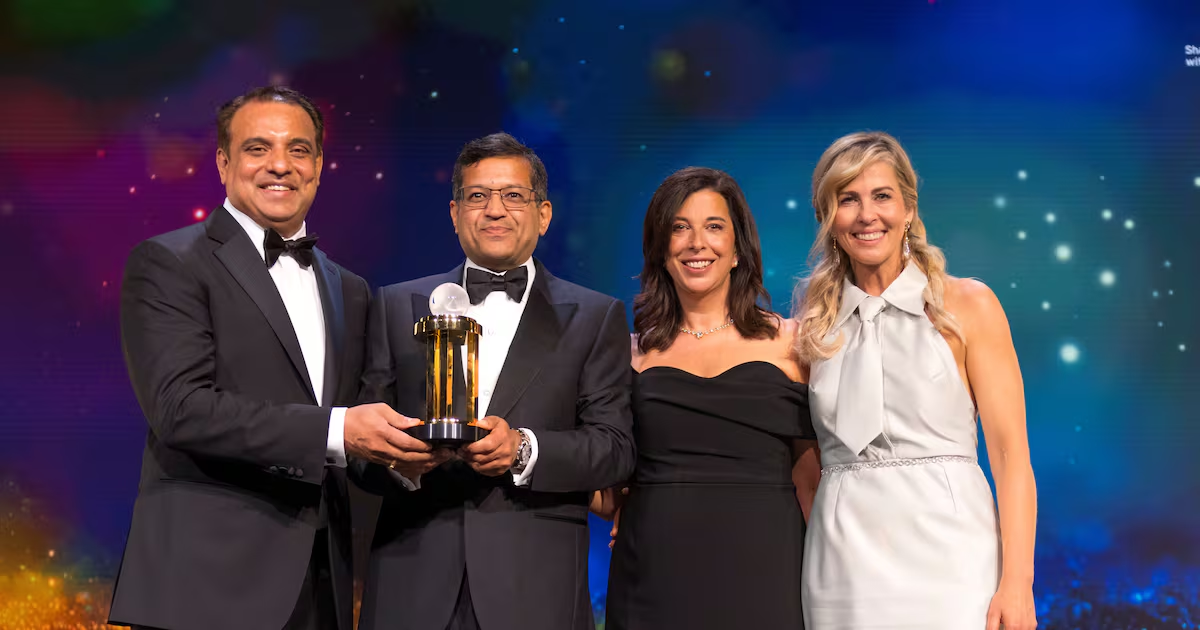
We profile four of the finalists chosen in the established category for this year’s EY Entrepreneur of the Year awards
TL;DRAI
Xtremepush launched XpertOS, a Governed Agentic OS automating customer engagement with compliance for banking, insurance, and gaming. For tech leaders: AI in regulated industries demands governance-first design. Xtremepush targets autonomous engagement systems meeting compliance—a premium market.
2,514 words~11 min read