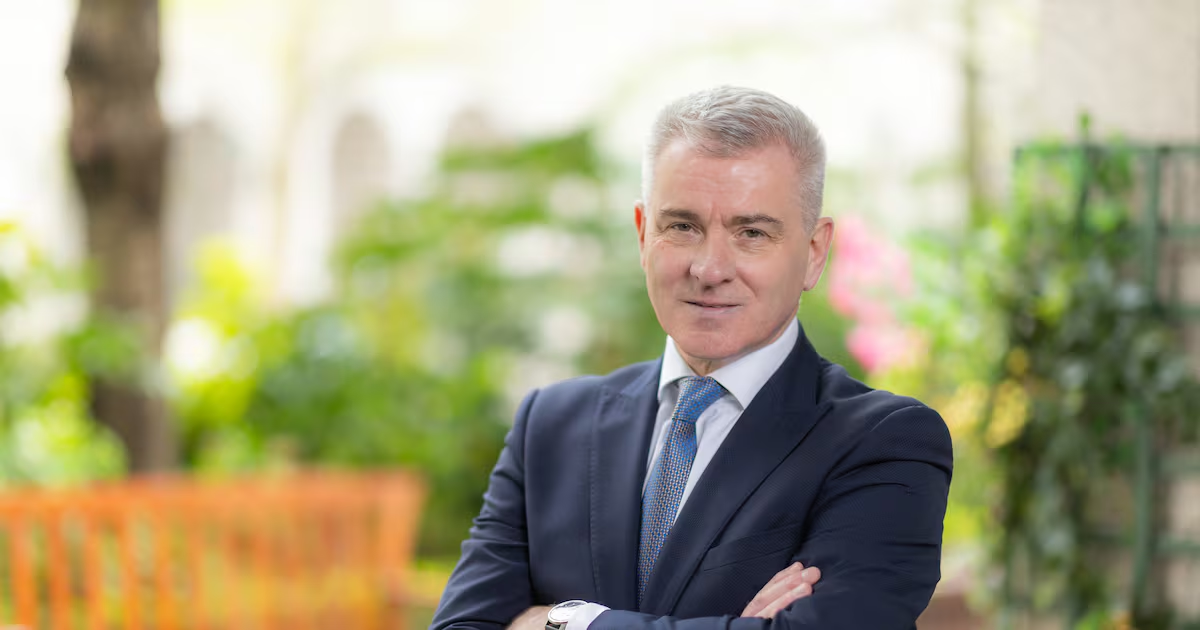
Revive cofounder has been nominated in the emerging category for this year’s EY Entrepreneur of the Year awardsLiam Kearney is the CEO and co-founder of The Revive Group. Mon Aug 03 2026 - 06:00 • 3 MIN READLiam Kearney is the CEO and cofounder of the Revive Group, an Irish manufacturer of underground infrastructure maintenance equipment, producing both new builds and fully refurbished sewer cleaning units. The company focuses on the design, manufacture and supply of both new and fully refurbished equipment to offer customers high-performance and cost-effective solutions.Its flagship product, the Revive Warrior, is a combination sewer cleaning unit engineered to be refurbished and redeployed every seven to 10 years, delivering a lifespan of over 30 years.Revive operates from offices in Ireland, Britain, Denmark, Switzerland, France and New Zealand, with further expansion planned into Australia towards the end of 2026. The company employs over 100 direct staff and is supported by an extensive network of subcontractors in Ireland. What vision/light bulb moment prompted you to start up in business?The light bulb moment came from recognising a clear gap in sustainable manufacturing. Existing products were built to last around 10 years, creating waste and inefficiency. I saw an opportunity to extend lifespans to more than 30 years, reducing environmental impact while delivering longer-term value and significant cost savings to our customers.What are your annual revenues and profits?In 2025/26, we achieved revenues of €32 million, excluding our international companies, with an Ebitda of €2.7 million. We are doubling in size year-on-year. By 2030, we are targeting €102 million in revenue and over €15 million in Ebitda.What is your greatest business achievement to date?Our greatest achievement to date is developing Revive Eco Park in rural Tipperary, a fully off-grid manufacturing facility. It reflects our absolute commitment to environmental responsibility, delivering complete energy independence. When complete, all six of our sites will operate off-grid, redefining the future of manufacturing where innovation meets sustainability.How much has your company invested in AI and how has it impacted on the performance of the business?We have integrated AI across all areas of our business, making it a core part of how we operate daily. Through our 10-year contracted partnership with AIMI, we continue to strengthen implementation, driving factory efficiency, smarter decision-making and improved performance. Every area of our business will eventually be enhanced by AI.What impact have the US tariffs had on your business? How has this affected your view of the United States as a place in which to invest?US tariffs have had zero impact on our business because, based on prior market experience, we deliberately chose not to enter the US market. As a result, these trade tariffs simply reinforce our cautious stance and make the United States a much less attractive destination for our future investmentWhat are you doing to disrupt, innovate and improve the products/services you offer?Innovation is at the heart of our operations. Last year, we secured a global patent for our first big product disruption, the compact recycling piston. We also have three additional innovative products currently undergoing rigorous research and development, all of which are scheduled for commercial release in 2027.How will your market look in three years and where would you like your business to be?Driven by climate change, altering weather patterns, urbanisation, ageing infrastructure and changing dietary habits, demand in the underground environmental sector will surge. In three years, we expect strong global expansion. Our ambition is to position the business as one of the definitive leading players worldwide in our specialist industry.What deal would you cite as the “game changer” or turning point for the company?A true game changer was securing a supply agreement with TIP Group, Europe’s largest rental fleet company. This landmark partnership validated our circular manufacturing offering at scale, significantly boosted our market credibility and opened big growth opportunities across European marketsWhat was your “back-to-the-wall” moment and how did you overcome it?My back-to-the-wall moment was committing to retain 100% ownership while managing exceptionally tight cash flow. Operating with no safety net, I stayed highly disciplined by prioritising revenue, tightly controlling costs and making tough decisions. That intense focus and resilience allowed me to sustain the business and keep full controlIN THIS SECTION
Liam Kearney, Revive: ‘We deliberately chose not to enter the US market’
Revive cofounder has been nominated in the emerging category for this year’s EY Entrepreneur of the Year awards
698 words~3 min read