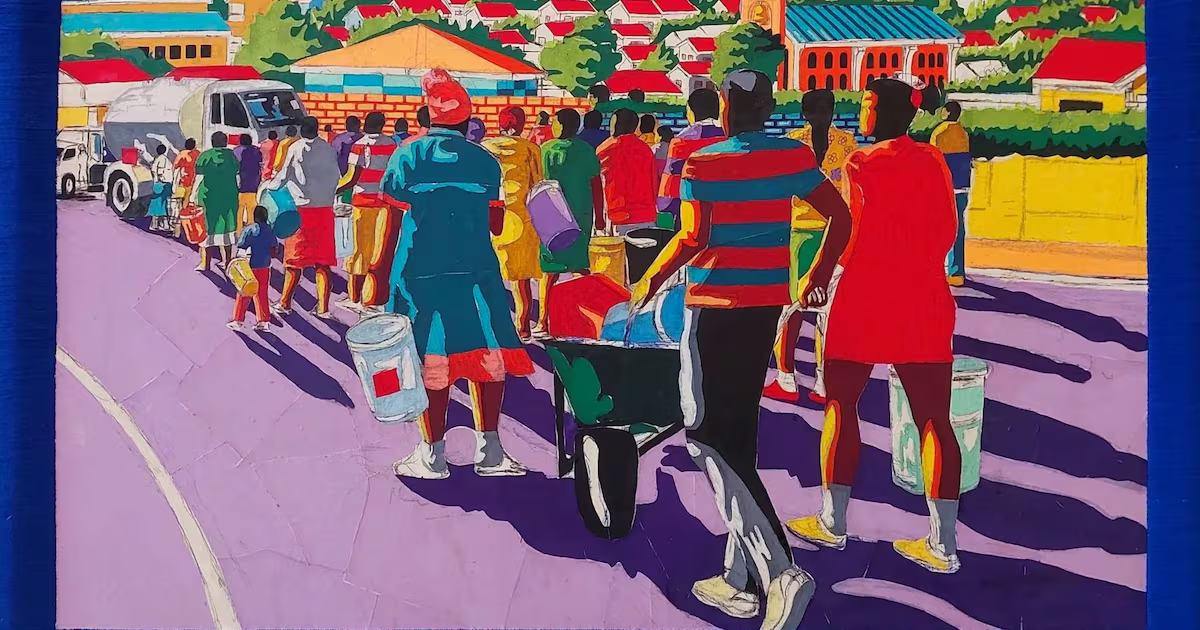
The world is on fire — and don’t it look pretty?One of the biggest challenges facing environmental activists is that shocking images, videos, graphs and statistics demonstrating how our planet has entered the early stages of eco-catastrophe don’t seem to have a salutary effect on human behaviour. “It’s terrifying,” we say (if we are not brazen climate change denialists), but then we go about our daily lives.Humans have developed advanced aestheticising and narrativising reflexes. What that means is we take raw sense data, recognise shapes and patterns, and give them meaning. Finding something visually pleasing or turning pieces of information into a coherent story has served us well in evolutionary terms — cognitively, physiologically and socially.The problem is that, in a media-dense age, the same learnt instinct is starting to work against our survival. If we look at photos of unprecedented global wildfires, from billowing smoke and flames to the ashy aftermath of depleted forests and destroyed settlements, we are shocked … but also quietly gratified by the spectacle. Facts and figures may wash over us, but if we truly try to process them, we do so in narrative terms: we make sense of them through story, and our big brains do love a good story.We even take a (perhaps guilty, perhaps unconscious) pleasure in the poignancy of it all. Tales of destruction and displacement horrify us but they form a positive nervous system feedback loop. Even warnings about how we will suffer a similar fate in the future result in a frisson of excitement along with a feeling of dread.The skies may be ablaze, but we’re conditioned to find this visually appealing. Red sparks from a fire pit promised our ancestors warmth and food; fireworks in the night sky still dazzle us like gods. Then there’s the air pollution that, as a sustained after-effect of industrial smog or the massive conflagrations seen on every continent in recent months, produces vivid and particoloured sunsets.The techbro solution? Space travel. Let’s pack this planet in and find another one, or so the dystopian logic goes. The result of such distortions is a feverish fusion of the interstellar and the apocalyptic in our collective imagination as we gaze up. Ambition merges with disaster; bright possibility is indistinguishable from burning despair.This paradox is a consistent feature in the skies stitched and patched together by Mondli Mbhele in Isikhathi noMkhathi (Time and Space). The multimedia artist broke onto the scene in 2022 when his fabric collages won the Sasol New Signatures Art Competition, startling viewers with the clash of form and content — colourful offcuts depicting vibrant but sombre scenes, such as a street protest in which one of the participants appears to lie dead on the floor.Mbhele’s new body of work, which employs textile collage and painstakingly detailed wool embroidery, is shown alongside those of Patrick Seruwu and Siphamandla Ex in the combined exhibition Where We Bloom. Together they explore “the environments that shape us and the experiences that influence who we become”. These are, in other words, scenes from everyday life. While Seruwu and Ex focus on portraiture, Mbhele emphasises the figure situated in — and, more often than not, moving through — a particular urban or rural landscape.Some of those settings might seem idealised or romanticised, especially when the subjects are children; boys and girls roll bicycle rims down the road, carry water buckets, ride bicycles. Yet there is much hardship here too, for both young and old. City life requires resilience, patience, hope against hope.This is why Mbhele’s skies are so interesting. They burn bright in orange, yellow, red, pink, blue and purple. They are interrupted by smoke stacks and green horizons in equal measure. They contain ambiguous spheres, which could be the sun, the moon, stars, planets, balls, balloons, spacecraft or something else.Mbhele uses lining fabric, he explains, because it is “hidden beneath a garment” in the same way that our stories are often “invisible to others”. We can only guess at the experiences of the people in each scene as their optimism and anguish, both beautiful, are projected skywards.• Where We Bloom is at The Firestation (16 Baker Street, Rosebank, Johannesburg) until September 8.Business Day
CHRIS THURMAN | Beneath the fabric of everyday life
Mondli Mbhele’s latest exhibition highlights the paradox of optimism and anguish
696 words~3 min read