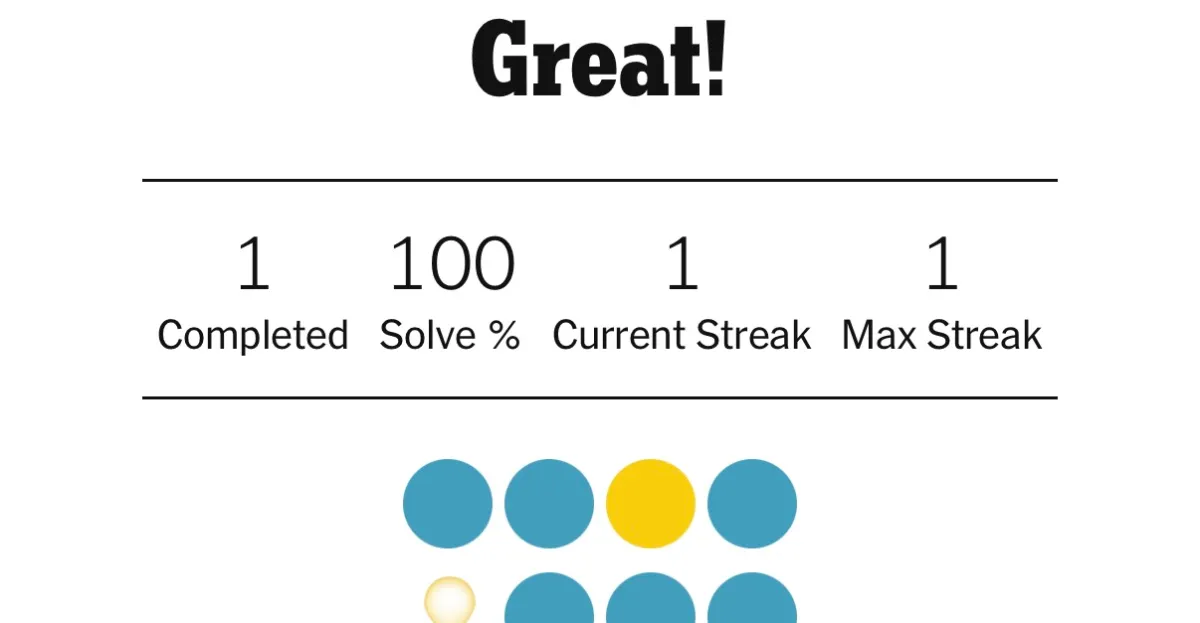
Some streaks serve you and the people around you, but others hijack your time and energy.gettyI got into bed last week, phone in hand, ready to run my nightly ritual: Spelling Bee, Connections, Wordle, in that order, always. Ten minutes, tops. Except it’s never just ten minutes. One quick text turns into one quick dinner or workout reservation turns into scrolling, because at that hour I don't have the willpower to stop myself. My 8Sleep data confirms what the research already tells me: this costs me real, measurable rest.Walking to bed with my phone that night, I had a small realization. I don’t actually care about the streak. I care about the ten-minute mental break the games are supposed to give me. The streak had hijacked my recovery strategy.I put the phone down. Picked up my Kindle instead. And felt a notable wave of relief.Why streaks work on us, precisely as designedThis isn’t a willpower failure, mine or anyone’s. It’s engineering. Daniel Kahneman and Amos Tversky’s foundational research on loss aversion found that people are roughly twice as motivated to avoid losing something they already have as they are to acquire something of equal value. A 40-day streak doesn’t feel like 40 opportunities to keep going. It feels like a credential you could lose to a single oversight. That asymmetry is exactly what keeps us opening the app.Product teams know this. Streak mechanics were built, deliberately, to convert something that started as recreational into something that feels obligatory: a compounding pressure layered in through counters, warnings, and social visibility, engineered specifically to keep users returning. None of this is a conspiracy theory. It's product strategy, and it's a good one, because it works.MORE FOR YOUWhich is exactly why leaders should be suspicious of their own streaks, especially the ones that started out fun and are creeping toward compulsion.The professional streaks nobody questionsLeaders chase streaks too. The unbroken run of 5 a.m. workouts. The inbox that always sits at zero. The all-hands that’s never skipped, shortened, or rescheduled; the Slack response that’s never further than 20 minutes away; the LinkedIn post that's never late.Some of these streaks genuinely serve you and the people around you. Consistency builds trust. Others have become the point, in the same way my Games Triathlon had: protected not because they’re serving their original purpose, but because breaking them feels like an unacceptable loss, even if their original purpose is no longer useful.The tell isn’t how long the streak is. It’s whether you can explain, right now, what the streak is actually for.A better question than "how do I keep this streak alive"I track a handful of daily habits – meditation, workouts, alcohol-free days – in a simple, non-monetized habit app. Watching that number climb (474 straight days of meditation, as of this week) is genuinely for me. It reflects a habit I’ve chosen because of what it does for my wellbeing: it's the difference between showing up regulated and showing up reactive.But I’ve also chased streaks that had nothing to do with what I actually wanted. Like a couples’ quiz streak with my husband that fizzled once I realized I was the only one doing it “for the streak” rather than for us. Same mechanic, different verdict, because the question isn’t “is this a streak,” it's “is this actually still serving the thing I built it to serve.”This is where Stop, Drop, and Roll – the subtraction sequence I use with the leaders I advise – becomes most helpful. Stop is noticing which of your streaks you’re protecting reflexively, without having checked lately whether they’re still working. Drop is the experiment: break one on purpose this week, not as a stunt, but to find out what happens when you let it go. Roll is redirecting whatever energy you get back (you will always get some back) toward whichever dimension, ME, WE, or WORLD, actually needed it.Not every streak deserves debunking. Just the unexamined ones.None of this is an argument against consistency. Consistency, chosen deliberately, is one of the most underrated leadership disciplines there is. The problem was never the streak. It's mistaking the counter for the reason you started.So ask yourself, streak by streak: is this still serving me, or has it just gotten very good at being sticky?If you have to think about it too hard, you already have your answer.
The Streaks We Keep For The Wrong Reasons
Loss aversion keeps us chasing streaks long after they stop serving us. Nell Derick Debevoise Dewey on when consistency is discipline, and when it's just sticky.
726 words~3 min read