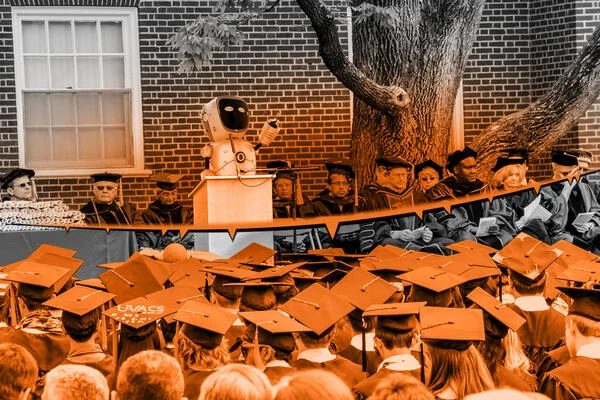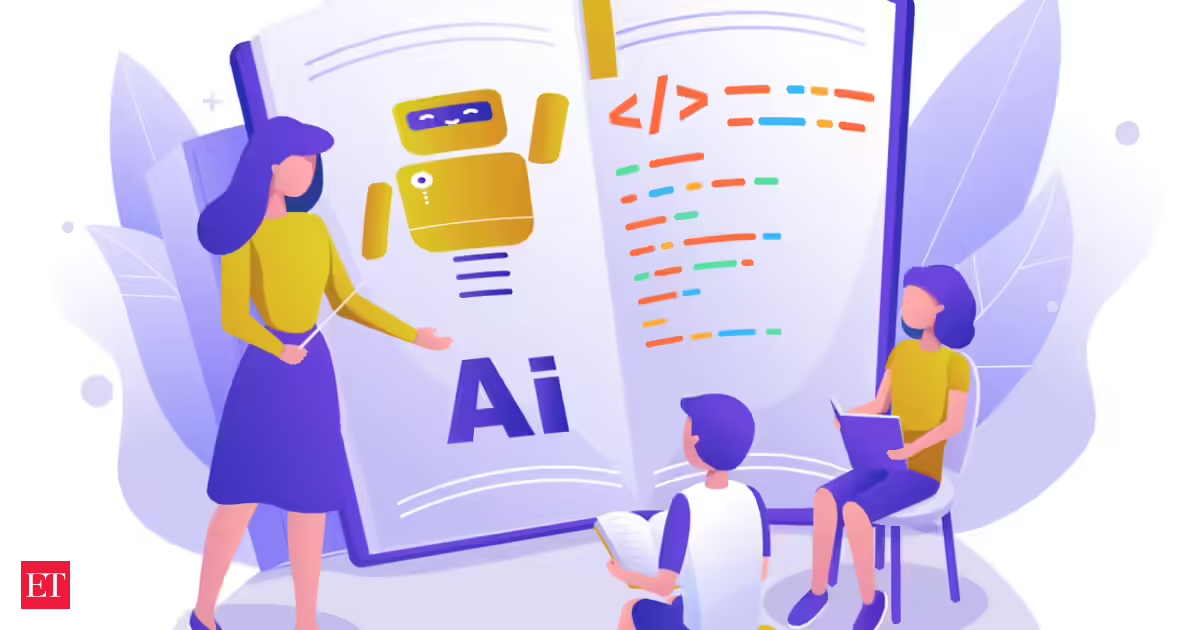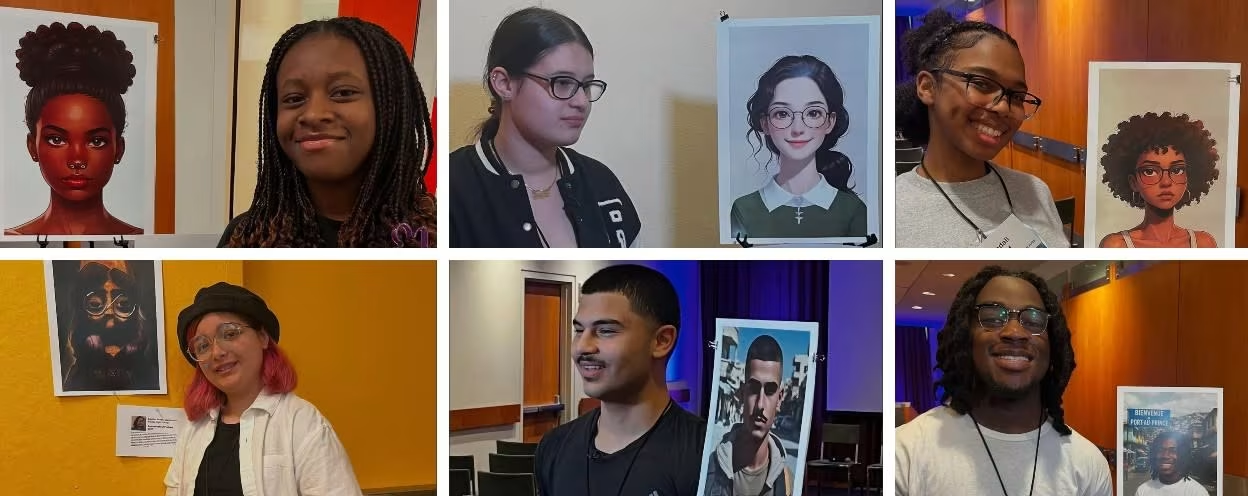
The college graduating class of 2026 is the first to have full exposure to robust artificial intelligence (AI). But even at the high school level, U.S. students generally have considerable experience using AI — and mixed feelings about its growing role in everyday life. They may take advantage of AI benefits, but some fear where the technology could take us in the future. That concern was on clear display at the Me, Myself, and AI art show at the recent America’s Youth AI Festival in Boston. The three-day event gathered student leaders, educators and school system leaders from across the country to discuss acceptable AI use in the classroom and how it is already influencing student lives. The festival was hosted by Day of AI, MIT RAISE, The School Superintendents Association and the Edward M. Kennedy Institute. Day two of the event featured two contests: AI for a Better World and an art competition. Day three concluded with “student senators” from across the country debating a first-of-its-kind national AI policy for K-12 classrooms.Four students shared the spotlight as winners of the 2026 Me, Myself, and AI competition. Their work reflected AI’s influence in their communities today and what AI may look like in 50 years. Annie, an 11th grader from the Barbara Keel Art School and Auburn High School in Alabama, exemplified the worry on the minds of many students with her two-part entry titled “Which Way We Run.”A Self-Portrait Across Time by Juliette, Rye, NYDepicting AI’s Evolving InfluenceAnnie’s two pieces illustrate how AI is already affecting human life and what could happen to humans if we continue to rely on it for trivial needs every day. “The first piece represents my current community and focuses on how AI is beginning to integrate into everyday life,” she says. “The buildings are bright and colorful, symbolizing liveliness, creativity and emotion — all human qualities. In the center, two people are running, representing different stages of human interaction with AI-driven technology.”Which Way We Run by Annie, Auburn, ALIn addition to Annie, other competition winners (last names withheld) were Evangelina, grade 11, from the Essex County Newark Tech school in Newark, New Jersey, for “A Free Venezuela”; Juliette, grade 11, from the Rye Country Day School in Rye, New York, for “A Self-Portrait Across Time”; and Wendi, grade 9, from the Atlanta Contemporary Chinese Academy in Decatur, Georgia, for “Community Today as Meandering in Divide, Community in 50 Years as Yearning into Time.”The Me, Myself, and AI competition grew out of a curriculum developed by the MIT Responsible AI for Social Empowerment and Education (RAISE) initiative, explains Jeffrey Riley, executive director of Day of AI. The ideas were first explored in a high school summer program in 2024 and later expanded into Day of AI’s five-lesson AI and the Creative Arts Curriculum, which was released in January 2025 for students ages 8 and up. A Free Venezuela by Evangelina, Newark, NJThe lessons invite students to examine the relationship between AI and creativity by analyzing AI-generated artwork, discussing questions of authorship and originality and creating art of their own. Winning entries were selected through a multi-reviewer evaluation process similar to those used in college admissions or scholarship competitions, Riley says. “Judges evaluated submissions holistically, considering creativity, originality, evidence of process, thoughtful use of AI and the authenticity of each student’s personal voice,” Riley explains. “The emphasis was never on creating the most impressive AI-generated image but on how effectively students used creativity and, where appropriate, AI, to communicate their ideas.”Community in 50 Years, by Wendi, Decatur, GAThe Growing Impact of AI on Art and MediaAI will likely become a standard part of many artists’ creative workflows, much like digital design software, cameras or animation tools are today, Riley says. It has the potential to make creative exploration more accessible, helping people prototype ideas, explore new styles and bring concepts to life more quickly.“AI will shape how young people live, learn, create and connect,” explains Cynthia Breazeal, director of MIT RAISE and cofounder of Day of AI. “What is so powerful about Me, Myself, and AI is that it gives students the opportunity to reflect on that future in a deeply personal and imaginative way.”Annie says she was attracted to this competition because of its themes in connecting art, AI and humanity. She saw it as a forum to share and learn what her generation thinks of AI, its ethical concerns and the implications it has for art, especially with the current contention surrounding AI-generated images.“The use of AI to create media is not appropriate in corporate models that exploit the work of artists without consent,” Annie says. “Instead, if any artist believes that AI is integral to a project they want to create, they should look toward models that are trained on open-source data or ethically sourced media. Additionally, even with ethical models, AI’s large environmental footprint means we should be mindful of what we ask it to do.”Encouraging Lessons from the CompetitionRiley says that what impressed the judging team most was how thoughtful students were in their decision-making and how candid they were about their feelings toward AI. Rather than simply using AI because it was available, many carefully considered when it strengthened their creative vision and when it didn’t. Some intentionally limited or even chose not to use AI for portions of their projects because they wanted certain elements to remain entirely their own.“One of the biggest lessons we took away was that young people are far more thoughtful about AI than they’re often given credit for,” Riley says. “Students didn’t see AI as simply ‘good’ or ‘bad.’ Instead, they expressed a wide range of perspectives based on their own experiences using the technology.”The competition also reinforced the importance of giving students authentic, hands-on opportunities to wrestle with these questions rather than simply teaching them about AI in the abstract. These insights will continue to shape curricula and learning experiences as we help students develop the critical thinking, creativity and ethical decision-making skills they’ll need in an AI-driven world,” Riley explains. “Our goal has never been to encourage or discourage AI use but rather to empower young people to make informed, intentional choices about how they use these technologies.”
Me, Myself, and AI: Student Artists Wrestle with AI’s Promise and
Four student artists imagined what artificial intelligence means for their communities today — and 50 years from now.
1,037 words~5 min read