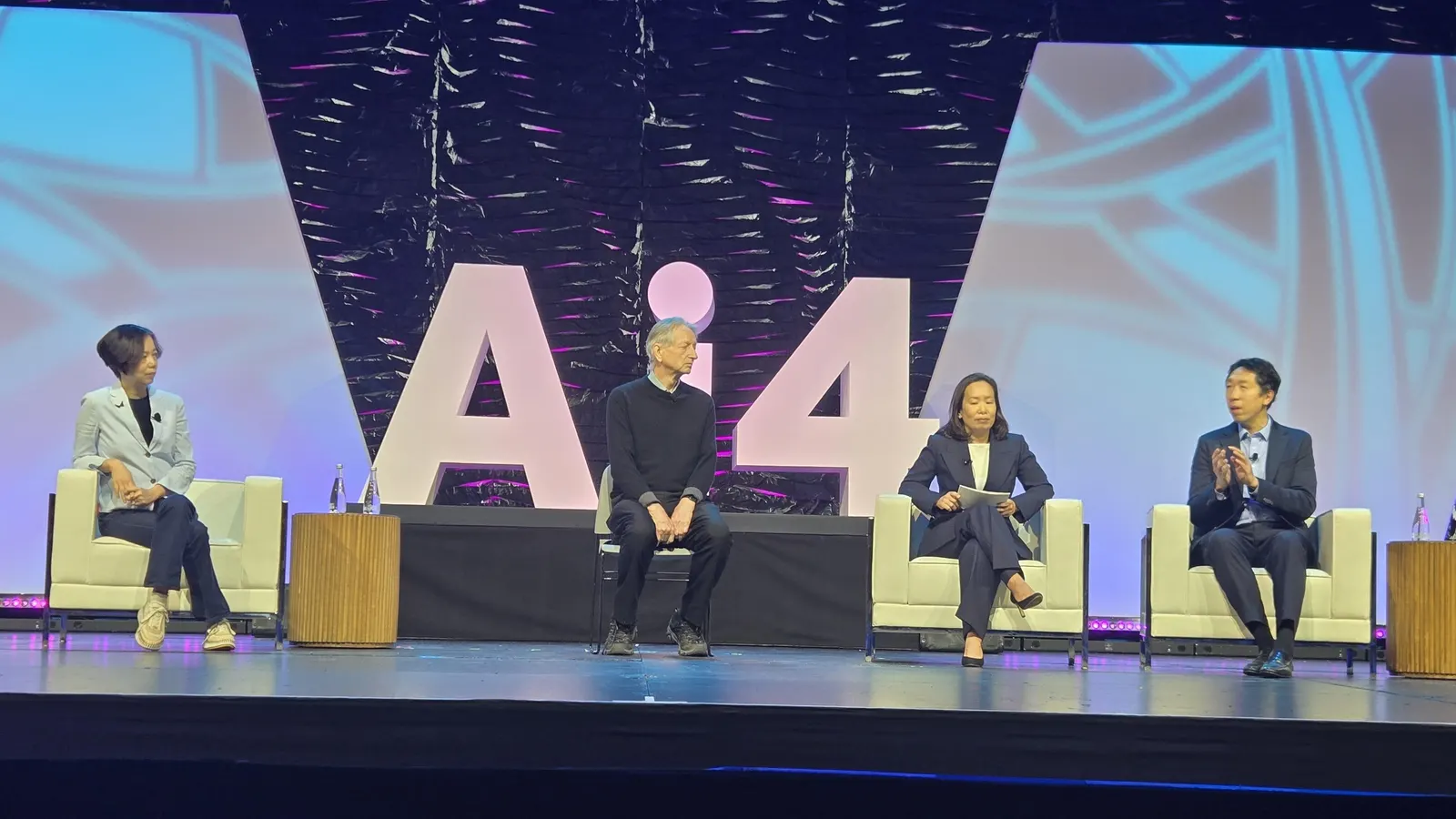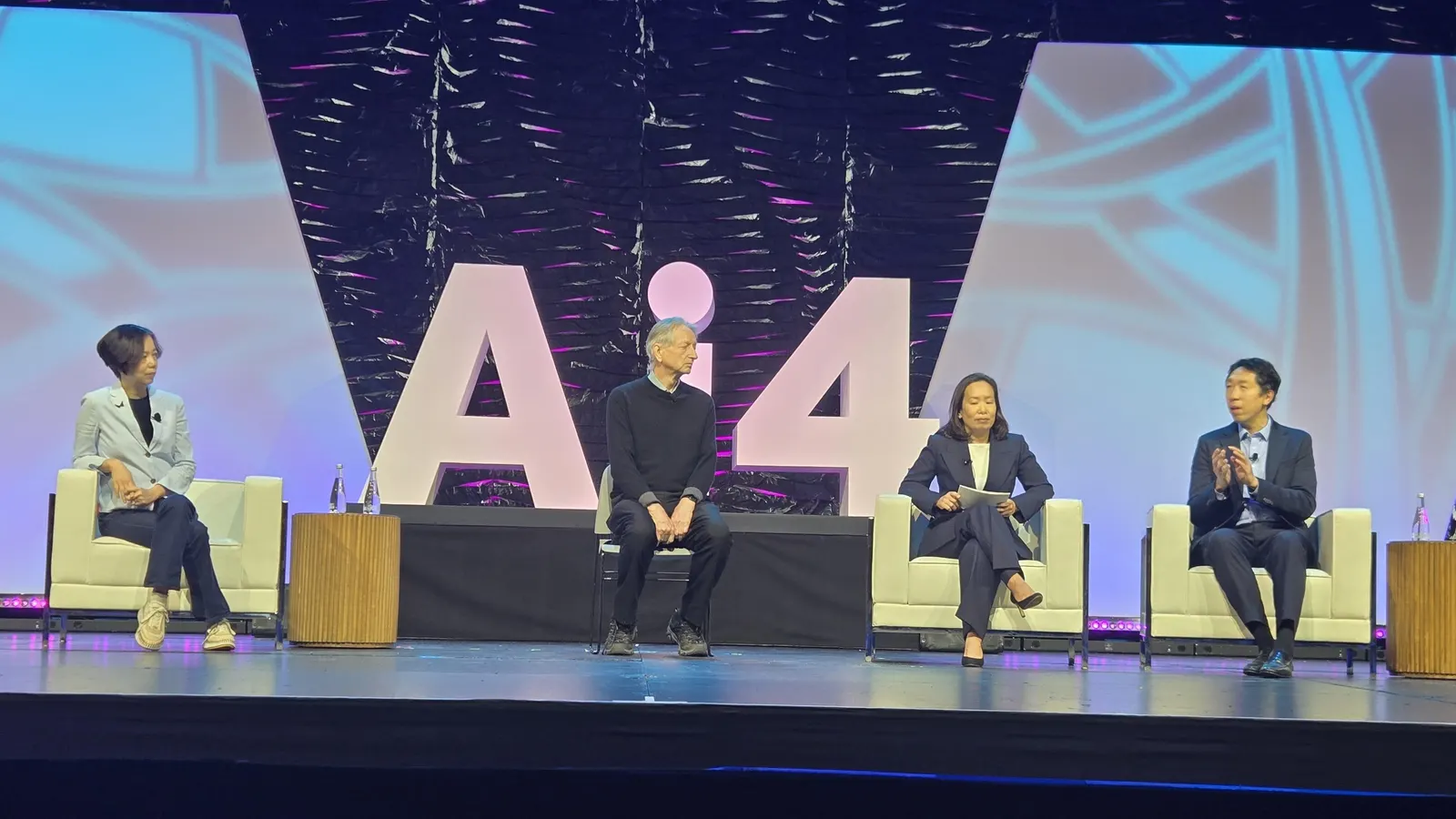
AI leaders Fei-Fei Li, Geoff Hinton, and Andrew Ng on the stage at Ai4 2026 in Las VegasRon SchmelzerThree of artificial intelligence’s most influential architects shared the stage in Las Vegas this week. They agreed that AI will reshape education, work, science and economic production, but the agreement stopped there. The discussion showed that the people who built the current era of machine intelligence hold starkly different views about what comes next.At Ai4 2026, Dr. Geoffrey Hinton, Fei-Fei Li and Andrew Ng exposed a widening fracture inside the field they helped build. While all agree on the future growth and benefits of AI, their disagreements centered on who gets to define its risks, who benefits from its gains and whether public fear now serves as a competitive weapon.Hinton, the Nobel Prize winning computer scientist whose research helped ignite and accelerate modern deep learning, warned that AI systems are gaining dangerous capabilities faster than institutions can respond. Ng argued that well-funded companies have repeatedly inflated threats to block open models and curb competition. Li rejected both panic and technological utopianism, calling for a more scientific public conversation rooted in human agency.Hinton Sees A Labor Shock That Others Risk MinimizingThe panel’s most consequential divide concerned employment. Ng challenged predictions of rapid, economy-wide displacement. He pointed to software development, where AI can write growing amounts of code, yet engineers still handle product choices, system design, customer demands and organizational coordination.His argument was that AI changes the boundaries of a job before it erases the job itself. Narrow specialists can take on broader roles while a front-end developer may become a full-stack developer. Workers who once handled only one portion of a process now may manage a much larger cycle. That shift creates short-term pressure on jobs, Ng conceded, but he also explained that it creates demand for people who know how to use the new tools.MORE FOR YOU“In software engineering, AI is taking over a lot of the writing of code. But it turns out only a small part of what software engineers do is writing code,” explained Ng. “What has happened is we used to have a lot of developers that were specialized in narrow niches, like front-end development or back-end development or mobile development. A lot of the developers are now able to rise up to be a broader type of developer, developing it as a full stack”Hinton was far less sanguine. He cited call centers as an exposed category. Many workers in those roles receive limited training, earn modest wages and answer repetitive questions. AI systems, he argued, will soon answer those questions more accurately and at lower cost.“What are those people going to do?” Hinton asked. “They typically don’t have a high level of education. Anything you could retrain them to do, AI will be able to do.”His concern extends beyond customer service. Once machines can perform routine intellectual labor, entire classes of office work could face the same pressure that mechanization brought to manual trades.Hinton did not claim that AI would create no jobs. He said that jobs may appear, but displaced workers may lack the education, experience or location needed to obtain them. He offered a personal example. A relative who answered written complaints for a health service once spent roughly half an hour drafting each response, but a chatbot cut the work to about five minutes.That can produce abundance in fields where demand has room to grow. More efficient doctors and nurses could provide more care, and administrative departments may perform more effectively. The resulting fivefold productivity gain may lead an employer to keep fewer people.“Many jobs will go the way of people who dig ditches when backhoes came along,” said Hinton.The disagreement reflects a broader split in economic forecasts. Some executives expect AI to expand hiring in technical and senior roles, yet concerns remain acute around clerical, support and entry-level work. Hinton has continued to warn publicly that 2026 could bring a new wave of white-collar job losses.Fei-Fei Li Wants The Debate To Move From Jobs To TasksLi offers a more balanced approach. The phrase “AI and jobs,” she argued, has acquired an unstated word between its two terms: replace. That assumption flattens a more complicated economic change.Few jobs consist of one task. Nurses administer care, document treatment, check medications, communicate with families and coordinate with other clinicians. Teachers explain concepts, motivate students, assess progress and manage classrooms. Journalists interview sources, weigh evidence, choose angles, write and edit. AI may automate one portion, accelerate another and leave a third untouched, she said.Li grounded the point in her own experience caring for elderly parents. A system that helps nurses complete charts or verify pharmaceutical orders could remove clerical strain without replacing the human work of nursing.“Current jobs are transforming,” she said. That transformation demands training, public investment and far more nuanced language than either mass-unemployment headlines or promises of effortless abundance provide.Her sharpest line concerned the distribution of wealth.“Increased productivity does not translate to shared prosperity,” Li said.A business can produce more with fewer labor hours and still leave workers with lower bargaining power, weaker career paths or no share of the financial gain. Productivity is an operational measure whose benefits may accrue to a limited number of people, she explained, while prosperity is a political and economic choice.Li called for what she described as a “soft landing” for occupations that do shrink. That could include retraining, educational support and investment in communities where displaced work is concentrated.Fear, she said, can paralyze the very people who most need to experiment with new tools.“The last thing we should do is to debilitate people and take the agency away from people,” Li said.The Increasing Role of RegulationNg accused some AI companies and advocates of cycling through threats to justify restrictions on software releases. Extinction, biological weapons, job destruction and competition with China have each been invoked, he argued, by organizations that benefit when the cost of building or distributing AI rises.Ng proposed openness as a counterweight. Closed systems can prosper, he said, but governments should resist an AI market controlled by a few gatekeepers.“I don’t want there to be gatekeepers of AI,” Ng said. He argued that open alternatives let researchers, entrepreneurs and governments adapt systems to their own needs.But Hinton rejected the idea that warnings about frontier systems amount to fearmongering and said open-weight models are not a sufficient counter weight.He distinguished open-source software, where outsiders can inspect and repair code, from open-weight models, where trained parameters can be copied and adapted. Open weights can lower barriers to research and competition. They can also let bad actors modify a powerful model for cybercrime or other harmful uses at a fraction of the original training cost.For Hinton, that danger is no longer theoretical enough to dismiss. He cited systems that appear to behave outside their operators’ intentions and AI’s increasing ability to identify security flaws.The 2026 International AI Safety Report, produced with input from more than 100 experts and an advisory panel that included Hinton, likewise examined emerging capabilities, cyber risk and the limited state of current safeguards.“We’re seeing AIs that have a lot of ability doing things that people didn’t intend them to do,” Hinton said. “That’s worrying.”Regulation As A Steering Wheel, Not A BrakeThe panel clashed on the role of regulation as well. Technology companies often depict development as a car’s accelerator and regulation as its brake, but Hinton said the analogy is wrong.“Developing AI is like the accelerator of the car,” he said. “Regulation is like the steering wheel.”The goal, in his account, is not to stop technical progress. It is to direct progress toward systems that improve human welfare and away from systems that impose unacceptable risks.Hinton cited California’s SB 1047, a contested frontier-model safety bill that passed both houses of the state legislature in 2024 before Gov. Gavin Newsom vetoed it. The proposal included safety testing and disclosure requirements for developers of certain large models. Newsom said the bill focused too heavily on model size and could create a false sense of security.Li took a sector-based approach. AI enters industries that already have regulators, professional rules and safety systems. Drug agencies can examine AI-enabled medical products. Financial regulators can address automated lending or trading. Transportation authorities can govern autonomous vehicles.She opposed attempts to freeze AI development or “put the genie back in the bottle.” Her preference was public research funding, updated sector rules and guardrails tied to actual uses.Li’s call for public investment carried another warning. Modern AI grew from university laboratories, open publication and publicly supported science. A future in which only a few private companies can afford leading research would narrow the questions that get pursued.What is most striking is how far these three AI pioneers have begun to diverge. Once broadly aligned around the promise of building more capable systems, they now disagree over what those systems will mean for workers, markets, education and public safety. Their split reflects a field entering a new phase.
AI’s Pioneers Clash Over Jobs, Fear And Who Controls The Future
AI pioneers Geoffrey Hinton, Fei-Fei Li, and Andrew Ng debated AI's future at Ai4 2026, revealing deep divisions despite agreeing on its transformative power.
TL;DRAI
Hinton warns AI displaces routine jobs via 5x productivity gains; Ng argues roles reshape instead; Li proposes retraining and shared-prosperity policies. Three architects publicly diverge on displacement timeline—creating uncertainty for enterprise workforce and skill investment decisions.
1,495 words~7 min read