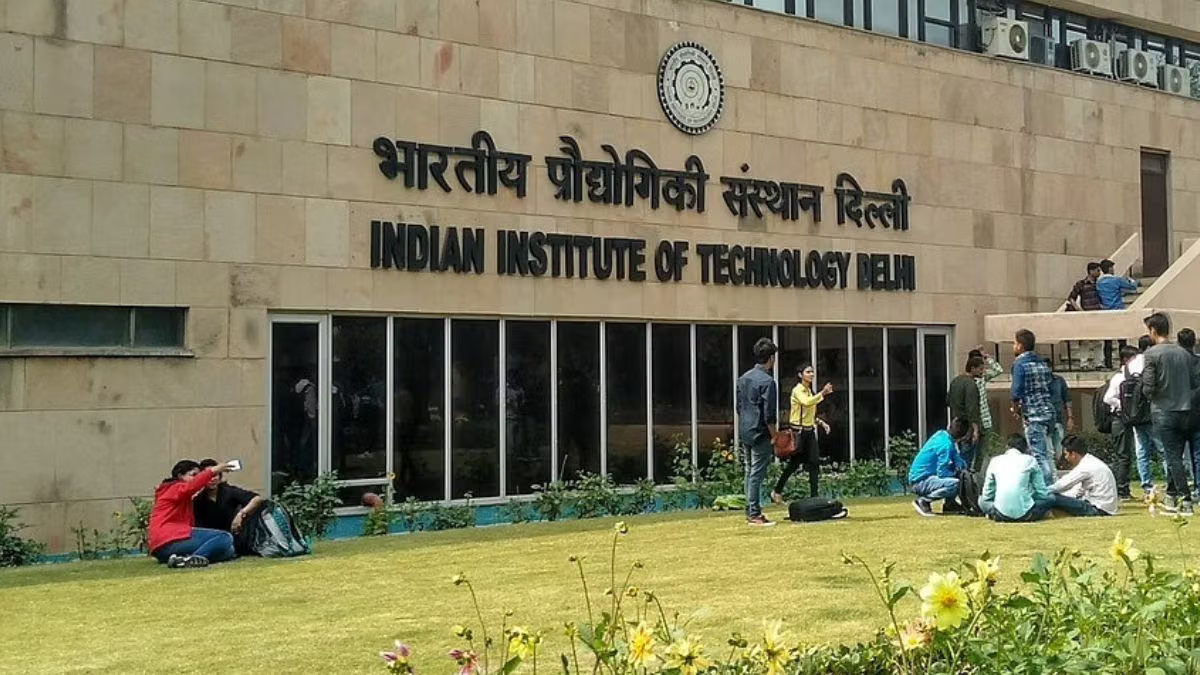
Last summer, I taught a course called Quantitative Reasoning and Mathematical Thinking. Much of it was focussed on the history of mathematics in India: numbers in the Vedas, the geometry of the Sulbasutras and the work of Pingala, Aryabhata, Brahmagupta, Bhaskaracharya, and Ramanujan.Teaching this course was among the pleasures of my year.It was also difficult. A large part of what I did in that classroom was not teaching what Indian mathematicians had achieved, but separating it from what they did not.We read SG Dani’s Myths and Reality: On ‘Vedic Mathematics’ to see why a set of arithmetic shortcuts compiled and published in 1965 has nothing to do with the Vedas, and Rick Briggs’s Knowledge Representation in Sanskrit and Artificial Intelligence to trace where the claim that Sanskrit is “the language of AI” or the most logical programming language ever, came from – and to see that the paper itself says no such thing.We worked through why a genuine theorem from the Sulbasutras is not made truer, or more Indian, by attaching to it claims it does not support.Teaching topics in Indian Knowledge Systems meant defending it from pseudoscience. The boundaries between science, culture, belief and pseudoscience are narrow, and a lot of work in this field involves keeping them clear and separated.What helps tell science from pseudoscience is a single test. A scientific claim can be refuted: it commits to a prediction that could fail, and if the prediction fails, the claim is wrong. A claim that no possible observation could contradict is not science – whatever its mathematics or its numbers.While this is not a complex idea, applying it takes training. Most people starting out in science, reasonably, rely on a shortcut instead: if a claim comes from a respected institution, they take it to be sound. That shortcut works only as long as the institutions hold the line themselves.Increasingly, in Indian science, they do not.Mind, Brain and Consciousness Conference 2026In June, IIT Mandi’s Indian Knowledge System and Mental Health Applications Centre hosted the third edition of its Mind, Brain and Consciousness Conference. This was held under the patronage of the Indian Knowledge Systems Division of the Ministry of Education and included a 275-page abstract book, 19 keynote lectures, 250 technical presentations, and eminent scientists among attendees and chair.Attendance was reportedly mandatory for several groups of students.On page 13, the book of abstracts lists the conference themes in a single sequence: cognitive neuroscience, brain-computer interfaces, yoga and meditation, science of reincarnation, energy chakras and Pancha Kosha – the “Vedic framework that maps human existence from gross matter to pure consciousness”. The sequence helps transfer the credibility of the first items to the last.Delighted to share that the home-grown flagship conference of the IKSMHA Centre at @iit__mandi, the 3rd Mind Brain Consciousness Conference (MBCC 2026), is set to bring together leading minds exploring consciousness, neuroscience, cognition, meditation, philosophy, and Indian… pic.twitter.com/iuECunfHIH— Director, IIT Mandi (@Dir_IIT_Mandi) May 29, 2026
Can the Indian Knowledge Systems be defended from pseudoscience?
Indian science can only be strengthened when its boundaries are clearly separated from culture, belief and pseudoscience.
981 words~4 min read