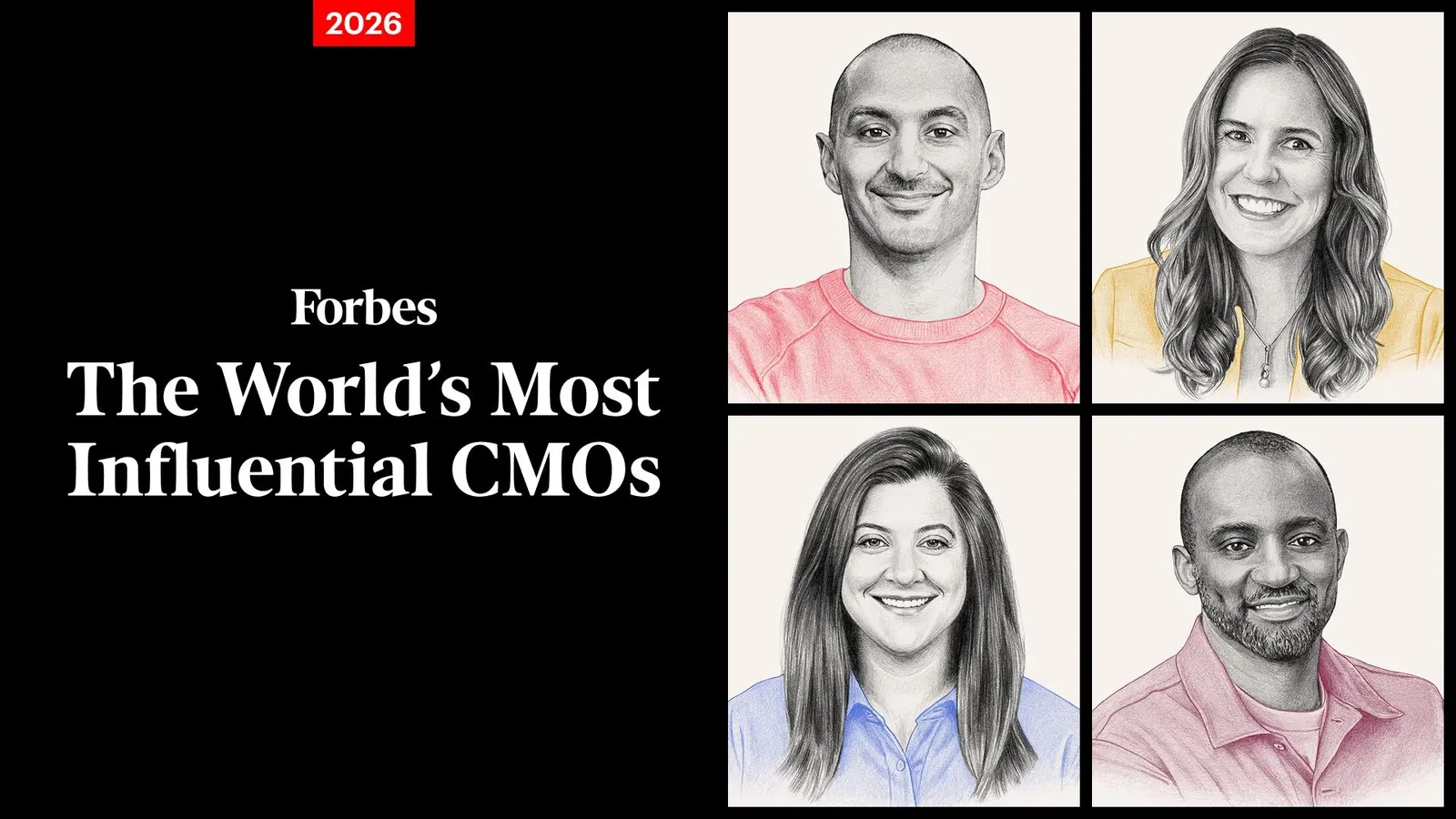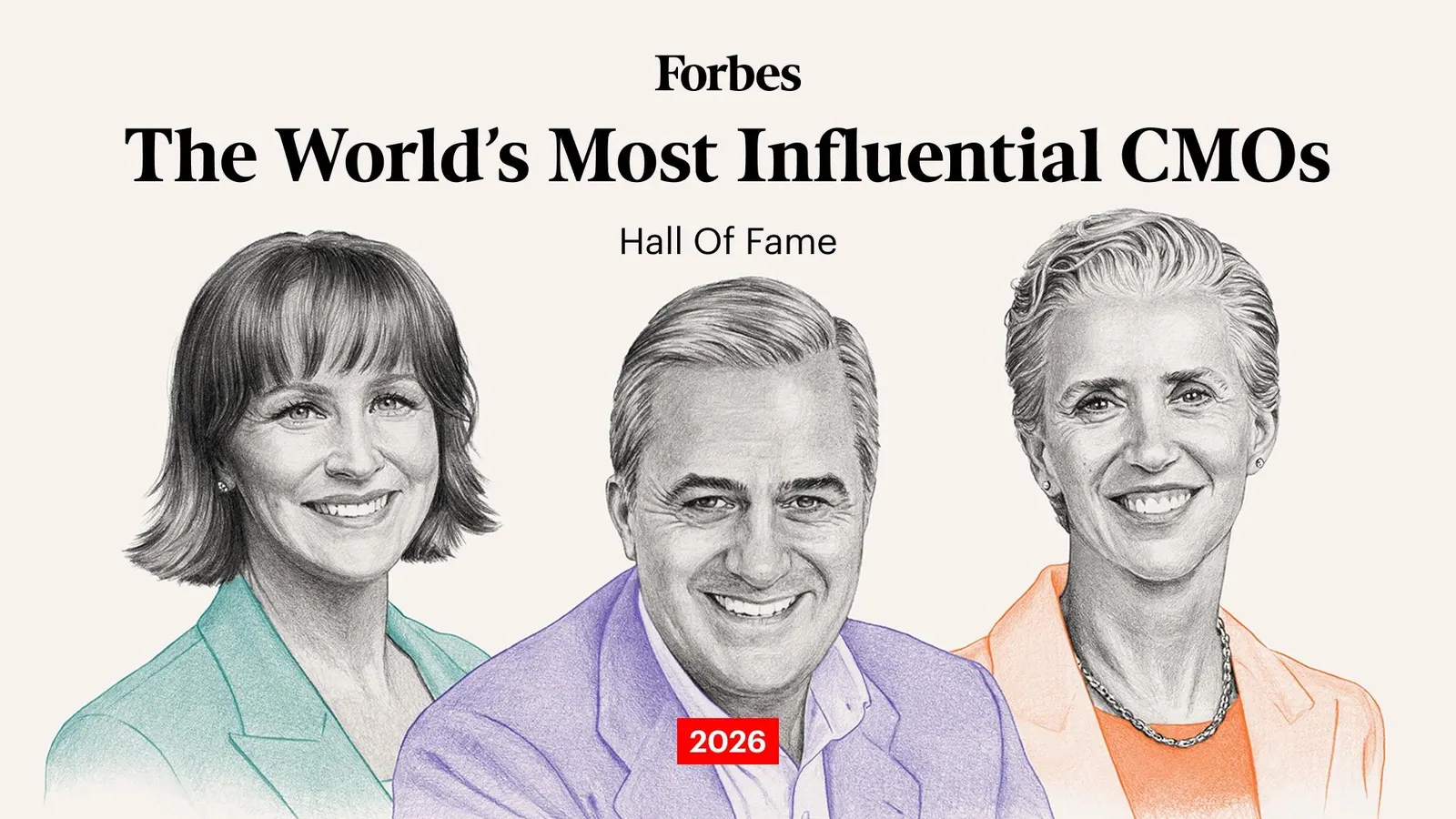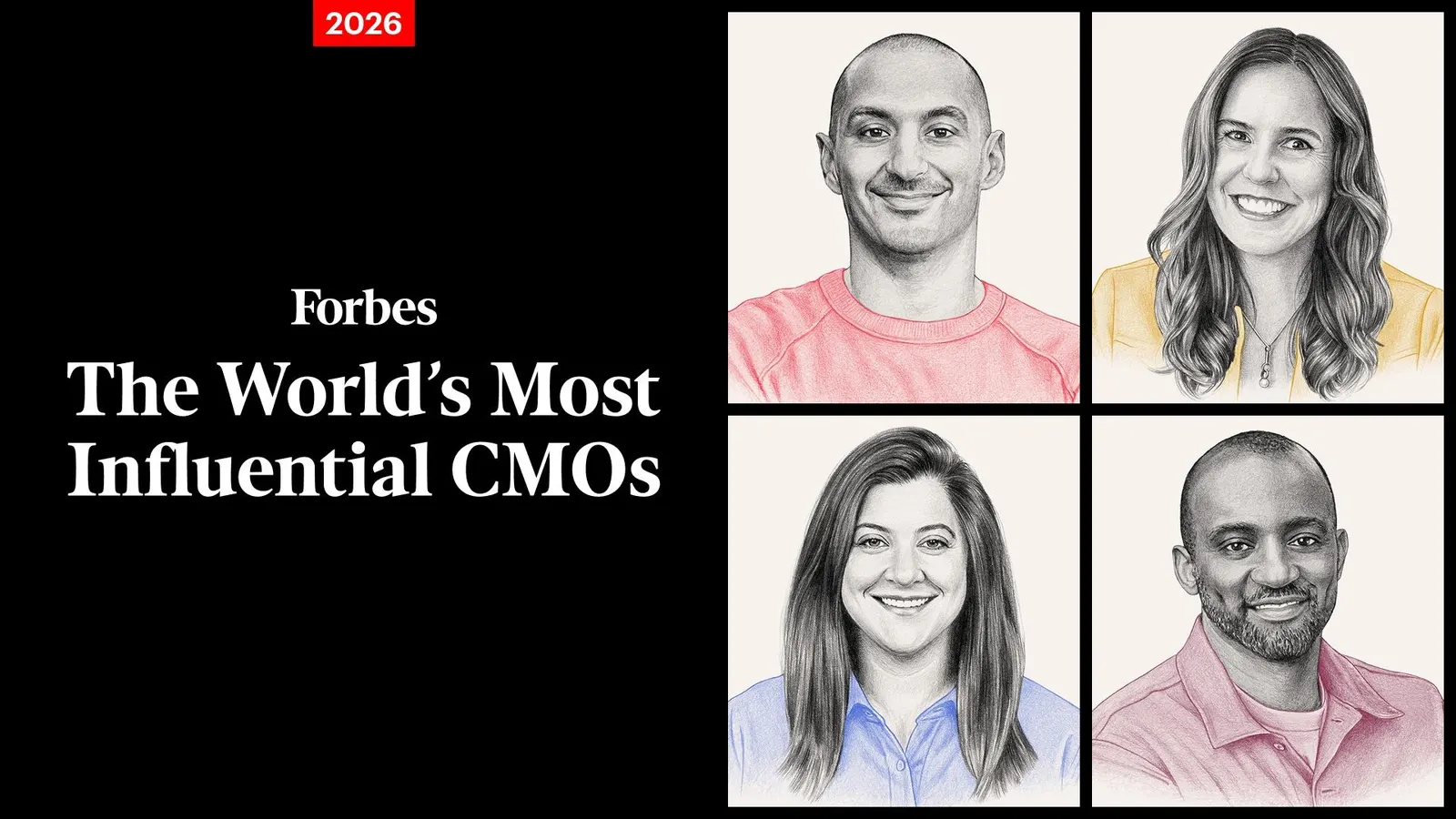
At the New York Stock Exchange on Monday.Sarah WhitmireAt Forbes, we consistently recognize the best in business and innovation, but this week we got to do it from an entirely different platform. I was part of a group from Forbes that rang the opening bell at the New York Stock Exchange on Monday to celebrate our 2026 World’s Most Influential CMOs list.Before we went down to the floor to do the bell ringing, Forbes CMO Network President Linda Boff—who actually did the honors—shared why it’s so important to put successful CMOs in the spotlight.“Marketing leaders, like the ones in this room, are being asked to navigate extraordinary change—once-in-a-career change, in many ways,” she said. “It’s not enough just to build a brand, and it’s not enough just to steward a brand. CMOs today are strategic business leaders that define what’s next for their organizations, drive meaningful growth, and set the pace for championing creativity and driving innovation—as well as demonstrating, as the CMOs on our list so beautifully do, the power of purpose-driven leadership.”As we cheered the opening of trading this week, we also cheered for the work that CMOs do, especially in challenging times. I talked to Petula Lucey, WeWork’s chief marketing and communications officer, who was hired to transform the company’s story from a cautionary tale to one of success. With $2.3 billion in revenue last year, WeWork has so far mounted an impressive turnaround, and my conversation with Lucey is later in this newsletter.Until next time.This is the published version of Forbes’ CMO newsletter, which offers the latest news for chief marketing officers and other messaging-focused leaders. Click here to get it delivered to your inbox every Wednesday. In The NewsFIFA President Gianni Infantino arrives at the FIFA World Cup 2026 Final between Spain and Argentina last month.Florencia Tan Jun/Getty ImagesIn the U.S., we’re accustomed to all kinds of sponsorship deals in the world of sports, even if they seem a bit sketchy. But as FIFA President Gianni Infantino has learned in the last two weeks, those kinds of deals won’t get far in other countries. Last week, Infantino floated a plan to raise $4.2 billion by selling a 20% stake in FIFA to an entity known as FIFA Forward Enterprise, which would control FIFA’s commercial and event operations. And yes, the deal raised some eyebrows: The lead investor in the group hoping to take the stake was Thrive Eternal, a fund led by President Donald Trump-connected Josh Kushner. Forbes contributor Clemente Lisi writes the plan would have made FIFA seem more like something representing a multinational entertainment brand.In order for the deal to take effect, it would have needed support from a majority of FIFA’s member organizations. Instead, many cried foul. Regional soccer federations, like the Union of European Football Associations; the Confederation of North, Central America and Caribbean Association Football; and the Asian Football Confederation spoke out against the deal. The groups assailed FIFA for trying to sell the “soul and governance” of the sport, as well as the short timeline for approval—especially immediately after a successful World Cup.Last Friday, Infantino scrapped the idea. “It has become clear that the project has created divisions of a nature that, regardless of the level of support, are no longer in the interest of the objective set out in the first place,” a statement from Infantino on X said. But the backlash isn’t over. FIFA leadership called an emergency meeting in Morocco today, presumably to discuss how Infantino can shore up support to continue in his position, which comes up for re-election in March. Meanwhile, in a completely different matter, the head of the Jordanian Football Association on Tuesday accused Infantino of blackmail to win the organization’s vote for his continued leadership.Artificial IntelligenceAs of this week, many businesses with customers in the EU are now required to disclose AI-generated content, writes Forbes senior contributor Rachel Wells. This provision of the EU AI Act applies to publishers, creators, those using generative AI for professional and public interest content, and AI tool and model providers and developers. Under the law, deepfakes of all kinds must always be disclosed, but text content that has been subject to human editorial review and revision does not.While this is a EU-based law, given the boundary-free nature of online life, it makes sense for U.S.-based companies to pay more attention to disclosing AI-generated content. Wells writes that some platforms will label AI-generated content on their own, and violators face noncompliance fines of up to 3% of annual gross revenue or €15 million.Beyond the law, AI-generated images have been in the news this week. Google had a quick rollout—and rollback—of its Nano Banana 2 AI image generator in Google Earth. Forbes senior contributor Paul Monckton wrote when the function was introduced last Thursday, its intention was to visualize historic (or future) views of an area, create infographics or imagine development projects. But, he wrote, the feature was pulled less than 24 hours later after it was used to generate misleading images of things that could be confused as real, including a nuclear power plant in Iran and refugees teeming over the U.S. southern border.On MessageHow WeWork’s CMO Transformed Its StoryWeWork Chief Marketing and Communications Officer Petula Lucey.WeWorkWhile many companies fail, some see spectacular declines—and one of those was co-working office space rental company WeWork. The company was once thought of as the future of office space, worth as much as $47 billion and publicly traded. In late 2023, it all imploded. The company filed for bankruptcy protection, founding CEO Adam Neumann was out, and WeWork seemed destined for the scrap heap.Except it wasn’t. In 2024, Cupar Grimmond bought a majority stake and hired a new team to bring WeWork back from the ashes. Real estate luminary John Santora was hired as CEO from commercial real estate giant Cushman & Wakefield, and he recruited experienced CMO Petula Lucey as the chief marketing and communications officer. This spring, Time named WeWork as one of its 100 Most Influential Companies, and it closed 2025 with $2.3 billion in revenue.I talked to Lucey about how she changed WeWork’s story and helped bring it back from the brink. This conversation has been edited for length, clarity and continuity.When you came to WeWork, what did you see as the biggest challenges ahead of you?Lucey: First and foremost, the business had gone through one of the most public restructurings in history. The brand was suffering from eroding trust and perception—certainly in public opinion. Yet all the fundamentals were in place. The bones of the company were so positive and strong, coupled with this major shift happening in the category. It was about: How do you harness this opportunity and start to help change the narrative and help the world understand? Usher in this new era for WeWork for our stakeholders—businesses of all sizes, solopreneurs all the way up to some of the largest global enterprise companies in the world, brokers, and of course small- and medium-sized businesses. Changing that narrative: there was so much negativity. Repositioning the company so it was a representation of where the company was—and is even moreso today—was a challenge.I think by all accounts we have [done that] and are continuing to be quite successful.What did you do to begin shifting that narrative in the eyes of the general public?In the back end, evolving our marketing strategy. Just to get that alignment with the CEO and chairman: translating their vision into a marketing strategy that was in itself a mirror of our business strategy. I basically repositioned the brand and, in doing so, shifted the narrative away from WeWork as coworking only to a real estate platform. We created a surround sound, integrated marketing strategy with multiple touch points that would allow stakeholders throughout the entire funnel to really get our narrative out there through a very heavy comms push coupled with marketing. It was both a narrative evolution in the traditional sense, then really focused on the acquisition engine. Optimize that, then help this function itself be a force multiplier for the business, really focusing on digital strategy, marketing mix modeling. Ensuring that we were optimizing that reputation management, then bringing our brand to life in a way that it hadn’t been: through integrated marketing channels. Everything from CTV to out-of-home and very select markets. From a consumer standpoint, really bringing a very surgical, precise approach to reach and resonance, which historically had not been the case.How about WeWork’s clientele? How did you change what they saw, heard and thought about the company?We did it on multiple cylinders. First of all, basically taking [CEO] John Santora and the leadership, getting them out there and leveraging his expertise kind of throughout. John is a renowned iconic figure in the commercial real estate industry. For him to be part of our story and bring credibility and brand authority in that realm was very powerful. Our campaign is: WeWork for business, [which] we continue to convey to businesses of all sizes. First, we’re in business. We mean business. We’re a serious company, and we are relentlessly focused on serving businesses of all sizes.The other thing was bringing the truth of our business and brand to life: the fact that we are a healthy, stable company. But more to the point: Our platform consists of solutions that really do meet the needs of businesses of all sizes. What we have also tried to bring to light for businesses is the pressures are very significant: macroeconomic, geopolitical, AI. Flexibility has never been more important. What we’ve tried to do is shape that exposure and the story to help them understand we have a robust platform of real estate solutions, regardless of where you are. You’re at the beginning of your journey. In the middle. Scaling up. Scaling down. You want to set an R&D team in São Paulo, we can stand you up there. You want to build your headquarters in London, we’ve got you. Just reinforcing that story through campaign, unique and integrated channels, really focusing on content.What advice would you give other CMOs who realize they’ve got to change the way everyone looks at their brand?Alignment with the CEO is critical. McKinsey came out with a study that said 70% of CEOs measure the impact of marketing through growth and margin, but only 35% of CMOs include those as key metrics as a top measurement criteria. Understanding the CEO’s vision is critical. As a marketer, my job is to translate that vision—but I would also encourage that bias toward growth and revenue. I am a business leader with functional experience and expertise, and I think that is very important for any CMO to be successful today. Talent reigns supreme. In today’s world, you’ve got to ensure that you understand how to get to the end goal—then what talent do you need in order to get there. Embrace change. Especially with AI, marketers are worried about what that means for them—as opposed to thinking about this moment of change: How can I leverage and weaponize it to help my function be a force multiplier for the success of this company? In terms of the narrative, you’ve got to start with the business and then bring marketing in to help you figure out that precision-targeted reach and resonance that I think are the keys to success.Strategies + AdviceAs AI use expands and the technology improves, more companies are using it to boost their e-commerce sales. Here are five tips for AI use from Gary Huang, founder of the 7 Figure Seller Summit.Businesses are using AI throughout their operations, and marketing appears to be one of the most vulnerable disciplines for AI replacement. Here are five reasons why, and what the people working in marketing need to do to show their value.QuizWhich celebrity announced this week that they will soon be taking a break from being in the public eye because of “endless, ongoing public scrutiny”?A. ZendayaB. Timothée ChalametC. Ariana GrandeD. Jimmy FallonSee if you got it right here.
The CMO Behind WeWork’s Brand Reset
Also in the Forbes CMO newsletter: Celebrating influential CMOs at the NYSE, Infantino’s FIFA stake sale debacle, EU now requires AI disclosure.
TL;DRAI
Petula Lucey, WeWork's CMO, transformed the company's story from bankruptcy (2023) to $2.3B revenue turnaround under new ownership. Strategic CMO leadership—beyond brand stewardship—recovers market trust and drives enterprise adoption in crisis scenarios.
2,005 words~9 min read