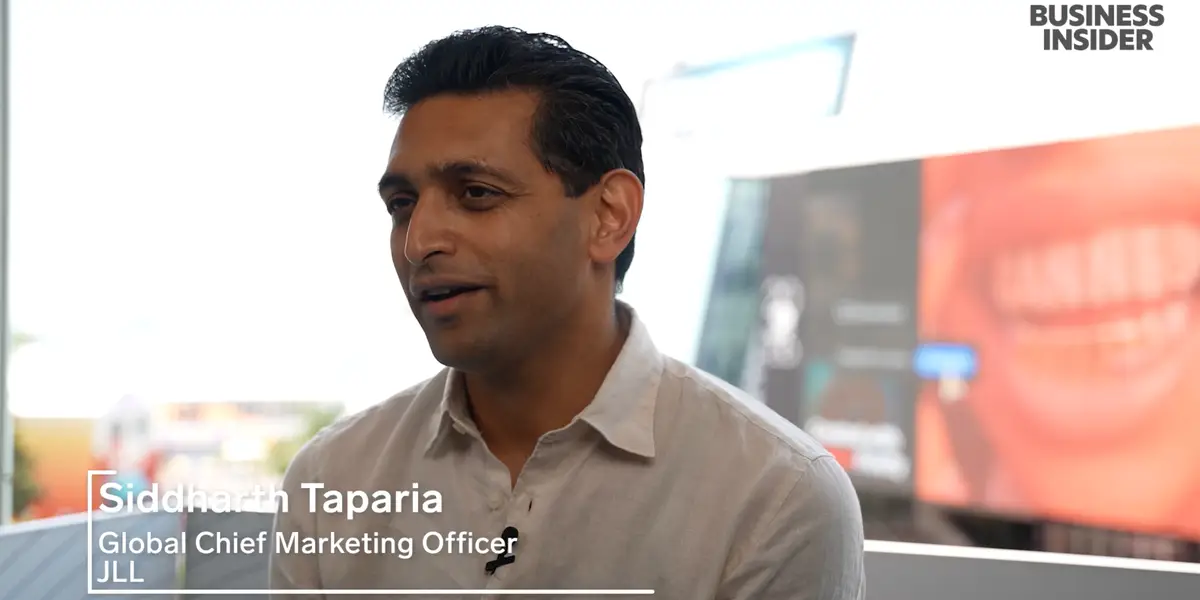
B2B marketing has changed dramatically in the last few years. While the audience for these messages was once limited to business leaders, some B2B companies now invest in eye-catching and memorable messages in highly visible places. Siddharth Taparia, CMO of global corporate real estate giant JLL, told me that’s central to their strategy: Brand building is one of the company’s six corporate goals.Today, Taparia told me, many more people are involved in finding corporate spaces. While JLL as a company is more than 240 years old, he said it’s important for JLL to bring its experience to marketing, both in activations that people can see, as well as through the wealth of data and expertise it has amassed over the years. We talked about JLL’s strategic brand building push, and an excerpt from our conversation is later in this newsletter.Until next time.This is the published version of Forbes’ CMO newsletter, which offers the latest news for chief marketing officers and other messaging-focused leaders. Click here to get it delivered to your inbox every Wednesday. In The NewsA Taco Bell restaurant in Pasadena, California.Mario Tama/Getty ImagesTaco Bell and produce giant Taylor Farms have come under scrutiny over their potential connection to the largest documented cyclosporasis outbreak in the U.S. According to a CNN tally, more than 11,000 people across 41 states have been infected with the parasite, which causes severe digestive problems and dehydration. In outbreaks, raw fruits and vegetables become contaminated with the parasite, which spreads through water used in irrigation and processing. Last week, the FDA said the culprit was Taylor Farms shredded lettuce, which was also used by Taco Bell restaurants.While it’s unclear whether the right cause has been pinpointed—the FDA said on Sunday that test results on Taylor Farms lettuce from Taco Bell showed a false positive, but the agency did not walk back its determination—it’s been a difficult time for the fast food restaurant and produce company. Last Friday, foot traffic to Taco Bell restaurants was down 19% compared with other Fridays this year. Since July 7, stock for corporate parent Yum! Brands is down more than 11%. Several lawsuits have already been filed against Taco Bell by people sickened during the outbreak. Meanwhile, Taco Bell removed all Taylor Farms iceberg lettuce from its restaurants, and the grower pulled its iceberg lettuce from restaurants and salad kits.As far as corporate crises go, this is one that the companies have at least prepared for. Yum! Brands—and many other publicly traded quick-service restaurants—lists cyclospora outbreaks as one of their known risks in SEC filings, and Taylor Farms has previously recalled products including raw onions and salad kits because of potential contamination. Taco Bell and Taylor Farms both spoke up quickly once they had been identified as potential sources of the outbreak, and Forbes senior contributor Edward Segal writes this is an important step toward regaining the public’s trust once the outbreak is over. Companies need to think about their entire supply chains when it comes to crisis planning, he writes, and it’s important that Taco Bell and Taylor Farms reinforce each other’s messaging. Now TrendingThe 2026 FIFA World Cup is over, and while the action on the pitch thrilled sports lovers worldwide, what did it do for the U.S.? At this point, the answer seems to be a shrug. While ticket prices surged to make last Sunday’s final, where Spain defeated Argentina for the FIFA World Cup Trophy, the most expensive sporting event ever, its impact on international tourism seems to be muted. Forbes’ Suzanne Rowan Kelleher writes that in the World Cup’s opening weeks in June, the number of foreign tourists coming into the U.S. was essentially flat compared to last year, according to Commerce Department statistics. Hotels in game cities raised their rates, but CoStar statistics showed they didn’t see greater occupancy.It’s unclear if the World Cup will boost MLS, the U.S.’s men’s professional soccer league. Forbes’ Hank Tucker writes the league is hoping interest in World Cup soccer will translate to more people watching the professionals and supporting local teams. After all, MLS was created after the U.S. hosted the 1994 World Cup, and international stars like Argentina’s Lionel Messi play for MLS teams. Tucker writes that the league had been growing even before the World Cup, though game attendance and streaming viewership for games is nowhere near those of professional soccer leagues in other countries.But interest in World Cup soccer certainly grew in the U.S. Fox One, the streaming service with exclusive rights to broadcast the World Cup in English, got 2.8 million new subscribers in June—and that’s not counting those who subscribed to watch the tournament’s more competitive rounds in July. And the enthusiasm for watching sports may have also spread beyond soccer. Major League Baseball viewership has been especially strong this year, with last week’s All-Star Game posting the event’s highest viewership numbers since 2018, writes Forbes senior contributor Maury Brown.On MessageHow JLL’s CMO Combines Business Strategy And Brand BuildingJLL CMO Siddharth Taparia.JLLOne of the lasting legacies of the Covid-19 pandemic is it opened up the world of work—both to create more remote opportunities, but also to give businesses and workers of all kinds new ideas on what a workspace looks like. Global commercial real estate giant JLL has used this opportunity to cast a wider net with its marketing, and has made brand building one of its six top corporate initiatives. I talked to JLL CMO Siddharth Taparia about how JLL is building its brand, and how the CMO is a vital part of corporate strategy. This conversation has been edited for length, clarity and continuity.What have been some of your initiatives to build the brand?Taparia: Our goal is to show up in places where people expect us to show up, and in places people don’t expect us. We know that more and more people are relying on AI overviews that Google is providing, or large language models to just get an answer to their question. So a big part of our focus is building a brand that is mentioned more frequently, cited more frequently. That happens through thought leadership, being more at the forefront with data and insights, and with things that are interesting to people.We have a several hundred person research team in-house. How do we take the research they’re doing and bring it to life for people? We announced last year the Bid Intensity Index, which is a way for people to understand which properties are being bid on and where is the bid intensity going up or down—in which markets, for what type of properties, et cetera. That’s a combination of our ability to bring our data, insights and research together, but it is an initiative to ultimately make our brand more relevant to people so it becomes a conversation starter. Second is places people don’t expect us to show up. We did an activation [earlier this year] at Grand Central Station in New York. [About] 750,000 people go through it every day. A lot of those are business decision makers. A lot of them have never heard of JLL. It is a way for us to introduce not just us, but also the importance of commercial real estate to people that don’t necessarily know it or appreciate it.CMO is a strategic role. How do you work to build the strategy for JLL, and where do marketing and messaging fit in?The role of the CMO has expanded well beyond marketing. Now it really sits at this intersection: There’s pieces of technology, pieces of finance, big pieces of business strategy, and a lot of collaboration that is required. I’ve been very fortunate. We have a CEO that believes in brand. We have an executive leadership team that are big supporters of marketing and building our brand. A big part of being strategic is that you have to collaborate with business leaders, and you have to come to the table with something of value. Oftentimes, that could be, ‘Can we get into additional customer segments we’re not targeting today?’ Or, ‘Can we create a positive perception so we are on shortlists more often?’ Or, ‘We know our data shows us 70% to 80% of the time people have already made up their mind who they want to select amongst two or three providers. How do you shape that perception early on?’ A lot of these things may lead to marketing as a solution, but they’re not marketing problems. They’re business problems. That’s where the starting point of marketing conversations has to be. It requires building trust and having a fair amount of collaboration with your peers, with your business leaders.What advice would you give other CMOs?The best way to do AI is to just get started. I don’t think you can get a sense of AI without actually personally being educated about it, personally using it. A lot of people might think this is a technology project. It’s not. It’s something you have to be familiar with because leadership today is leadership in AI, and a lot of CMOs can do well by embracing that. It’s really important to tune in and understand the magnitude of change that’s happening. Platforms are becoming relevant and irrelevant very quickly. AI is changing this quite a bit, and the world of CMOs is changing. The world of agencies has changed so much in the last just two years. When you’re making a bet for the next two, three, five years, you have to account for assumptions that two, six months ago are no longer true. How do you incorporate those assumptions and make better decisions for yourself and the company you’re working for?Comings + GoingsBiotech firm Illumina appointed Mike Sullivan as chief commercial officer, effective July 20. Sullivan steps into the role from Caris Life Sciences, where he worked as chief commercial officer.Digital advertising company The Trade Desk hired Kristi Argyilan as chief commercial officer and executive vice president. Argyilan joins the company from Uber, where she worked as global head of advertising.Government contractor Everforth ECS selected Steven Irish to be its first chief growth officer. Irish has previously worked in senior leadership positions at Peraton, LexisNexis and DXC Technology.Strategies + AdviceWhile brands spend effort and money marketing on several different social channels, a new report shows that Snapchat is often overlooked. Here’s why Measured CEO Trevor Testwuide says the disappearing photo platform provides opportunities for growth.When you’re planning your enterprise AI strategy, it can actually pay off to go big. A new study from Blue Ridge Partners found that large-scale AI uses both brought more revenue over the long run and cost less.QuizPresident Donald Trump made a primetime speech dealing with his often-disputed claims of election interference last week, and several TV stations and networks opted not to run it live. Which two of the following networks did he threaten to revoke broadcast licenses from in retaliation?A. ABCB. CBSC. CNND. NBCSee if you got it right here.
The Strategic CMO: How JLL Blends Tech, Data And Brand
Also in the Forbes CMO newsletter: Brand management lessons from the cyclosporasis outbreak, will the FIFA World Cup impact American tourism or soccer?
1,826 words~8 min read