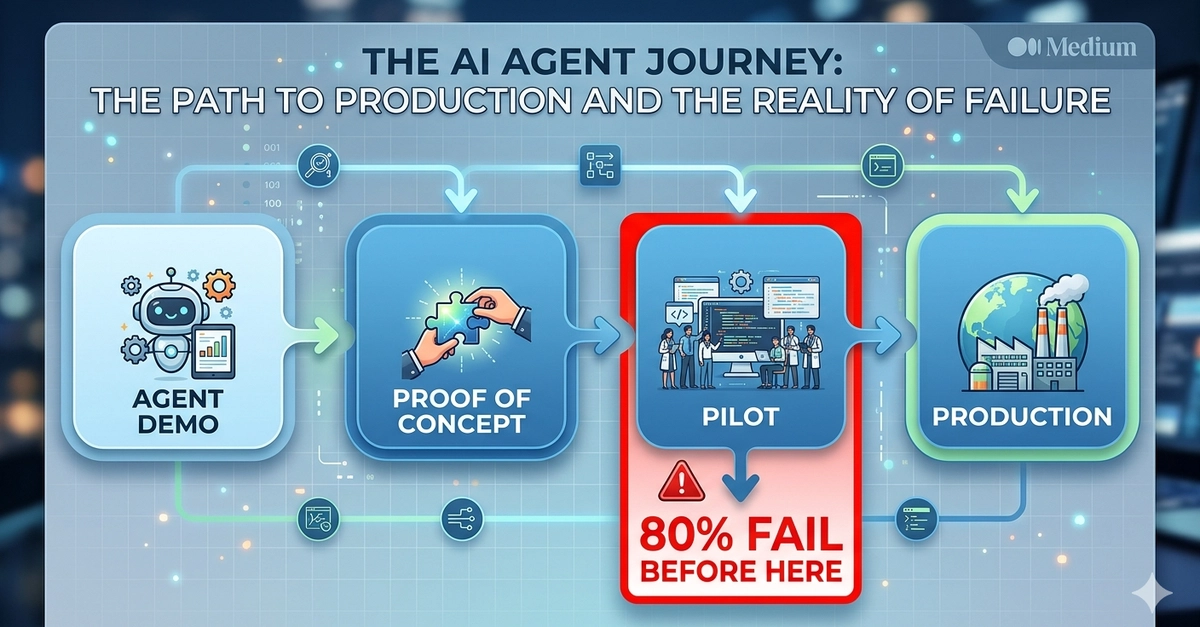
Ram Dhiwakar Seetharaman is the Head of AI at Synera, where he builds agentic AI and multi-agent systems for industrial engineering teams.gettyThe first time I tried to get an AI agent to modify a single dimension on a CAD model, I thought the limitation was the model. I'd built a clever orchestration loop and a reasoning chain that would have surpassed any benchmark. CATIA—design software many manufacturers use—sat open on a second monitor. The AI agent knew what it wanted: Extend a wall from four millimeters to six, run the structural check and report back. But it couldn't close the loop. A better large language model (LLM), I assumed, would mean a better outcome.That was two years ago. The models have improved dramatically. The reasoning is sharper, the planning longer and the tool is more reliable. Now, in building a new agent for design engineering, I find the model is no longer the limitation. What determines whether an agent works in production is everything I assumed I already had: the infrastructure that lets the AI's intent move something real.What I relearned with agents is that production exposes limitations. There, the LLM turns out to be one small part of a much larger system—most of which wasn't built for generative AI.The line between what you entrust to the model and what you keep deterministic is the architecture of agentic AI for engineering. Everything else is detail.Interpretation Is What ChangedThe industry conversation implies that everything in R&D should be agentic—design review, simulation and BOM management. But what LLMs changed is one specific thing engineering depended on humans for: interpretation. This includes reading an RFQ and translating it into design parameters, judging whether a simulation result satisfies a requirement and comparing variants and articulating why one fits the load case better. These are the gaps where intelligence has always lived and automation couldn't go. That's what makes agentic AI for engineering a distinct category, not a feature of generic platforms.Most of the pipeline is, and should remain, deterministic. The solver is the solver. The geometry kernel is mathematical. Product structure has versioning rules that shouldn't bend to an LLM's mood. None of these improve by being made agentic; many get worse.Every agentic choice takes on a liability: variability, regression risk and hallucination. Every deterministic choice takes on a different risk: rigidity, or the inability to handle unanticipated inputs. The skill is knowing where each liability is the right one to carry.Engineering Software Was Built For Humans, Not AgentsCATIA, SolidWorks and NX were built decades before the API era. CATIA goes back to the late '70s, an internal Dassault tool for fighter jets. They were designed around a single human at a workstation dragging geometry with a mouse, assuming another human would take that geometry and do the next thing. The human was the integration layer.The rest of the world moved to APIs and microservices; engineering didn't. The reasons are real—the formats encode genuine physical complexity, the solvers are delicate and a wrong call can mean a part failing in flight. But the result is that I was trying to talk to programs never built to listen.The model can plan, decompose and hold a goal in memory. What it might not be able to do is reach external tools and systems. Some tools have APIs but were built for plugin developers, not the stateful, high-frequency, error-tolerant interaction an agent needs. Until you can programmatically reach in, run operations and get results back, your agent is a capable chatbot about engineering—not doing engineering.Engineering Data Speaks No Common LanguageEven if we solve the tool reach problem for agents, nothing on the other side speaks the same language. Geometry returns in proprietary binaries (.CATProduct, .prt, .stp). Simulation lives in solver files, cost in spreadsheets, requirements in PDFs and material properties in a database or someone's head.What really matters is the interpretation that you actually need. Trying to unify everything will only result in your integration projects sinking.The Workflow Runs The Agent, Not The Other Way AroundIn customer support, coding and marketing, the LLM is the control plane and variability is fine. Engineering inverts this. If your agent skips a modal analysis because it reasoned the check probably wasn't necessary, you may ship a part that fails in a customer's hands.In engineering, the deterministic workflow is in charge, and the LLM operates inside it. The workflow encodes the process—steps, checks and validation gates—and the LLM is the interpreter called only at the points where it's needed. At Airbus, one of Synera's customers, this method compressed a 50-hour RFQ workflow to seven minutes, not because the LLM did more but because the deterministic workflow did the right things around it.Autonomy Is Earned In StagesNo organization is ready on day one to hand over the wheel. The data is usually messier than anyone realized, the integrations have edge cases and the team doesn't yet trust the output. Six months in, the project fades away.Production is a progression: First, the engineer drives and the agent handles the mechanics—extraction, conversion and reports. Then, the agent runs whole subworkflows while humans review. Then, it orchestrates end to end, with humans validating exceptions. IMS Gear, another Synera client, did exactly this, arriving at a six-week process running in 10 minutes. You don't start at the third level; you arrive there by accumulating evidence.Production Is Retained Usage, Not A Release DateThe real measure is whether a real engineer uses the agent again on any given afternoon. That's retained usage, and it's fragile. It depends on unsexy infrastructure: Humans must trace what tool was called, why it answered the way it did and how confident the system was—or they stop using it.In an enterprise, the audit trail must be explainable to security in March, compliance in May and the IP audit in November. That's the architecture of agentic AI for engineering—and the one I keep building in my own work at Synera.Forbes Technology Council is an invitation-only community for world-class CIOs, CTOs and technology executives. Do I qualify?
AI Agents Going To Production In Manufacturing
The real measure is whether a real engineer uses the agent again on any given afternoon. That's retained usage, and it's fragile.
1,002 words~5 min read